Category: HS code

  • Trade and Industry Compliance: Instant Classification with Classifast

    Trade and Industry Compliance: Instant Classification with Classifast

    Table of Contents

    Instantly Classify Goods and Services with Classifast

    If you’ve ever tried to classify a product or service by hand, you know the drill. Ten tabs open. Conflicting definitions. Clock ticking. And the risk that a wrong code leads to delays, fines, or messy rework. That’s exactly why we built Classifast—a high-performance web application designed to classify goods and services without the guesswork.

    Built with a modern FastAPI backend and powered by advanced semantic search technology, Classifast replaces the frustration of manual lookups with instant, intelligent categorization. Whether you are dealing with UNSPSC, NAICS, ISIC, ETIM, or HS/HTS codes, Classifast provides a fast, accurate audit trail for every decision.

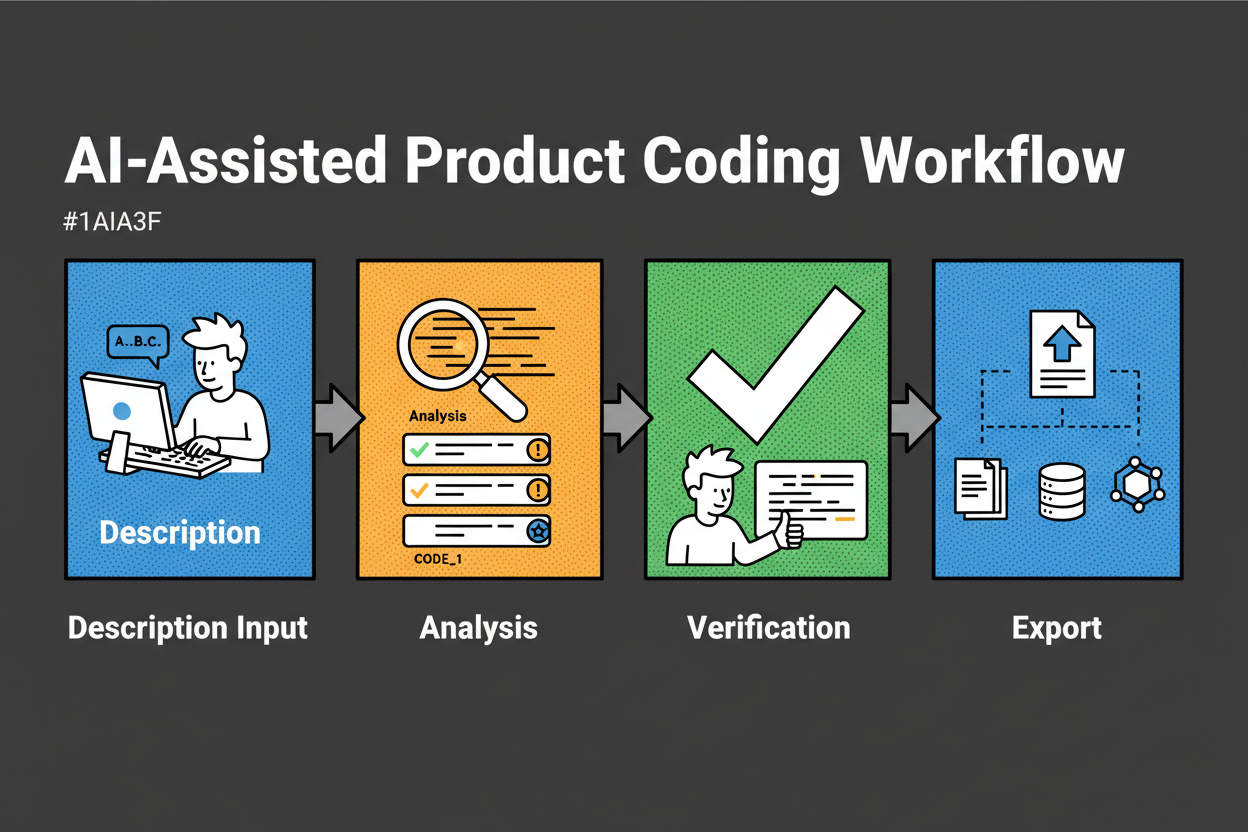
    Type in a clear description and get instant code suggestions with plain-language definitions. See notes, exclusions, and related categories to confirm the fit. Then export your choice directly into customs paperwork, accounting systems, product catalogs, or market research files. It’s simple, accurate, and built for busy professionals.

    Real-World Efficiency

    Imagine an importer who needs the correct industry code for “Bluetooth speakers” before filing customs entries. Instead of digging through PDFs, they paste the description into Classifast, review suggested codes with definitions and exclusions, confirm the match, and export the result with their rationale. That single flow saves hours and reduces rework across compliance, logistics, and finance teams.

    Four-step workflow showing a user typing a product description on the left, flowing through a magnifying glass icon to a list of suggested codes with confidence badges, then a checkmark for verification, and finally an export icon to documents and systems

    Why Accurate Classification Matters: Compliance, Efficiency, and Business Success

    Classification is more than a form field. It’s how your business describes what it does and what it moves across borders. Get it right and workflows click. Get it wrong and you invite delays, penalties, and audits.

    There are two major families most teams deal with:

    1. Harmonized System (HS): For goods moving in trade, customs authorities use this 6-digit nomenclature to underpin tariffs and trade statistics worldwide.
    2. NAICS & ISIC: For industries and services, these standards support economic statistics and are reused for administrative, regulatory, contracting, and tax purposes.

    Misclassification can trigger a chain reaction. A team classifies an electronics accessory under a generic category; customs flags the shipment; the goods are held; and documents must be reissued. Meanwhile, operations schedules slip and costs mount. Classifast prevents these bottlenecks by surfacing the critical context—definitions, notes/exclusions, and related categories—up front.

    Manual vs. Classifast Comparison

    FactorManual ClassificationUsing Classifast
    SpeedSlow, cross-referencing multiple sourcesInstant suggestions with prioritized matches
    AccuracyDependent on individual experienceSemantic search reduces guesswork
    Audit TrailOften undocumented or scatteredExportable results with rationale fields
    ScalabilityDifficult at volumeHandles repeated queries and batch-friendly workflows
    Compliance RiskHigher risk of misclassificationBuilt-in checks and standardized outputs

    How Classifast Works: A Step-by-Step Guide

    You don’t need to be a trade expert to get accurate results. Classifast is designed to guide you through the process.

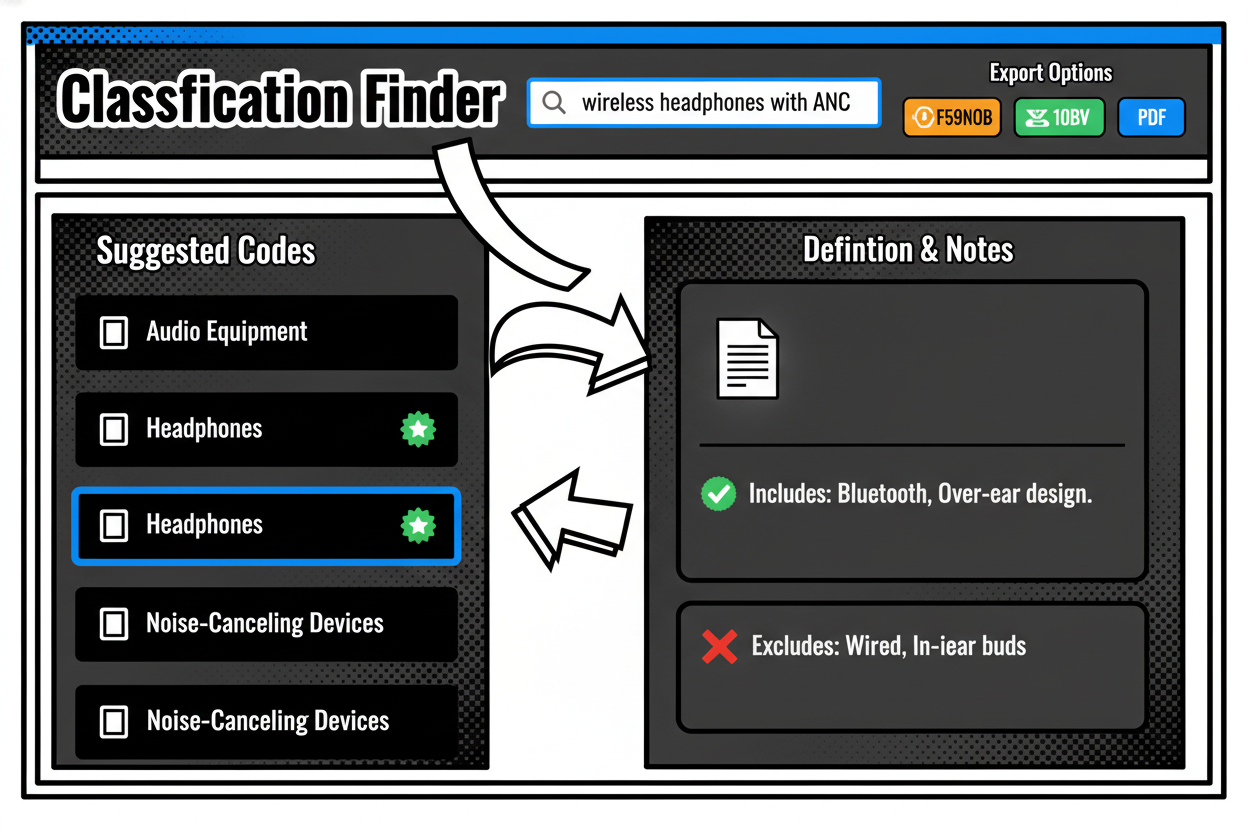
    1. Input: Type a clear description (e.g., “wireless headphones with active noise cancellation”).
    2. Search: Our semantic search engine analyzes the intent and returns suggested codes prioritized by relevance.
    3. Verify: Review the definitions and check for exclusions that might rule your item out.
    4. Export: Save your choice as a CSV or PDF, complete with your decision rationale.
    Mock interface of the Online Classification Finder with callouts: 1) search input containing 'wireless headphones with ANC'; 2) left pane showing suggested codes with confidence badges; 3) right pane showing selected code definition, notes, and exclusions; 4) top-right export buttons for copy, CSV, and PDF

    Refine Ambiguous Cases

    Ambiguity happens. The word “adapter” can point to electrical power, plumbing, or software. If your first pass is too broad, add attributes like “AC power adapter for laptops, 65W.” Classifast’s intelligence helps you navigate these nuances by providing “Related Categories” to ensure you are in the right neighborhood.

    Practical Use Cases: Real-World Applications

    Import/Export Compliance

    When moving goods across borders, “close enough” isn’t enough. Customs decisions on duties and controls are built on HS codes. Classifast allows shipping specialists to move from a “hunch” to a defensible, documented choice in seconds.

    Market Research and Analysis

    If you work in strategy, you live in codes. NAICS and ISIC group businesses by production processes. Classifast helps research teams map real-world offerings—like “cloud security consulting”—to standard industry codes consistently, ensuring your competitive analysis is based on clean, aligned data.

    Tax and Regulatory Filings

    Tax teams and controllers use Classifast to ensure industry codes reflect the business’s primary activity across all registrations and returns. This reduces friction during audits and ensures reporting consistency across different jurisdictions.

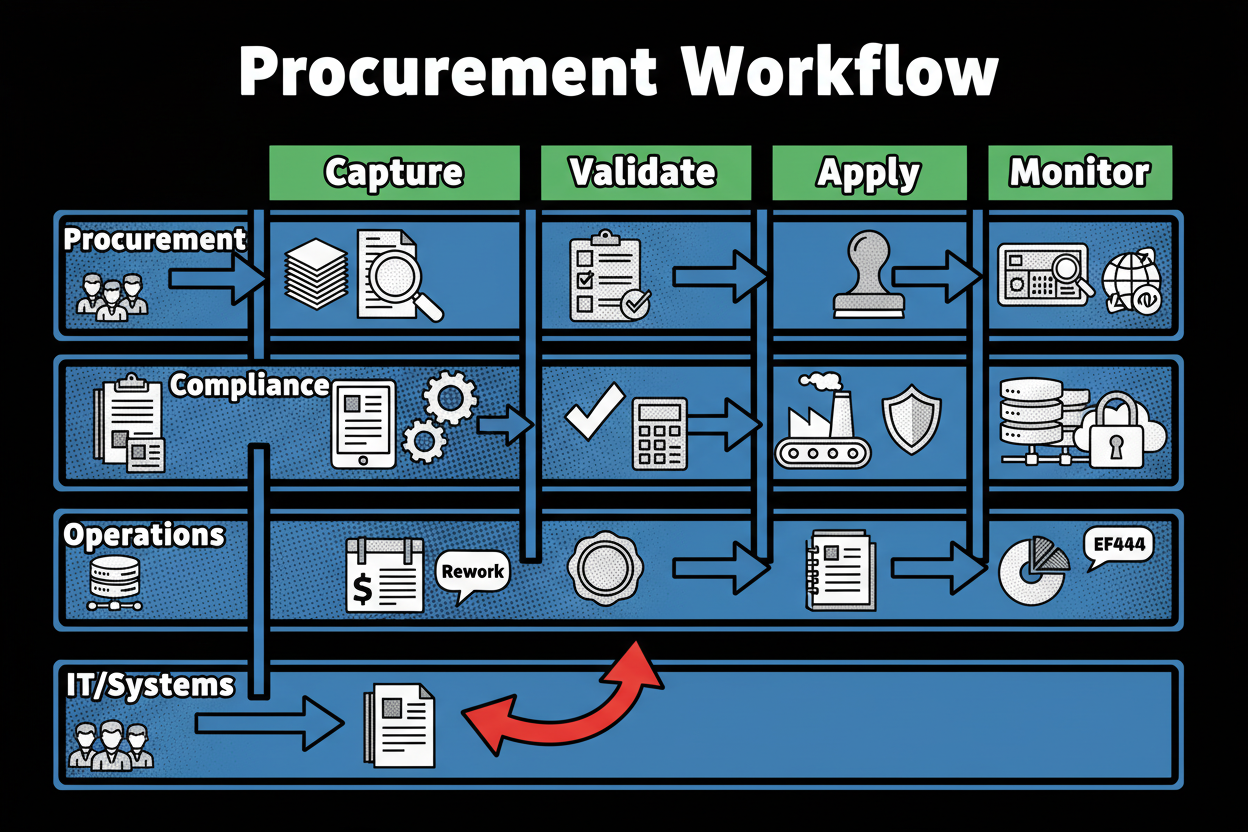
    Process flow diagram with swimlanes for Procurement, Compliance, Operations/Logistics, Finance/Tax, and IT/Systems

    Frequently Asked Questions

    What classification systems does Classifast support?
    Classifast currently supports major international standards including UNSPSC, NAICS, ISIC, ETIM, and HS/HTS. We are constantly expanding our coverage.

    How accurate are the results?
    Results are generated using advanced semantic matching. We recommend a 3-point validation: check the definition match, review exclusions, and scan related categories.

    Can I export results for an audit trail?
    Yes. You can export your findings via Copy-to-clipboard, CSV, or PDF. Each export includes the code, definition, notes considered, and your custom rationale.

    Is my data secure?
    Absolutely. Only your query text is processed to generate suggestions. We offer enterprise options for high-sensitivity use cases requiring specific data security standards.

    Getting Started: Unlock the Power of Accurate Classification Today

    Accurate classification drives compliance and efficiency. Classifast turns complex plain-language descriptions into reliable data you can trust. By cutting manual research time and providing a documented audit trail, we help your team focus on high-value tasks instead of scrolling through spreadsheets.

    Ready to see it in action? Start Classifying Now at Classifast.com.

    Clean banner with a prominent 'Start Classifying Now' button
  • The Ultimate Online Goods and Services Classifier: Instantly Categorize Any Product or Service with Classifast

    The Ultimate Online Goods and Services Classifier: Instantly Categorize Any Product or Service with Classifast

    Table of Contents

    Effortless Goods and Services Classification: Instantly Categorize with AI

    You’re staring at a spreadsheet with hundreds of items. A few are simple. Most are oddly specific or bundled. You tab between a category tree, a customs reference, and a marketplace guide. Each choice feels like a guess you’ll have to defend later. Goods and services classifier is required.

    That’s the grind of manual classification. It’s slow, inconsistent, and it doesn’t scale. In catalog operations, humans typically spend 30–180 seconds per SKU just to pick a product category. Assigning an HS code for a trade can take 5–20 minutes per line when you check notes and rulings.

    What if you could paste a description, click once, and get the best-fit code with a confidence score and a short rationale? That’s exactly what Classifast does. Classifast is a web application designed for the instant classification of goods and services using advanced semantic search technology to ensure accuracy and speed.

    What is a goods and services classifier?

    A goods and services classifier reads a product or service description and assigns the right code from a defined taxonomy. Classifast supports major international standards, including:

    • UNSPSC (Procurement and spend analytics)
    • NAICS (Industry classification)
    • ISIC (International standard industrial classification)
    • HS/HTS (Global trade and customs)
    • ETIM (Electrotechnical and technical product data)

    The benefit is simple: consistent labels for compliance, analytics, and findability, generated instantly with transparent confidence measures.

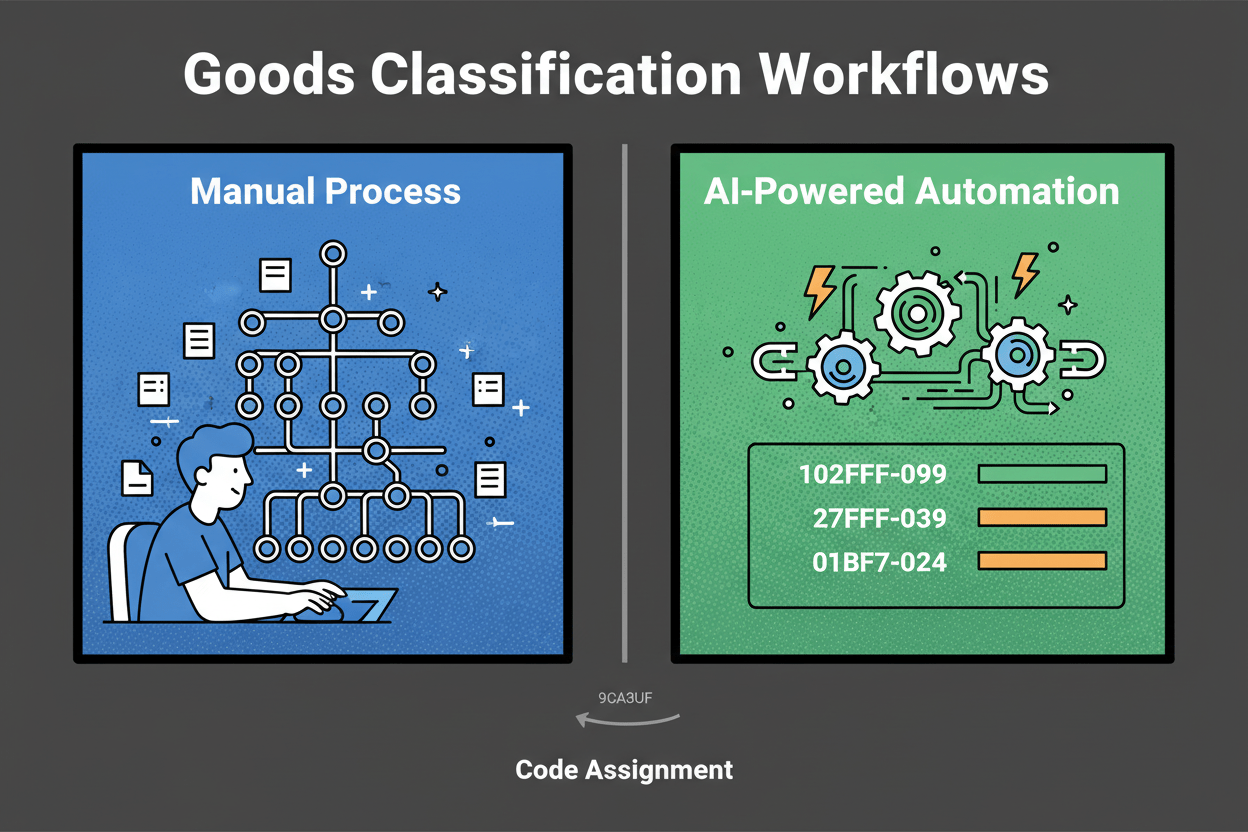
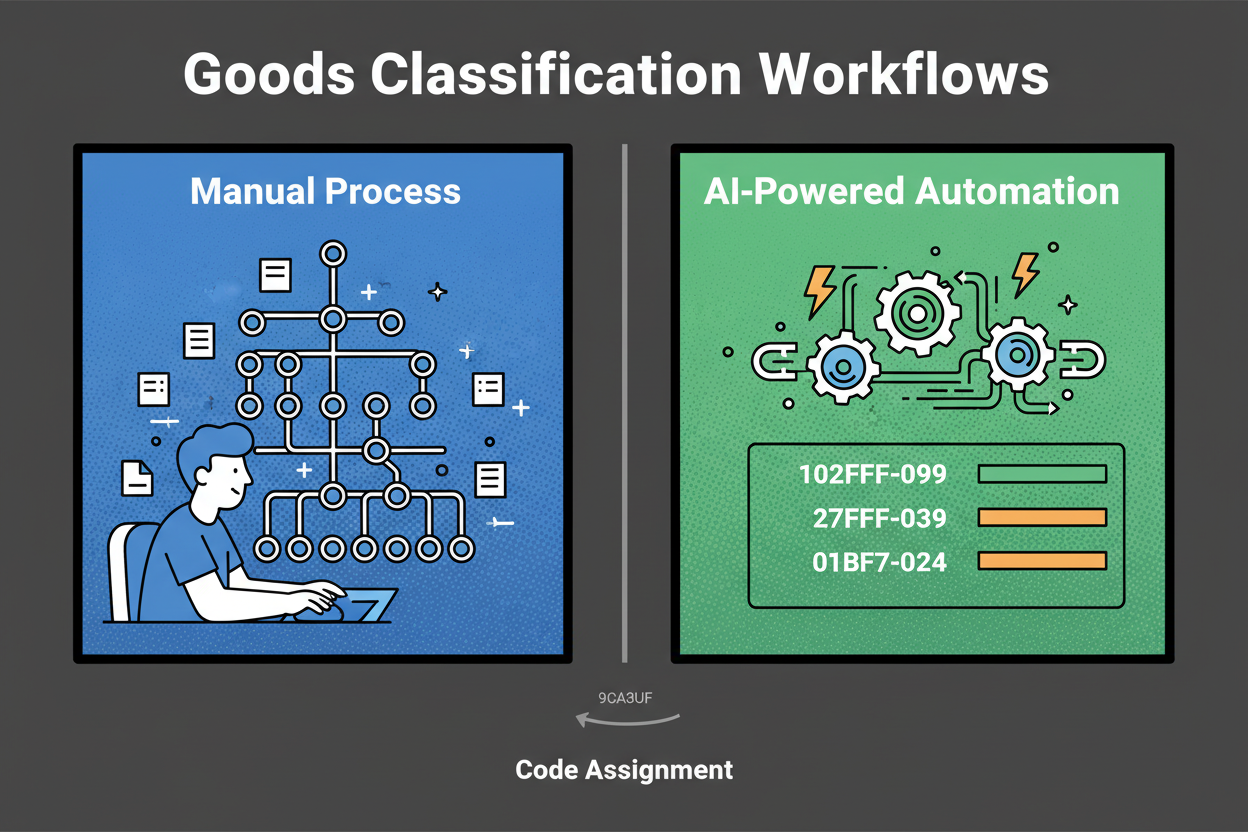
    Manual vs Automated Classification Workflow

    How Classifast Works: Semantic Search and High Performance

    You shouldn’t have to guess how an AI made its pick. Classifast is built with modern web technologies like FastAPI to deliver near-instant results. Unlike traditional keyword matching, our system uses advanced semantic search. This means the tool understands the context and meaning behind your text, not just the words themselves.

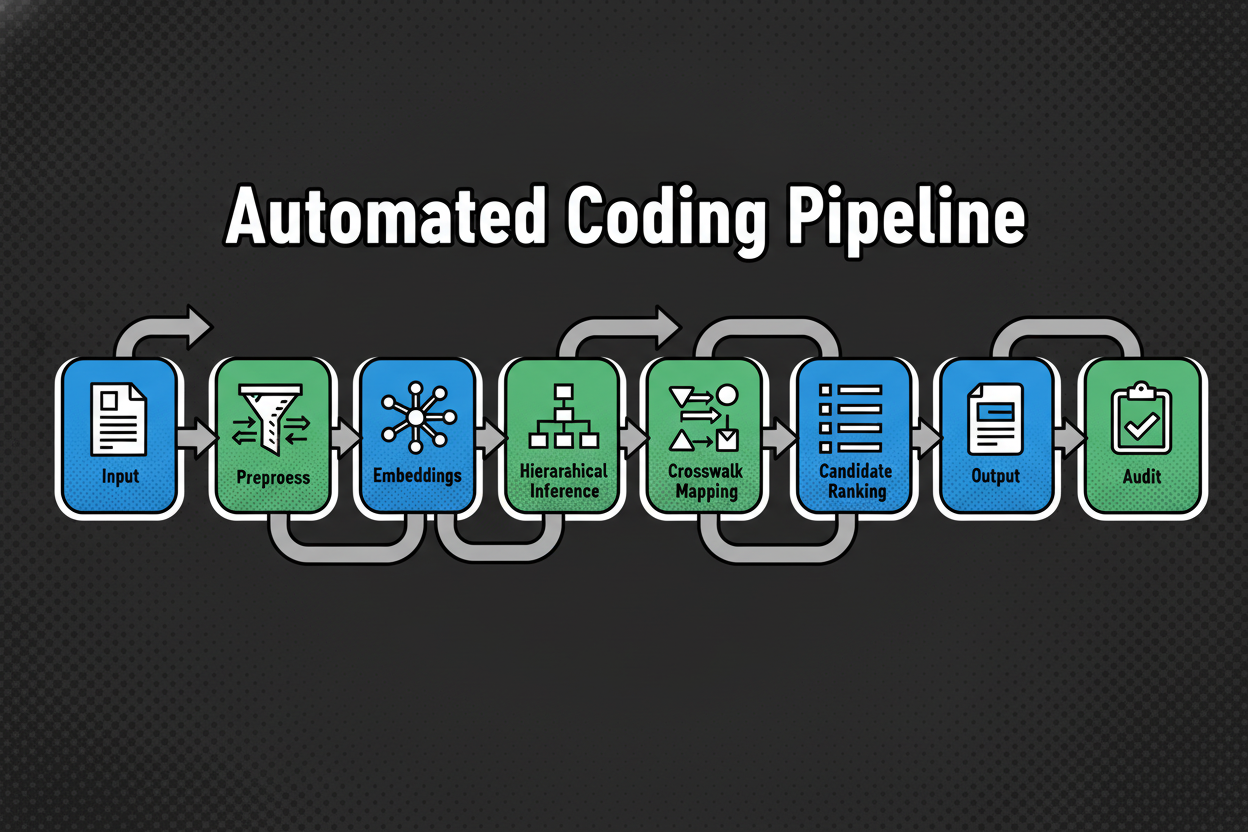
    The AI Pipeline: From Description to Code

    1. Inputs: You provide a title, description, or attributes (like materials or voltage).
    2. Preprocessing: Classifast cleans the text, detects the language, and prepares it for analysis.
    3. Semantic Embedding: The text is converted into high-dimensional vectors that capture its true meaning.
    4. Hierarchical Inference: The model drills down the taxonomy (e.g., from “Electronics” to “Smartphones”) to find the exact leaf node.
    5. Output: You receive a top code, a confidence bar, and a rationale explaining the decision.
    Classifast Process Flow

    Practical Use Cases: Who Benefits from Automated Classification?

    Automation is useful when it moves needles: faster cycles, cleaner data, and fewer rework loops.

    • Compliance Officers: Reduce HS/HTS research time and keep audit-ready logs for every shipment.
    • Ecommerce Managers: Stabilize categories across your site to improve findability and reduce returns.
    • Procurement Leads: Map thousands of PO lines to UNSPSC instantly to unlock true spend visibility.
    • Data Scientists: Ensure consistent labeling across datasets to build better forecasting models.

    Step-by-Step Guide: Using Classifast

    Getting started is simple. You don’t need a complex integration to begin cleaning your data today.

    1. Prepare your data: Use clear, factual titles and descriptions. Include specs like materials or intended use.
    2. Choose your taxonomy: Select from UNSPSC, NAICS, ISIC, ETIM, or HS.
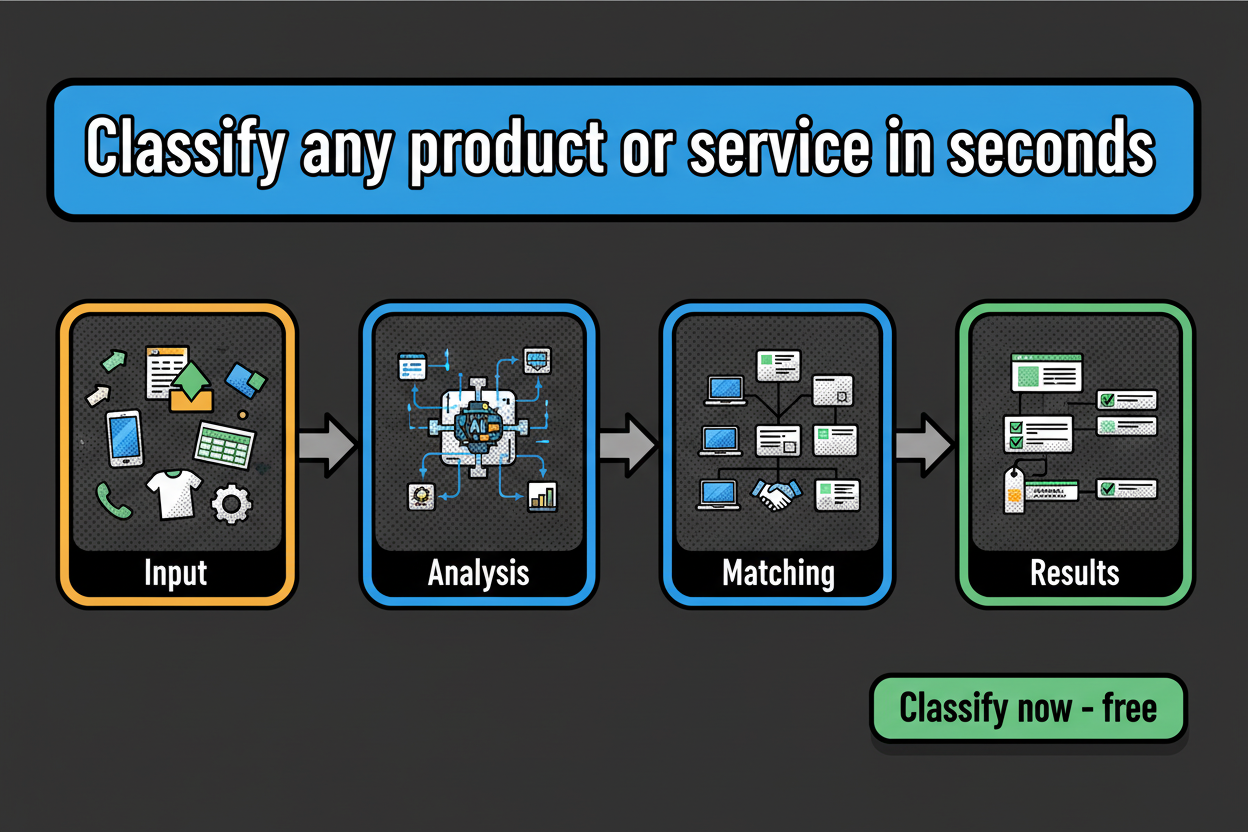
    3. Run the classification: Click “Classify” and get results in seconds.
    4. Review and Audit: Check the confidence score. If it’s high, you’re good to go. If it’s low, the rationale will tell you what extra info (like “material type”) is needed to be certain.
    Classifast Single Result Panel

    Bulk Classification for Large Projects

    For those with tens of thousands of SKUs, Classifast supports bulk uploads. Upload your CSV, map the columns, and let the semantic engine process the entire batch. You can set a “confidence threshold” to automatically accept the most certain results, leaving only the edge cases for human review.

    Frequently Asked Questions

    Q: Which systems does Classifast support?
    A: We support UNSPSC, NAICS, ISIC, ETIM, HS/HTS, GS1 GPC, and eCl@ss. We can also map to your own custom internal taxonomies.

    Q: How accurate is the semantic search?
    A: Semantic search allows Classifast to understand synonyms and technical context that traditional tools miss. This often matches or exceeds human accuracy in complex retail or industrial settings.

    Q: Is my data secure?
    A: Yes. Classifast practices data minimization and uses encryption in transit and at rest. We align with SOC 2 and ISO 27001 principles to ensure your product data is protected.

    Unlock Consistent, Accurate Classification with Classifast

    The real win of moving to an automated system is simple: faster outputs, steadier decisions, and clean data you can trust. Manual labeling is a bottleneck that your business can’t afford in 2025.

    By using Classifast.com, you shift from minutes per item to seconds. You invest human time only where it moves the needle—on high-risk exceptions—while the semantic engine handles the rest.

    Key Takeaways

    • Instant Results: Categorize in seconds using FastAPI-powered search.
    • Global Standards: One tool for UNSPSC, NAICS, ISIC, HS, and ETIM.
    • Defensible Logic: Every code comes with a rationale you can audit.
    • Consistent Data: Eliminate the variance caused by human error and manual fatigue.

    Ready to try it? Visit Classifast.com to run your first items right now. No sign-up required—just paste your description and go.

    Classify now - free

  • Essential Guide to Interpreting Customs Tariff Amendments

    Essential Guide to Interpreting Customs Tariff Amendments

    Table of Contents

    Understanding Customs Tariff Amendments: What, Why, and When

    Your shipment is on the water. Everything looks routine until your customs broker calls: the subheading you used was narrowed by a recent amendment. Your goods now fall outside the scope. The entry is flagged, delivery stalls, and you scramble to reclassify, amend documents, and explain the delay to your customer. Painful, but avoidable. Customs tariff Amendments are at hand.

    Customs tariff amendments are official changes to the legal classification text that your codes depend on. At the international level, this means updates to the Harmonized System (HS) structure or wording. Locally, it involves changes to national tariff lines, duty rates, or trade measures.

    Why do these changes happen?

    • Technological evolution: New products (like drones or green energy tech) need dedicated spots in the schedule.
    • Trade policy shifts: Free trade agreements (FTAs) or new trade remedies (anti-dumping duties) trigger code splits or rate changes.
    • Environmental goals: New classifications for plastic waste or hazardous chemicals help track global environmental impact.

    (Note: Insert an image of shipping containers or a busy port here to represent the scale of international trade.)

    Decoding Section Notes, Explanatory Notes, and Footnotes

    To master amendments, you must look beyond the 6-to-10-digit code. The real legal power lies in the notes.

    Section and Chapter Notes

    These are legally binding. They define what is included or excluded from a specific part of the tariff. An amendment might change a “Section Note” to include a new material, effectively shifting thousands of products into a new category.

    Explanatory Notes (ENs)

    Published by the World Customs Organization (WCO), these provide the “official interpretation” of the HS. They are the best tool for understanding the technical boundaries of a code.

    Footnotes and Trade Measures

    National schedules often use footnotes to link specific codes to licenses, quotas, or additional taxes. Always check if an amendment has added a “hidden” requirement to your existing codes.

    Mapping Tariff Amendments to Your Product Catalog

    When an amendment occurs, don’t just “find-and-replace.” Use this 5-step framework to ensure accuracy:

    1. Analyze the Correlation Table: Use official WCO or national correlation tables to see which old codes map to which new ones.
    2. Verify the “Ex” Qualifier: If you see “ex” next to a code in a correlation table, it means only part of the old code moved. You must check if your specific product was part of that move.
    3. Apply GIR 1: Always start with General Interpretative Rule 1—check the terms of the headings and the Section/Chapter notes first.
    4. Audit the Evidence Pack: If you reclassify a product, update your evidence pack with the new logic and any updated technical specs.
    5. Sync the ERP: Ensure the new codes and effective dates are uploaded to your business systems before the legal deadline.

    Leveraging Semantic Comparison and Version History

    One of the biggest risks in compliance is “meaning drift”—where a code stays the same, but the legal description changes slightly.

    • Semantic Comparison: Compare the old legal text side-by-side with the new. Look for subtle word changes (e.g., “primarily of” vs. “containing”) that might change your product’s eligibility for a lower duty rate.
    • Version History: Maintain a clear log of why a product’s code changed. This “audit trail” is your best defense if a customs authority questions your past entries.

    (Note: Insert a screenshot or graphic showing a side-by-side text comparison or a version history log.)

    Comprehensive Checklist: Ensuring No Detail Is Missed

    Before you finalize an amendment update, run through this list:

    • [ ] Have I checked the WCO Correlation Tables?
    • [ ] Did I review the new Section and Chapter Notes?
    • [ ] Are my “ex” codes verified against actual product specs?
    • [ ] Is the effective date correctly set in our ERP?
    • [ ] Has a second person (reviewer) checked the logic?

    Frequently Asked Questions

    Q: Where can I find the official amendment tables?
    For international changes, visit the WCO website. For national changes (like the HTSUS), check your national trade commission or customs portal (e.g., usitc.gov).

    Q: What if the correlation table is ambiguous?
    If the official tables don’t clearly point to a new code, you should request a formal “Binding Tariff Information” (BTI) or a “Customs Ruling” from your national authority.

    Conclusion: Stay Proactive, Stay Compliant

    Customs tariff amendments are a constant in global trade. By moving from a reactive “fix-it-when-it-breaks” approach to a proactive mapping and versioning workflow, you protect your company from delays and unexpected costs.

    Key Takeaways

    • Track WCO tables for international shifts.
    • Prioritize Notes over Keywords when interpreting scope.
    • Maintain an Audit Trail with version history and evidence packs.
    • Use Semantic Comparison to catch subtle shifts in legal wording.
  • The Ultimate Guide to Customs Tariff Schedules: Structure, Changes, and Practical Usage

    The Ultimate Guide to Customs Tariff Schedules: Structure, Changes, and Practical Usage

    Table of Contents

    Introduction: Why Understanding Customs Tariff Schedules Matters

    If you import or export anything, the customs tariff schedule is one of the most important documents you’ll ever use. In plain terms, a customs tariff schedules is the official list of product classifications and duty rates that customs authorities use to decide how much duty, tax, and other charges to collect. It’s the rulebook that sits behind every customs entry, and it shapes your costs, speed, and risk.

    Here’s why this matters. Picture a distributor that imports a multifunction printer-scanner. The team picked a code based on a quick keyword search. Customs reviewed the shipment and reclassified it under a different heading with a higher duty rate and an anti-dumping measure. Result: a week at the port, a five-figure cost swing, and a very unhappy sales team.

    Decoding the Structure of Customs Tariff Schedules

    A customs tariff schedule is the official list of product classifications and duty rates used by customs to assess import and export charges. It is structured by the Harmonized System hierarchy: sections, chapters, headings, and subheadings, with tariff lines showing codes, descriptions, duty rates, notes, rules, and legal annotations.

    The HS hierarchy and tariff lines

    The Harmonized System (HS) is a global language for goods. It groups products by what they are and what they do, not by brand names. At the top are sections, followed by chapters, headings (4 digits), and subheadings (6 digits). Beyond 6 digits, countries extend the code to create national tariff lines that set local duty rates.

    Notes, rules, and legal scaffolding

    Two legal backstops govern how you classify: notes and rules. Section and chapter notes define the scope of categories and list inclusions and exclusions. Then come the General Rules for Interpretation (GRIs), which tell you how to navigate conflicts—for example, how to classify a retail set based on its “essential character.”

    How Customs Tariff Schedules Change: Updates, Amendments, and Triggers

    Schedules are not static. New technologies, trade agreements, and policy goals drive constant amendments. These updates typically involve:

    • Duty rate adjustments: Raising or lowering costs.
    • Code splits: Breaking one line into two for more precision.
    • Wording clarifications: Refining legal descriptions.

    Type of Change Impact

    ElementOld EntryNew EntryImpact Notes
    Code8508.11.008508.11.10 / .90Code split; handheld move to .10
    Duty Rate6%3% (.10) / 8% (.90)Rate differential by subheading
    MeasuresNoneQuota applies to .90Additional license required

    Practical Usage: Applying Customs Tariff Schedules in Your Business

    The 7-Step Product Classification Workflow

    1. Gather detailed product specs (materials, function, power source).
    2. Identify candidate headings.
    3. Read section and chapter notes.
    4. Apply GRIs to resolve conflicts or composite goods.
    5. Select the national tariff line.
    6. Confirm MFN duty, preferential rates, and additional measures.
    7. Document your logic in an analysis memo.

    Best Practices for Staying Compliant

    • Internal Controls: Every classification should have a “maker” and a “checker” to ensure accuracy.
    • Evidence Packs: Build a folder for every SKU containing specs, photos, and your GRI analysis memo.
    • ERP Integration: Store both the HS base and the full national line with “effective date” controls so updates happen automatically on the right day.

    Frequently Asked Questions

    Q: How often do customs tariff schedules change?
    Updates happen on a recurring international cycle (HS level) and frequently at the national level. You should set alerts for the chapters you trade in.

    Q: What happens if I misclassify?
    Underpaying leads to duty recovery, interest, and penalties. Overpaying erodes your margins. Corrective actions include reclassification and potential voluntary disclosure.

    Conclusion: Key Takeaways

    • Build a single source of truth in your ERP with effective dates and evidence.
    • Classify using GRIs and notes, not just keywords.
    • Monitor changes through official bulletins and chapter-specific alerts.
    • Keep a complete evidence pack per SKU to satisfy customs audits at any time.

  • The Ultimate Guide to Harmonized System Classification with Live Tariff Context

    The Ultimate Guide to Harmonized System Classification with Live Tariff Context

    Table of Contents

    Why accurate HS classification is the linchpin of modern trade compliance

    Misclassification is expensive. One retailer, Z Gallerie, agreed to pay 15 million dollars to resolve allegations it misclassified wooden bedroom furniture to avoid antidumping duties [reference:2]. That was not a rounding error. It was a hard lesson in how a wrong code can morph into an enforcement case, reputational damage, and a massive check.

    Customs tariff classification sets your landed cost. It determines base duties, triggers additional measures like antidumping or countervailing duties, and gates eligibility for preferences. Get it right and your landed cost is predictable. Get it wrong and you either overpay quietly for months or underpay and invite penalties when someone looks closer.

    It also dictates risk and speed. Officers and auditors start with your HS code. It drives which admissibility rules apply, which partner agency flags fire, and whether your shipment sails through or gets parked for an exam. A defensible HS code is your first line of risk control and your fastest path to release.

    Here is a nuance that seasoned pros know: classification errors are common, but only a subset actually change the duty owed. CBP’s compliance measurement work has long observed high performance in revenue collection even when classification errors show up in audits, because many of those are non‑revenue mistakes that shift goods between same‑rate or duty‑free provisions [reference:1]. That does not make them harmless. Non‑revenue errors still burn time, invite queries, and erode credibility. Revenue‑impacting errors can add up quickly and can turn into enforcement if they look intentional.

    The hardest part today is the data fog. You’re mapping from messy, natural‑language product descriptions to legal texts. At the same time, tariffs don’t stand still. Rates move. Quotas fill. Safeguards and special measures appear. Static spreadsheets cannot keep up, which is why live context has become the quiet advantage of top compliance teams. We will lean on it in this guide, but we’ll start with the legal backbone so your decisions stand on their own.

    Here is what you will get by reading this guide end to end:

    • A step‑by‑step method to go from natural‑language descriptions to a defensible HS code
    • How to surface live tariff context while you classify, so you see cost and risk in real time
    • A validation checklist that aligns to the GRIs, legal notes, and WCO guidance
    • A practical way to compare candidate codes side by side and choose confidently
    • An export workflow to push mappings to ERP, your broker, and reporting without per‑match fees

    To orient you, this is the workflow we will follow from input to export.
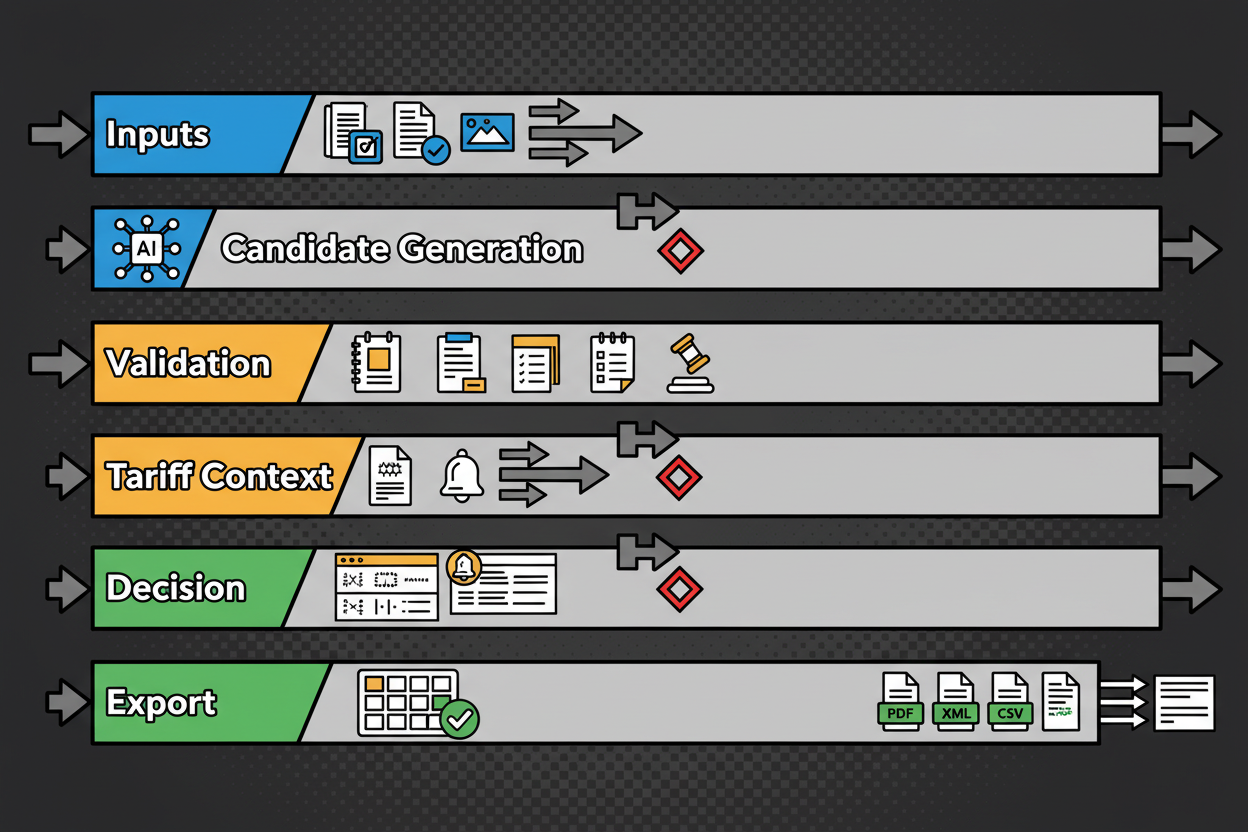
    A clean, horizontal swimlane diagram showing the full customs classification workflow: Lane 1 (Inputs) with stacked cards for 'Natural-language product descriptions', 'Specs', 'Images'; Lane 2 (Candidate Generation) with AI search nodes suggesting 3-5 HS headings; Lane 3 (Validation) with icons for 'GRI 1-6', 'Section/Chapter Notes', 'Explanatory Notes', 'Rulings'; Lane 4 (Live Tariff Context) with a side panel showing 'MFN rate', 'Preferential rate', 'AD/CVD', 'TRQ fill rate', 'Safeguards', and a bell icon for 'Amendments'; Lane 5 (Decision) with a comparison matrix icon and a checkmark over the selected HS code; Lane 6 (Export) with file icons 'CSV', 'XLSX', 'JSON' and connectors to 'ERP', 'Broker', 'BI Dashboard'. Each lane labeled; arrows connect left to right; key decision points marked with small diamond icons.

    We will keep it practical, cite the World Customs Organization where it matters, and show you how to document each choice. By the end, you will have a repeatable path for customs tariff classification that your auditors, brokers, and CFO can all get behind.

    Understanding the Harmonized System: structure, rules, and common pitfalls

    Let’s ground the basics fast, the way practitioners use them in real work. The Harmonized System (HS) is the global naming and numbering framework administered by the World Customs Organization. At its core are the HS Nomenclature texts (Sections, Chapters, headings, and subheadings), the General Rules for Interpretation, and the legally binding Section and Chapter Notes [reference:3]. The first six digits of a code are harmonized worldwide. Many jurisdictions then add national digits beyond six to handle tariff lines or statistical splits [reference:3].

    Think of it as a tree. Chapters set broad families. Headings narrow scope. Subheadings refine within the heading. National extensions handle local tariff detail. The law tells you to read the actual words of the headings and the relevant legal notes first, not the titles or your intuition [reference:3].

    An illustrated HS code breakdown for a sample code (e.g., 8 or 10 digits): the first two digits highlighted as 'Chapter', next two as 'Heading', next two as 'Subheading', and remaining digits as 'National extensions'. Each segment boxed with color-coded labels. On the right, a sticky-note style callout listing 'Relevant Section Note', 'Chapter Note', and 'Explanatory Note references'. A small magnifying glass icon points to 'GRI 1 applies at heading level; Rule 6 at subheading level'.

    Now, the General Rules for Interpretation (GRIs) are the roadmap. They are part of the HS legal instrument, and the official wording is published by the WCO in the HS Nomenclature and on the WCO Trade Tools site [reference:3]. We will paraphrase the ones you use most, then apply them in the next section.

    Start with Rule 1. It tells you to classify according to the terms of the headings and the relevant Section or Chapter Notes. The titles are just guides. This is where most correct classifications are settled if you read the legal notes carefully [reference:3].

    Rule 2(a) expands a heading that names a finished article to also cover an incomplete article that has the essential character of the finished one, or the same article presented unassembled. Think flat‑packed furniture or a bicycle missing a wheel. If it looks and functions like the finished thing in substance, Rule 2(a) keeps you in the same heading [reference:3].

    Rule 2(b) covers mixtures and goods of more than one material. It says that a heading that names a material also covers mixtures or combinations of that material with others, subject to the later Rules. When a product blends materials, you will often end up in Rule 3 to resolve which heading wins [reference:3].

    Rule 3 is where you live for sets, composites, and multi‑purpose goods that appear to fit more than one heading. The sequence is simple in concept: choose the most specific description if one is genuinely more specific, or if that does not resolve it, pick the heading of the component that gives the goods their essential character. If even that fails, select the heading that appears last in numerical order among the candidates [reference:3]. Essential character here is a practical test. You look for the component or feature that drives performance or consumer choice.

    Rule 5 gives special treatment to containers and packing. A fitted case that is clearly designed and shaped for a specific article, and that is presented with it, typically travels with the article when you classify the set [reference:3]. Everyday shipping cartons usually follow the goods too, but with exceptions you should check.

    Rule 6 repeats Rule 1 at the subheading level. Once you are in the correct heading, you apply the texts of subheadings and any Subheading Notes within that heading, in the same disciplined way, to reach the final six‑digit result. National splits come after [reference:3].

    What about the Explanatory Notes and Classification Opinions? The WCO publishes Explanatory Notes to clarify the scope of headings and subheadings and to provide examples and interpretation. They are not binding law under the HS Convention, but they are the official commentary and are highly persuasive worldwide. Many jurisdictions instruct decision makers to have regard to them. WCO Classification Opinions are case‑specific examples that guide consistency across countries [reference:3].

    National rulings sit below that in the hierarchy. In the United States, CBP binding rulings apply to CBP and the party to whom the ruling was issued for the specific described goods and facts. They are not legally binding on other importers, though they are often cited as persuasive precedent. If you want protection, you get your own ruling. Prior rulings in the CROSS database help you build your case but do not bind CBP in your situation if the facts differ or the law has changed [reference:4].

    Now for the traps that trip up even experienced teams. Each one ties back to a Rule or a legal note.

    • Function vs material: Don’t default to the material if a functional heading more specifically covers the product. Test Rule 1 first with the legal notes, then Rule 3(a) on specificity [reference:3].
    • Kits vs sets: Only certain retail sets get Rule 3(b) essential character treatment. Loose assortments are classified piece by piece. The Explanatory Notes to Rule 3 guide this distinction [reference:3].
    • Composite goods: Blends of materials or combined machines often require Rule 3(b). Evidence for essential character matters, not just gut feel [reference:3].
    • Parts vs accessories: Section and Chapter Notes often define parts. Some notes exclude parts of general use from “parts” headings. Read the Notes before assuming a parts heading applies [reference:3].
    • Principal use: For headings controlled by use, analyze the principal use in your market, not occasional uses. The Notes and EN examples shape this analysis [reference:3].

    If you remember one thing about HS structure, make it this: legal notes control. Always cite the exact Note that includes (or excludes) your product. Then, if you need interpretation, lean on the WCO Explanatory Notes. If you rely on a national ruling, state clearly whether it binds you or merely supports your reasoning [reference:3][reference:4].

    With that legal scaffolding in place, let’s walk a real product from messy description to a defensible code.

    From description to code: step‑by‑step classification using natural language

    We will classify a cordless drill kit that includes the drill, a lithium‑ion battery, a charger, and a fitted carrying case. This is a classic multi‑component scenario that forces you to apply Rule 3(b) and consider Rule 5(a) for the case.

    First, extract the attributes that actually drive HS classification. Most product blurbs are noisy. You want the features that map to headings and legal notes.

    • Function: hand‑held power drill for drilling holes and driving fasteners
    • Power: self‑contained electric motor, battery operated
    • Components included: one drill body, one Li‑ion battery pack, one charging unit
    • Packaging: molded, fitted hard case designed for the drill and accessories

    Next, identify the prima facie candidate headings under Rule 1 by reading heading texts and the relevant Section and Chapter Notes. The drill appears under the tools heading for hand‑held tools with a self‑contained electric motor. The separate battery could fall under the batteries chapter, the charger under electrical transformers or power supplies, and the case under trunks and similar containers. You now have multiple headings that seem to apply to parts of the bundle [reference:3].

    That brings you to Rule 3. Because the goods are put up together for retail sale and are prima facie classifiable under more than one heading, you apply the sequence in Rule 3. The most specific description test in 3(a) does not resolve it because different headings specifically describe different components. So you move to 3(b), the essential character test for sets and composite goods [reference:3].

    Which component gives the kit its essential character? The drill. It performs the core function the consumer is buying. The battery and charger are enabling components. The fitted case protects and presents the main article. The Explanatory Notes to Rule 3(b) discuss similar examples where the functional article imparts the essential character in a retail set [reference:3]. On that basis, you classify the kit as a drill under the hand‑held electric tools heading.

    Before you lock that in, consider Rule 5(a). The case is specially shaped and fitted to contain the drill and accessories and is suitable for long‑term use. When presented with the drill, such cases are classified with the article. That supports keeping the case within the drill classification, rather than classifying it separately under containers [reference:3].

    Now apply Rule 6 to pick the subheading. Within the hand‑held electric tools heading, look for the subheading that covers drills with a self‑contained electric motor. Read any Subheading Notes. Then choose the correct six‑digit subheading by the terms of those subheadings, mirroring the disciplined approach of Rule 1 at this level [reference:3]. If your market requires national extensions beyond six digits, you would continue through the national tariff splits using the same logic.

    Two final validation touches make this airtight. First, open the Explanatory Notes for the relevant heading and for Rule 3(b). If there are examples of drill kits or analogous sets, capture those excerpts in your evidence file to show the interpretation path you followed [reference:3]. Second, search national rulings databases for similar sets. In the United States, a CBP ruling on a comparable drill kit can be persuasive support, but it does not bind CBP for your imports unless the ruling was issued to you for the same goods and facts. Treat third‑party rulings as helpful precedent, not as law you can rely on without question [reference:4].

    You now have a defensible HS code derived from the legal texts and the GRIs, with a clear reasoning trail. In the next part of the guide, we will layer in live tariff context so you can see duty rates, additional measures, and quota signals at the exact moment you make the call.

    Surfacing live tariff context: duty rates, quotas, safeguards, and amendments

    You now have a defensible HS code. Great. Next, you need to see what that code actually costs you today and what risks ride along with it.

    Live tariff context is the real-time picture around a tariff line. It shows the base duty, any preferential duty by origin, plus everything layered on top, like additional duties, quotas or tariff rate quotas, and safeguards. Think of it as the operational lens you apply to the legal classification you just finished. You still start from the HS structure and GRIs, then read measures and rates that your market applies to that code [reference:3].

    Here’s what “live” typically includes for customs professionals:

    • Base or MFN duty rate for the importing country, preferential rates by origin, and seasonal rates if the line changes in defined windows
    • Additional measures: surtaxes, anti-dumping, countervailing, and safeguards that sit on top of base or preference
    • Quotas and TRQs with current fill status, remaining quantity, and thresholds
    • Amendments and scope updates on the code or measures, plus notes or rulings that affect interpretation [reference:3]

    Why does this matter? Because the HS gets you to the correct legal box, but duties and measures change. Some measures turn on or off with quota fill. Some apply only with certain origins. Static PDFs can’t capture that movement. The WCO provides the legal scaffolding for classification and publishes the official HS and Rules, while national tariffs layer on current measures and rates. Treat the HS texts as your legal base and use live national tariff data to capture current application [reference:3].
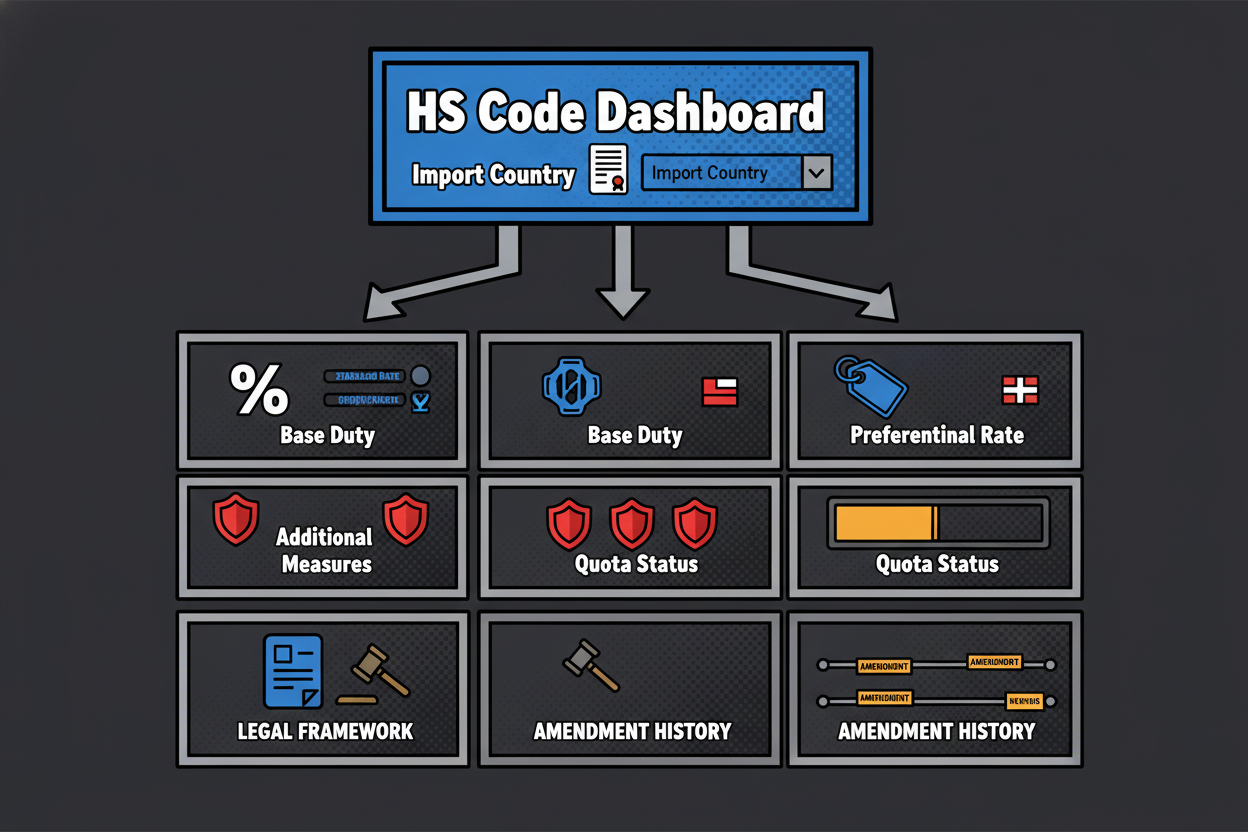
    A side-by-side dashboard view with a selected HS code at the top and a collapsible panel below showing: 'Country of import', 'Base/MFN duty (%)', 'Preferential duty (%) with origin flag', 'Additional duties (AD/CVD) as badges', 'TRQ status with progress bar fill and remaining quantity', 'Safeguards indicator', 'Measure legal basis with link icons', and 'Latest amendments' listed as concise tags. Color accents for alerts (red for additional duties; amber for partial TRQ fill).

    Let’s unpack the moving parts you’ll read in a live panel.

    Base and preferential rates. The base, often called MFN, is your default. Preferential shows what applies if your origin meets a trade agreement’s rules. Some lines are seasonal. If the code has seasonal periods, the panel should show which period you are in and the rate in effect.

    Additional duties. These are the silent budget breakers. Anti-dumping and countervailing duties target unfair pricing or subsidies. Safeguards respond to import surges. Surtaxes and special measures can appear on short notice. Your live panel should flag them clearly so you don’t rely on a base rate that looks harmless while a large additional duty actually applies [reference:3].

    Quotas and TRQs. A quota is a hard cap. A TRQ splits a quantity into two bands: a lower in-quota rate up to a limit and a higher over-quota rate after. You want three things here: the unit of measure, the total in-quota quantity, and the current fill status. A progress bar or a remaining-quantity figure lets you plan timing. If you rely on a lower in-quota rate for pricing, you need alerts as the fill rate approaches the ceiling.

    Amendments and updates. Tariff lines can change text, notes, and rates. New classification opinions or national rulings can shift practice. While the WCO manages HS updates and explanatory guidance, national administrations update rates and measures whenever policy requires. You want an update feed that tells you when a rate changed, a note was adjusted, or an administrative ruling impacted scope, so you can re-validate key SKUs at the right time [reference:3].

    How often does this move? In practice, base nomenclature has structured cycles, and national measures update as policy changes. That’s why static spreadsheets or PDFs are risky. You lose the thread on mid-cycle actions like a TRQ opening, a safeguard trigger, or a measure suspension. Live context keeps your costing and compliance aligned to what’s in force now [reference:3].

    Before and after: the cost of classifying without live context

    Picture a small appliances importer classifying a multifunction kitchen machine. Their static sheet shows a base rate that’s attractive. They pick a subheading, lock pricing, and ship. Only later do they learn that for their origin, an additional duty applied to that heading, while a near-by subheading carried no additional measure but a slightly higher base rate. Net effect: the static pick looked cheaper but cost more because of the added measure.

    Now replay with live context on screen. The candidate comparison shows the base and preferential rates for both options, plus a red badge on the additional duty for the first choice. The second choice has no additional measure, and there’s no TRQ. The team chooses the second subheading, avoids the added duty, and documents the decision logic. That is the difference between hoping your static data is current and proving your decision with what is actually in force.

    Validation, comparison, and export: streamlining your classification workflow

    You’ve got a candidate code and live context at hand. Lock it down with a validation flow that stands up in an audit. Keep it simple, consistent, and evidence-first.

    • Record the GRI path: which Rules you applied and in what sequence, from Rule 1 through Rule 6 as needed [reference:3]
    • Cite the exact legal texts: heading terms plus any relevant Section or Chapter Notes that control scope [reference:3]
    • Add Explanatory Notes excerpts and any WCO Classification Opinions consulted, as persuasive support [reference:3]
    • Check national rulings: if your jurisdiction has a rulings database, capture relevant IDs and note they are persuasive unless issued to you; in the U.S., CBP binding rulings bind CBP and the requester but not third parties [reference:4]
    • Attach your live tariff snapshot: MFN and preferential rates, measures, TRQ status, and any alerts you relied on
    • Timestamp everything and sign off internally so you can show who decided what and why

    With your evidence in place, compare candidates side by side. Bring legal fit and cost into the same frame so stakeholders see the full picture.

    Candidate HS code comparison

    Field What to capture Why it matters
    Candidate HS code Heading/subheading under consideration Anchors legal scope to specific text
    Legal scope summary Plain-language summary of heading/subheading text Ensures you classify by terms of the heading (GRI 1) [reference:3]
    Relevant Section/Chapter Notes Specific notes that include or exclude product features Legal notes control scope; cite note identifiers [reference:3]
    Explanatory Notes excerpts Key EN guidance supporting inclusion/exclusion Persuasive interpretation and examples [reference:3]
    GRI path applied Rules invoked (e.g., 1, 3(b) essential character, 6) Documents interpretative logic [reference:3]
    Product-feature fit Yes / Partial / No, with 1-line justification Makes fit transparent to reviewers
    Rulings alignment Related rulings IDs and stance, noting binding vs persuasive Adds persuasive support; third-party rulings are not binding [reference:4]
    Duty impact Base/MFN rate and preferential rate (if origin known) Cost impact comparison across candidates
    Additional measures AD/CVD, safeguards, excise, surtaxes, with flags Highlights risk or cost beyond ad valorem rates
    TRQ exposure TRQ presence and current fill status Availability and timing implications
    Risk notes Scope ambiguity, exclusion notes, interpretative risks Supports internal risk decisioning
    Evidence references Links or IDs to notes, ENs, rulings, internal memos Traceability for audits [reference:3][reference:4]
    Comparative score 1-5 score on fit and risk with brief rationale Roll-up to select final code

    Example comparison for the cordless drill kit:

    Field Example entry – A Example entry – B
    Candidate HS code 8467.21 8507.60
    Legal scope summary Hand-held tools with self-contained electric motor, drills Lithium-ion batteries
    Relevant Section/Chapter Notes Section XVI notes on parts and composite goods; Chapter 84 notes on tools Section XVI notes excluding parts of general use from parts headings
    Explanatory Notes excerpts EN to 84.67 covers hand-held drills; EN to Rule 3(b) on sets EN to 85.07 covers accumulators, not sets dominated by a tool
    GRI path applied Rule 1 for heading; Rule 3(b) essential character of retail set; Rule 5(a) case with the article; Rule 6 for subheading [reference:3] Rule 1 would only apply if classifying the battery alone; fails Rule 3(b) for the set [reference:3]
    Product-feature fit Yes – drill imparts function; battery and charger support No – does not reflect the main function of the retail set
    Rulings alignment Similar CBP rulings on drill kits support Rule 3(b) outcome (persuasive) [reference:4] Not aligned for retail kit context
    Duty impact See live panel for MFN/preferential by market See live panel; would misstate cost for the set
    Additional measures None flagged for the tool line in example market N/A for the set
    TRQ exposure Not applicable Not applicable
    Risk notes Ensure no more specific subheading applies within 84.67 Misclassification risk and audit exposure
    Evidence references GRI pathway notes, EN 84.67, EN Rule 3(b), internal memo N/A
    Comparative score 4.8/5 1/5

    You can run the same grid for any product family. The structure forces clarity. Legal fit comes first. Cost and measures ride second, but they sit in the same view so decision makers see the trade-offs.

    Export your mappings without per-match fees

    Once a code is validated, you need it where work happens: ERP, broker portals, purchase systems, and BI dashboards. That means structured exports with evidence fields so your decisions remain traceable and easy to refresh.
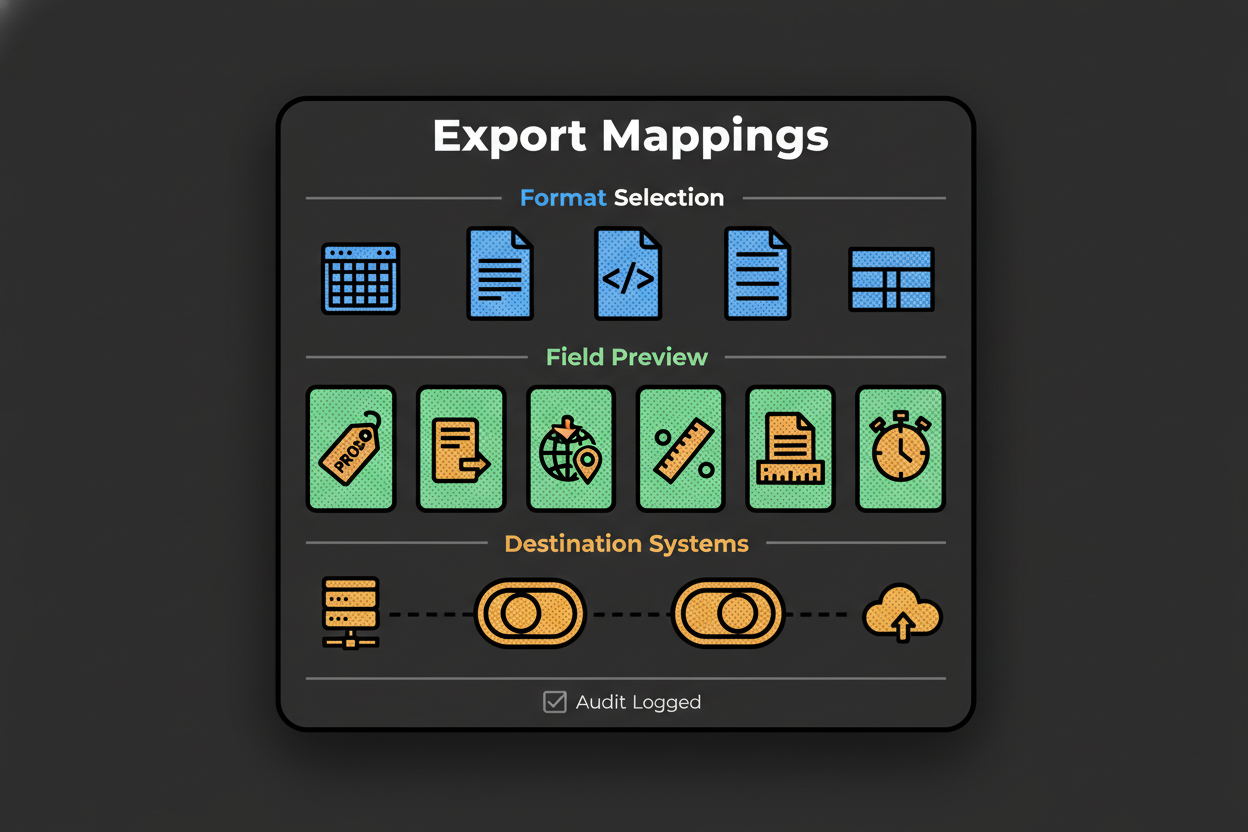
    A modal window overlay titled 'Export Mappings' with checkboxes for formats (CSV, XLSX, JSON), a field mapping preview grid (SKU, Normalized Description, HS Code by Market, Duty Rate, Measures, Evidence References, Timestamp), and destination toggles to 'ERP', 'Broker Portal', 'Data Lake'. A confirmation button labeled 'Export without per-match fees' and a small note reading 'All exports logged for audit'.

    Push codes out in the formats your stack expects. Include the SKU, the normalized description used for classification, HS code by market, duty rate and measures snapshot, evidence references, and a timestamp. Each export should log who exported what, when, and where it went. That single habit cuts audit scramble time dramatically.

    Per-match fee models punish you for doing the right thing, like revalidating at tariff change or refreshing a whole catalog. A flat, unlimited export model encourages routine checks and batch updates. The difference shows up in both cost and risk behavior [reference:1].

    Cost comparison: per-match vs unlimited export

    Dimension Per-match model Unlimited export model
    Pricing unit Price per classified SKU or transaction Flat license for unlimited classifications/exports
    Predictability Costs scale linearly with volume; budget volatility at peak cycles Stable cost; plan annually regardless of spikes
    Update cadence cost Reclassification triggers new charges No incremental cost to re-export updated mappings
    Team collaboration Disincentivizes re-checks due to cost Encourages peer review and periodic re-validation
    ERP/Broker sync Costly to refresh entire catalog Routine batch exports without penalties
    Total cost formula Unit price x monthly matches Flat fee + optional seats
    Example scenario If unit price is X and 10,000 SKUs refreshed quarterly, cost = 40,000X per year Single license covers initial and quarterly refreshes at no extra per-SKU cost
    Risk of under-classification Higher, due to cost avoidance behavior Lower, because reviews are not penalized

    When you stop counting clicks, your team focuses on quality: better evidence files, more frequent rechecks, and faster pushes to ERP and your broker. That is how you keep classification errors from becoming revenue-impacting surprises [reference:1].

    Frequently asked questions: HS classification and live tariff context

    Q: How often do tariff rates and measures change, and how should I track them?
    A: The HS legal framework is stable and managed by the WCO, but national duty rates and trade measures change whenever policy requires. Use live tariff context so you see current MFN, preferences, measures, and TRQ status when you classify. Set alerts for amendments and scope notes so you can re-validate high-volume SKUs at the right time [reference:3].

    Q: What if my product doesn’t fit any obvious HS code?
    A: Work the GRIs in order. Test heading terms and legal notes under Rule 1. If more than one heading fits, apply Rule 3. If it still resists, Rule 4 points to the goods it most closely resembles. Document each step and cite any Explanatory Notes used to interpret scope [reference:3].

    Q: How do I stay compliant when rulings or notes shift?
    A: Keep an evidence file for each decision. If a WCO Explanatory Note or a national interpretation changes, you can revisit the exact logic you used and adjust. In the U.S., a CBP ruling protects the requester and CBP for the covered facts. Others may cite the ruling as persuasive, but it is not binding on them. Monitor for modifications or revocations and keep your internal mapping aligned [reference:3][reference:4].

    Q: Can I automate classification for large catalogs without losing control?
    A: Yes, but keep humans in the loop. Use AI to generate candidates and highlight relevant notes. Then a specialist applies the GRIs, checks Explanatory Notes, reviews any rulings, and records the GRI path. Export with evidence and timestamps so your automation stays auditable [reference:3][reference:4].

    Q: How do I handle ambiguous or multi-use products?
    A: For composites, mixtures, or retail sets, Rule 3(b) pushes you to essential character. If two headings remain equally plausible, Rule 3(c) picks the one that appears last among those considered. Always tie your conclusion to the wording of legal notes and capture EN excerpts that support your interpretation [reference:3].

    Q: Where do Explanatory Notes and national rulings sit in my evidence file?
    A: Start with binding texts: heading terms and Section or Chapter Notes. Add EN excerpts and any WCO opinions as persuasive guidance. National rulings sit below that. In the U.S., a ruling binds CBP and the requester; for everyone else, it is persuasive and should be cited as such with a note on its scope [reference:3][reference:4].

    Modernizing customs classification for compliance and efficiency

    When you combine a disciplined GRI-based process with live tariff context, you control both legality and cost. You reduce the risk of enforcement outcomes like penalty cases built around misclassification and avoided duties, and you catch non-revenue errors before they chew up your team’s time [reference:2][reference:1].

    The workflow you saw is practical: extract attributes, generate candidates, validate with GRIs and notes, open live context, compare and decide, then export with evidence. That’s how high-performing teams cut through messy descriptions, moving tariffs, and audit pressure without slowing the business.

    Here’s a tight checklist you can implement right away:

    • Normalize product descriptions and extract classification attributes
    • Generate candidate headings and read the legal notes under Rule 1 [reference:3]
    • Apply GRIs 2 and 3 as needed, then Rule 6 at subheading level; capture EN support [reference:3]
    • Open live tariff context to compare MFN, preferences, measures, and TRQs
    • Document rulings alignment and whether any cited ruling binds you [reference:4]
    • Decide, record the evidence and timestamp, and export to ERP and your broker
    • Set alerts to re-validate high-volume SKUs when measures or notes change

    Adopt this now, and your customs tariff classification stops being a fire drill and becomes a repeatable, auditable advantage.

    Key Takeaways

    • Classification decisions must start with the HS legal texts and GRIs; live tariff data shows cost and risk in force now [reference:3]
    • Document your GRI path, cite legal notes and ENs, and note any rulings’ binding status [reference:3][reference:4]
    • Compare candidates on legal fit and live measures in one view so cost and compliance move together
    • Export mappings with evidence and timestamps, and avoid per-match fees that discourage revalidation
    • Use alerts to recheck critical SKUs when amendments, measures, or TRQs shift, minimizing revenue-impacting errors [reference:1]

  • Understanding the HS Coding System: A Key to Global Trade Compliance

    Understanding the HS Coding System: A Key to Global Trade Compliance

    In today’s global marketplace, the HS coding system plays an essential role in facilitating international trade, ensuring compliance with customs regulations, and enhancing the efficiency of supply chains. Whether you’re a business owner, customs broker, or logistics professional, understanding the HS coding system is crucial to navigating import and export processes smoothly. This article will delve into what the HS coding system is, how it works, and why it is vital for global trade compliance.

    What Is the HS Coding System?

    The HS coding system, or Harmonized System, is an internationally standardized numerical method of classifying traded products. Developed and maintained by the World Customs Organization (WCO), the HS system is used by over 200 countries worldwide to categorize goods when they cross borders. Its primary purpose is to provide a universal language that facilitates trade statistics, customs duties, and tariff applications.

    The system assigns a specific code — usually six digits — to every product based on its material composition, use, or nature. These codes are essential for customs clearance, tariff classification, and regulatory compliance. Countries may further extend these codes to more digits for additional specificity, commonly referred to as HS Codes or tariff codes.

    How Does the HS Coding System Work?

    The HS coding system operates by dividing all traded goods into chapters, headings, and subheadings:

    • Chapters: The first two digits indicate the chapter, representing broad product categories like live animals or machinery.
    • Headings: The next two digits specify a heading within the chapter, such as specific types of vegetables or electronics.
    • Subheadings: The final two digits in the six-digit code provide detailed classification within the heading, specifying variations or further product differentiation.

    For instance, the code 0101.21 corresponds to “purebred breeding horses.” This detailed hierarchical structure allows customs authorities to identify and categorize products precisely.

     business professionals analyzing HS codes on digital tablet, global trade background, compliance symbols

    Why the HS Coding System Is Critical for Trade Compliance

    The HS coding system is indispensable for various reasons tied to trade compliance:

    1. Customs Duty and Taxation

    Customs tariffs and taxes are calculated based on the HS codes assigned to imported or exported goods. Misclassification can lead to overpayment or penalties. Accurate HS codes ensure you pay the correct duties and avoid costly fines.

    2. Trade Statistics and Policy Making

    Governments rely on HS codes to compile trade statistics, which influence economic policies, trade agreements, and quota enforcement.

    3. Regulatory Compliance

    Certain products fall under specific regulatory controls, such as hazardous chemicals or pharmaceuticals. Correct HS coding helps regulatory authorities enforce restrictions and controls reliably.

    4. Efficient Customs Clearance

    Proper use of HS codes expedites customs clearance by reducing confusion and disputes, allowing goods to move swiftly across borders.

    How to Accurately Classify Products Using the HS Coding System

    Classifying products using the HS coding system can sometimes be complex, particularly for goods that have multiple uses or components. Here are some best practices to help with accurate classification:

    1. Consult the Official WCO HS Nomenclature: The World Customs Organization provides comprehensive documentation on HS codes.
    2. Analyze the Product Description Thoroughly: Understand the object, material, and function of the good.
    3. Use Product Classification Tools: Online classifiers can simplify your work by suggesting the correct HS codes based on a product description.
    4. Consult Customs Experts: When in doubt, seek advice from trade compliance specialists.
    5. Review Country-Specific Extensions: Remember that some countries add extra digits to the six-digit code for deeper categorization.

    One excellent resource is Classifast.com, a service that enables quick and precise classification of any text description according to international standards like HS, UNSPSC, and NAICS. This instant classifier can save time and improve accuracy in classifying products, ensuring compliance with global trade regulations.

    Benefits of Proper HS Code Classification

    Accurate classification according to the HS coding system can deliver multiple benefits for your business:

    • Reduce Risk of Customs Penalties: Avoid fines or shipment delays caused by misclassification.
    • Optimize Duty Payments: Pay the exact customs duties owed without overpaying.
    • Enhance Supply Chain Efficiency: Speed up customs processing and reduce paperwork.
    • Comply with Trade Agreements: HS codes are essential in applying preferential tariffs under trade treaties.
    • Improve Data Reporting: Provide precise data that helps in business forecasting and analytics.

    Common Challenges in Using the HS Coding System

    While the HS coding system is globally recognized, businesses often face challenges in using it correctly:

    • Complex Product Descriptions: Multi-component or hybrid products may be difficult to classify.
    • Frequent Updates: The HS system is updated regularly, requiring ongoing monitoring.
    • Variations in Country-Specific Codes: Some countries add additional digits to the base HS code.
    • Misinterpretations: Different interpretations of codes can lead to disputes with customs.

    To overcome these challenges, businesses should leverage technological tools and expert consultations to maintain compliance and accuracy.

    FAQs About the HS Coding System

    Q1: What is the difference between the HS coding system and tariff codes?
    A1: The HS coding system provides the standardized 6-digit codes for product classification internationally. Tariff codes may include additional digits added by countries for further specification, based on the HS base code.

    Q2: How often is the HS coding system updated?
    A2: The World Customs Organization typically reviews and updates the HS codes every five years to reflect changes in technology and trade patterns.

    Q3: Can I classify any product myself using the HS coding system?
    A3: While basic classifications can be done independently, complex products often require expert input or the use of classification tools like Classifast.com to ensure accuracy.

    Conclusion

    Mastering the HS coding system is a pivotal step towards achieving global trade compliance. Accurate classification under this system not only facilitates smoother customs procedures but also ensures you remain on the right side of regulations—protecting your business from costly delays and penalties. With the complexity inherent in product classifications and the dynamic nature of the HS system, leveraging resources like Classifast.com can dramatically simplify the process and boost your efficiency.

    Whether you’re an importer, exporter, or trade compliance professional, take charge today by adopting effective classification practices and tools. By doing so, you will safeguard your global operations and unlock opportunities in international markets with confidence.


    For more detailed and instant product classification, visit Classifast.com and ensure your trade compliance is always on point.


    Reference: World Customs Organization (WCO) Harmonized System Overview – wcoomd.org

  • Unlocking Global Trade Secrets with the Ultimate HS Code Directory Guide

    Unlocking Global Trade Secrets with the Ultimate HS Code Directory Guide

    In today’s fast-paced and interconnected world, efficient international trade is critical for businesses of all sizes. Central to smooth global transactions is the ability to accurately classify products, and this is where the HS code directory becomes indispensable. HS codes, or Harmonized System codes, streamline trade by providing a universal language for commodities across borders. This comprehensive guide will delve into the intricacies of HS codes, how to use an HS code directory effectively, and how it can unlock important secrets for your global trade success.

    What Is an HS Code Directory?

    The HS code directory is a structured catalog or database of Harmonized System codes, categorizing thousands of products according to internationally recognized standards. Developed and maintained by the World Customs Organization (WCO), the HS system assigns unique six-digit codes to goods, simplifying customs processes and aligning tariffs worldwide.

    An HS code directory allows businesses and customs officials to:

    • Quickly find the correct HS code for a product
    • Understand tariff rates, import/export restrictions, and compliance requirements
    • Access standardized product descriptions for seamless communication with global partners

    By using an HS code directory, companies reduce errors in documentation, avoid shipment delays, and ensure regulatory compliance.

    Why Are HS Codes Essential for International Trade?

    HS codes perform a vital role by facilitating smoother customs clearance and enabling accurate trade statistics. The benefits of leveraging a reliable HS code directory include:

    1. Simplifying Customs Procedures: An HS code defines exactly what the product is and subject to which regulations. Proper classification minimizes customs delays and potential fines.
    2. Determining Tariffs and Taxes: Customs duties are calculated based on HS codes, making classification key to understanding costs.
    3. Meeting Legal Requirements: Different countries may enforce varying restrictions or certifications on certain HS-coded goods.
    4. Enhancing Global Market Access: Correct codes help businesses comply with trade agreements and meet partner country standards.

    In short, the HS code directory serves as a secret weapon for businesses looking to optimize their supply chains and mitigate international trade risks.

    How to Use an HS Code Directory to Improve Your Global Trade Strategy

    Using an HS code directory correctly is paramount for unlocking its benefits. Here’s a step-by-step approach:

    Step 1: Understand Your Product Details

    Gather all relevant information about your product, including materials, components, and intended use. Detailed descriptions are vital as HS code classification is often nuanced and precise.

    Step 2: Use a Trusted Directory or Classifier Tool

    Access a reputable online HS code directory or classification tool. For quick, accurate results, you might consider classifast.com, which offers instant classification of any product description against international standards such as HS, UNSPSC, NAICS, and more.

    Step 3: Search Using Keywords or Descriptions

    Input detailed descriptions or keywords related to your product into the directory search interface. The directory will return relevant HS codes along with product category information.

     detailed open directory book with highlighted HS codes, digital data stream background

    Step 4: Review Descriptions and Choose the Best Match

    Examine the returned HS codes and ensure the descriptions align with your product specifications. Selecting the most accurate code is critical to compliance and avoiding costly errors.

    Step 5: Apply Your HS Code in Documentation

    Once identified, use the HS code consistently on all shipping, customs, and trade documents to ensure smooth processing.

    Benefits of Using Classifast.com for HS Code Classification

    To enhance your HS code lookup experience, classifast.com is a valuable resource worth mentioning. It is an instant classifier and category search platform for UNSPSC, NAICS, ISIC, and importantly, HS codes. Here’s why businesses rely on Classifast:

    • Speed and Accuracy: Instant results from any product description save time and minimize manual errors.
    • Multiple Classification Standards: Useful for companies working with diverse classification systems.
    • Ease of Use: An intuitive interface designed for trade professionals and novices alike.
    • Global Relevance: Supports international standards essential for worldwide trade.

    Leveraging tools like Classifast empowers exporters and importers to confidently navigate the complex world of product classification.

    The Structure of HS Codes: Decoding the Numbers

    To fully understand the HS code directory, it helps to know how the codes are structured:

    • First 2 digits: Chapter – Broad product category
    • Next 2 digits: Heading – Further product specification
    • Last 2 digits: Subheading – More granularity on the product type

    For example, an HS code like 1006.30 represents "Rice in the husk," specifying the product layer by layer.

    Countries can add extra digits (usually 2-4 more) to create their own tariff codes based on the international six-digit HS standard, further tailoring trade requirements.

    Common Challenges When Using an HS Code Directory

    While HS code directories are invaluable, some challenges may arise:

    • Product Complexity: Items with mixed materials or new technology may be difficult to classify.
    • Changing Regulations: Regular updates to HS codes mean businesses must stay informed.
    • Interpretation Variance: Different customs authorities may interpret codes slightly differently, requiring due diligence.

    To mitigate these, always cross-check codes via multiple sources and consider consulting customs brokers or classification experts.

    Top Tips for Efficient HS Code Directory Usage

    To make the most of your HS code directory experience, follow these tips:

    • Keep product descriptions detailed and specific.
    • Utilize advanced classification tools like classifast.com for quick codes.
    • Monitor updates from the World Customs Organization regularly.
    • Train your staff on HS code knowledge and classification best practices.
    • Document classification decisions for audit and compliance purposes.

    By following these guidelines, your global trade will be more streamlined and compliant.

    FAQ: HS Code Directory Essentials

    Q1: How do I find the HS code for my product?
    Start with a detailed product description and enter it into an HS code directory or classifier tool like classifast.com. Review the suggested codes and select the one that best matches your product.

    Q2: Can an HS code directory help reduce import duties?
    Yes, using accurate HS codes ensures your product is classified appropriately, potentially qualifying for lower tariffs or trade agreements. Misclassification can result in higher duties or penalties.

    Q3: Is the HS code directory the same worldwide?
    The first six digits of HS codes are internationally standardized by the World Customs Organization, but countries may add additional digits for further categorization, so regional differences exist.

    Conclusion: Harness the Power of an HS Code Directory for Trade Success

    Unlocking the secrets of global trade starts with mastering product classification, and the HS code directory is your ultimate key. By understanding, correctly applying, and staying updated on HS codes, businesses can avoid costly delays, tariffs, and compliance pitfalls — gaining a competitive edge in international markets.

    Don’t let complex classification slow your trade down. Use efficient, trusted resources such as classifast.com to streamline your product categorization process effortlessly. Start leveraging the power of an HS code directory today and open the door to smoother, faster, and more profitable global transactions.

    For more detailed insights and instant classification tools, visit classifast.com and take the first step toward mastering the language of global trade.


    Source: World Customs Organization (WCO) – Harmonized Commodity Description and Coding System WCO official site

  • How Tariff Line Classification Impacts Global Trade and Pricing Strategies

    How Tariff Line Classification Impacts Global Trade and Pricing Strategies

    Understanding tariff line classification is essential for businesses engaged in international trade, as it directly influences customs duties, regulatory compliance, and strategic pricing decisions. A tariff line, also referred to as a tariff code or commodity code, is a detailed classification system used by customs authorities worldwide to categorize products according to agreed international standards. This classification affects everything from the cost of importing goods to eligibility for trade agreements, making it a critical factor in global commerce.

    In this article, we will explore how tariff line classification affects global trade flows and the pricing strategies companies adopt to remain competitive. Whether you are an importer, exporter, or supply chain manager, understanding this concept will enable smarter decision-making and optimize your operational costs.


    What Is a Tariff Line and Why It Matters

    A tariff line is a numerical code assigned to specific products, often aligned with the Harmonized System (HS) codes created by the World Customs Organization. These codes organize goods into hierarchies of chapters, headings, and subheadings, enabling customs officers to efficiently determine applicable tariffs and regulatory requirements.

    Tariff lines matter because:

    • They determine customs duties—the taxes levied on imported goods vary by tariff line.
    • They impact non-tariff measures, such as import quotas, licensing, or safety standards.
    • They guide trade policy enforcement, enabling countries to apply different rules based on product type.
    • They influence pricing strategies by affecting landed costs and profit margin calculations.

    Incorrect tariff line classification can result in costly fines, shipment delays, or unexpected expenses due to misapplied tariffs or regulatory breaches.


    How Tariff Line Classification Influences Global Trade

    Streamlining Customs Clearance and Compliance

    Efficient classification reduces the risk of customs clearance delays. Accurate tariff line assignment ensures shipments are processed swiftly, avoiding costly hold-ups at borders. On the other hand, misclassification can trigger inspections and investigations that disrupt supply chains.

    Optimizing Duty Payments and Exploiting Trade Agreements

    Different tariff lines may be subject to widely varying duty rates. By correctly classifying products, companies can minimize customs duties, sometimes benefiting from preferential tariffs under trade agreements such as the USMCA or EU trade deals. For example, products classified under a tariff line eligible for a free trade agreement will incur lower tariffs, reducing the overall import cost.

    Enhancing Market Access and Regulatory Compliance

    Certain products require compliance with safety and environmental standards that depend on their tariff classification. Proper tariff line categorization ensures that all regulatory controls, such as labeling requirements or product certifications, comply with the import country’s standards, avoiding export restrictions or penalties.


    Impact of Tariff Line on Pricing Strategies

    Pricing Based on Landed Costs

    Landed cost includes the product price plus all associated costs incurred until the goods reach the buyer’s doorstep, including tariffs, taxes, and shipping. Since tariffs depend on tariff lines, precise classification directly affects landed cost calculations and, consequently, pricing strategies.

    For instance, a product classified under a tariff line with a high duty rate will have a greater landed cost, potentially reducing profit margins. Businesses must factor such costs into their pricing to remain profitable while competitive.

     Businesspeople analyzing pricing strategies on digital charts, global trade symbols, financial graphs background

    Competitive Pricing and Market Entry Decisions

    By understanding tariff lines and their associated duties, exporters can strategically price products to balance affordability and profitability in target markets. They may also decide which product variants to develop or promote based on tariff impacts.

    Adjusting for Currency Fluctuations and Tariff Changes

    Tariff rates can change due to trade policy shifts or geopolitical tensions. Companies that actively monitor tariff line classifications can adapt prices promptly, leveraging tariff concessions or mitigating cost increases.


    Tools to Simplify Tariff Line Classification

    Classifying products can be intricate due to the complexity of international standards like the Harmonized System (HS), UNSPSC, or NAICS. To simplify this process, services like Classifast.com offer instant classification and category search for multiple international classification standards. By inputting a product description, users quickly get accurate tariff lines and codes, which helps avoid misclassification risks.


    How to Ensure Accurate Tariff Line Classification: A Step-by-Step Guide

    1. Understand Your Product Thoroughly
      Know your product’s materials, function, and components in detail.

    2. Refer to Official Customs and Trade Resources
      Consult the Harmonized System database or national customs authorities’ tools.

    3. Use Classification Tools
      Utilize services like Classifast.com that provide instant classification assistance.

    4. Seek Expert Advice if Needed
      Complex products or ambiguous cases may require consultation with customs brokers or trade lawyers.

    5. Maintain Documentation
      Keep records of product specifications and classification decisions for audits.


    Frequently Asked Questions

    Q1: What is a tariff line in customs classification?
    A tariff line is a detailed numerical code used to categorize products for customs purposes, impacting tariff rates and regulations.

    Q2: How can tariff line classification affect import costs?
    The tariff line determines the applicable customs duty rate, which directly influences the total import cost and pricing.

    Q3: Are tariff lines standardized internationally?
    Tariff lines are based on international standards, primarily the Harmonized System (HS), but countries may have their own extensions or adaptations.


    Conclusion: Why Mastering Tariff Line Classification Is Crucial for Your Business

    In the complex world of global trade, mastering tariff line classification is a game-changer. It directly influences customs duties, regulatory compliance, and your ability to adopt effective pricing strategies that keep you competitive and profitable. Leveraging tools like Classifast.com to simplify classification processes can save time, reduce errors, and optimize your global supply chain operations.

    Don’t let tariff classification be a costly mystery—equip your business today with the knowledge and resources to navigate global trade smoothly and strategically. Visit Classifast.com now to get started on accurate tariff line classification and take control of your international pricing strategy.


    References:
    World Customs Organization. (n.d.). Harmonized System (HS). Retrieved from https://www.wcoomd.org/en/topics/nomenclature/overview/what-is-the-harmonized-system.aspx

  • HS Codes Explanation: Unlocking Global Trade Simplified for Beginners

    HS Codes Explanation: Unlocking Global Trade Simplified for Beginners

    Understanding HS codes is essential for anyone involved in global trade. If you’re new to importing or exporting, having a clear HS codes explanation will simplify the complexities of international commerce and help ensure your shipments comply with regulations. This guide breaks down what HS codes are, why they matter, and how to use them effectively, making the whole trade process smoother and more efficient.

    What Are HS Codes?

    HS codes, short for Harmonized System codes, are internationally standardized numerical codes used to classify traded products. The system was developed by the World Customs Organization (WCO) to create a universal language for goods entering or leaving countries. Each HS code corresponds to a specific product or product category, helping customs officials identify items accurately and apply the correct tariffs, duties, or restrictions.

    By providing a consistent method for describing goods, HS codes facilitate trade negotiations, compliance with trade policies, and the compilation of international trade statistics.

    Why Are HS Codes Important?

    HS codes are more than just numbers—they are the backbone of smooth international shipping and trade compliance. Here’s why understanding HS codes is crucial:

    • Customs Clearance: Correct HS codes ensure quick and accurate customs processing, reducing delays and fines.
    • Tariff Application: Customs duties are calculated based on HS codes, affecting the cost of imported and exported goods.
    • Trade Policy Enforcement: Government regulations on quotas, embargoes, or prohibitions rely heavily on accurate HS classification.
    • Global Trade Statistics: HS codes allow countries to track trade volumes and economic activities for policymaking.

    Without properly classifying your products using the correct HS codes, you risk shipment delays, added costs, or potential legal issues.

    How Are HS Codes Structured?

    Understanding the structure of an HS code is key to using them properly. The system is hierarchical and numeric:

    • First 2 digits: Chapter – Broad category (e.g., 01 for live animals)
    • Next 2 digits: Heading – More specific classification (e.g., 0102 for live bovine animals)
    • Next 2 digits: Subheading – Even more specific, detailing product variations (e.g., 010221 for live bovine animals, purebred breeding)
    • Additional digits: Many countries add up to 2–4 additional digits for national tariffs and more precise classification.

    This 6-digit base code is universal worldwide, while additional digits might vary depending on national requirements.

    Leveraging tools like Classifast can save valuable time and mitigate errors with their quick and accurate HS code identification from simple text descriptions.

     diverse cargo ships navigating sea trade routes with digital HS code symbols

    How to Find the Correct HS Codes for Your Products

    Accurate classification is crucial. Here’s a simple step-by-step approach for beginners:

    1. Identify Your Product: Understand the material, use, and nature of your product in detail.
    2. Consult Official HS Tariff Books or Online Databases: Many customs agencies publish HS codes online.
    3. Use a Classification Tool: Services like Classifast.com provide instant classifiers and category searches for HS codes and other international standards like UNSPSC or NAICS.
    4. Cross-check with Customs or Trade Experts: When unsure, seek advice from customs brokers or trade compliance professionals.
    5. Review and Confirm: Make sure your selected HS code aligns with relevant national rules and declarations.

    Common Mistakes to Avoid With HS Codes

    Incorrectly assigning HS codes can cause costly trade disruptions. Steer clear of these pitfalls:

    • Using overly broad or generic codes rather than specific ones.
    • Ignoring updates or changes to HS codes that happen every 5 years.
    • Forgetting that additional national digits may apply in your country.
    • Misclassifying products by ignoring material composition or product use.
    • Not verifying codes with customs authorities or trade professionals.

    Benefits of Using an HS Code Classification Tool Like Classifast

    Accurately determining HS codes is not always straightforward. Although official tariff books exist, they can be complex and time-consuming to navigate. Here’s where a reliable tool like Classifast.com comes in handy. It offers:

    • Instant classification of products based on any text description.
    • Access to multiple classification standards including HS, NAICS, UNSPSC, and more.
    • Fast results reducing delays in documentation processes.
    • Higher accuracy ensuring compliance and cost efficiency.

    Using such a tool makes the trade process less intimidating for newcomers and increases efficiency even for seasoned traders.

    Frequently Asked Questions (FAQs)

    Q1: What exactly is an HS code?
    HS codes are internationally standardized numbers used to classify products for customs, tariffs, and regulations during international trade.

    Q2: How precise should I be when assigning HS codes?
    Very precise—use the most specific subheading available to avoid customs delays and unnecessary duties.

    Q3: Can I find HS codes for free online?
    Yes, many countries’ customs websites provide searchable HS code databases. Alternatively, websites like Classifast.com offer quick and easy classification tools.

    Additional Resources for Deepening Your Understanding

    If you want to explore official resources, the World Customs Organization’s website is an authoritative source providing in-depth insights on HS codes and global trade standards (source: WCO). Additionally, national customs portals often give access to current tariff schedules and classification guides tailored to local regulations.

    Conclusion: Master HS Codes to Unlock Global Trade Opportunities

    A solid HS codes explanation is the foundation for any successful international trading venture. Knowing how to classify your products using the correct HS codes avoids costly delays, helps comply with customs policies, and ultimately saves money. Whether you are a beginner or looking to streamline your trade processes, tools like Classifast.com can simplify classification tasks by providing instant, accurate HS codes and other product standard codes directly from text descriptions.

    Start today by identifying your product classifications accurately to unlock smoother global trade and maximize your business potential on the international stage!

  • Master HS Coding: Essential Tips for Success in Programming

    Master HS Coding: Essential Tips for Success in Programming

    In the world of programming, HS coding stands as a crucial skill that developers, data analysts, and IT professionals alike should master. Whether you’re working on automation, classification, or developing software that interacts with international trade data, understanding HS coding is essential. This article aims to provide you with essential tips for mastering HS coding, ensuring your programming projects are both efficient and effective.

    What Is HS Coding?

    HS coding, short for Harmonized System coding, is an internationally standardized system of names and numbers used to classify traded products. Developed and maintained by the World Customs Organization (WCO), the HS code serves as a global language for customs and trade documentation. In programming, HS coding often refers to tasks involving the classification and categorization of products or services within software applications.

    By incorporating HS codes into your programming workflow, you enable better data organization, improve accuracy in logistics, and speed up international transactions.

    Why HS Coding Matters in Programming

    Programming involving HS codes is pivotal in various domains:

    • Customs Automation: Software systems require accurate HS codes to calculate tariffs and duty taxes.
    • Inventory Management: HS coding helps companies classify items systematically.
    • E-commerce: Online platforms use HS codes to streamline shipping processes across borders.
    • Data Analysis: Analysts use HS codes for trade pattern evaluation and economic analysis.

    Mastering HS coding not only enhances your technical skills but also boosts your value in sectors where international trade is prevalent.

    Essential Tips for Success in HS Coding

    To effectively integrate HS coding within your programming projects, consider the following:

    1. Understand the Structure of HS Codes

    An HS code is typically a 6 to 10-digit number:

    • The first 2 digits represent the chapter.
    • The next 2 digits define the heading.
    • The following 2 digits indicate the subheading.
    • Additional digits (if any) provide further product specification depending on national requirements.

    Grasping this hierarchy helps in precise coding and parsing HS codes programmatically.

    2. Keep Updated with the Latest HS Code Versions

    HS codes are revised every 5 years to keep pace with changing trade landscapes. Programming solutions should incorporate the latest versions to ensure compliance and accuracy.

    3. Use Automated Classification Tools

    Manual classification of HS codes is prone to errors and time-consuming. By leveraging automated classifiers, you can streamline your workflow. For example, classifast.com offers instant classification of any text input according to global standards like HS coding. Their platform helps programmers quickly retrieve accurate HS codes based on product descriptions, saving valuable development and processing time.

     Young developer debugging code, vibrant tech environment, intense concentration, glowing laptop keyboard

    4. Incorporate Validation Checks

    Implement validation rules in your software to detect invalid or mismatched HS codes. This prevents costly errors during customs clearance or eCommerce transactions.

    5. Leverage APIs and Libraries

    Use APIs and open-source libraries designed for HS coding integration. Tools such as the WCO’s published data or third-party APIs provide real-time HS code data, improving your program’s reliability and accuracy.

    6. Document and Comment Your Code

    HS coding involves complex categorization logic. Maintaining clear documentation helps your team understand mapping rules and makes future updates easier.

    Common Challenges in HS Coding and How to Overcome Them

    Programming with HS codes poses unique challenges:

    • Ambiguous Product Descriptions: Products can fall into multiple categories.
    • Country-Specific Extensions: Some nations add extra digits or rules.
    • Frequent Updates: Staying current is demanding.

    To overcome these, integrate AI-based classification tools (consider checking services like classifast.com), maintain a comprehensive reference database, and regularly review changes in international trade standards.

    How HS Coding Interacts with Other Classification Systems

    HS coding is just one of many classification systems. Others include:

    • NAICS (North American Industry Classification System)
    • UNSPSC (United Nations Standard Products and Services Code)
    • ISIC (International Standard Industrial Classification)
    • ETIM (ElectroTechnical Information Model)

    For developers handling various standards, platforms like classifast.com provide invaluable resources by offering instant classification across multiple coding systems, helping maintain coherence and integration in your projects.

    Practical Application: Implementing HS Coding in Your Projects

    Here is a simplified outline of steps to implement HS coding effectively in your programming tasks:

    1. Gather Product Information: Collect detailed, standardized product descriptions.
    2. Select Classification Method: Choose between manual coding, rule-based algorithms, or AI classifiers.
    3. Integrate Classification Tools: Use APIs from reliable services or build your own classification logic.
    4. Validate Codes: Program tests to ensure classifications meet international and country-specific standards.
    5. Update Codes Periodically: Plan regular updates aligned with the WCO cycles.
    6. Log and Report: Maintain logs of classification results for auditing and improvement.

    FAQs About HS Coding in Programming

    Q1: What programming languages are best suited for working with HS coding?
    A1: Most programming languages like Python, Java, and JavaScript can handle HS coding effectively. Python, with its rich libraries for data manipulation and APIs, is especially popular for classification tasks.

    Q2: Can I automate HS code classification from product descriptions?
    A2: Yes. Many automated tools, including classifast.com, leverage AI and predefined rules to classify products from textual descriptions quickly and accurately.

    Q3: How often should I update HS code databases in my software?
    A3: It’s recommended to align updates with the WCO’s 5-year HS code revision cycle, but also monitor for interim changes specific to countries you operate with for full compliance.

    Authoritative Source Highlight

    For a comprehensive overview of HS coding regulations and classification guidelines, the World Customs Organization’s official website offers detailed resources and updates (source: https://www.wcoomd.org).

    Conclusion: Take Your HS Coding Skills to the Next Level

    Mastering HS coding is a strategic advantage for programmers involved in global trade, logistics, or product classification. By understanding the structure, using modern tools like classifast.com, and implementing best practices, you can enhance both the accuracy and efficiency of your HS coding implementations.

    Ready to boost your programming capabilities with precise classification? Explore services like classifast.com today and accelerate your journey toward HS coding mastery!