Tag: how to find naics code

  • The Complete Guide to North American Industry Classification (NAICS) for Businesses and Analysts

    The Complete Guide to North American Industry Classification (NAICS) for Businesses and Analysts

    Table of Contents

    Introduction to North American Industry (NAICS) Classification

    You open a grant application with a tight deadline. Everything looks routine until one field stops you: Enter your NAICS code. If you’ve ever paused at that moment, you’re not alone.

    What is NAICS? The North American Industry Classification System is the standard used by Federal statistical agencies to classify business establishments for the purpose of collecting, analyzing, and publishing statistical data about the business economy. It is production-oriented and designed for comparability across the U.S., Canada, and Mexico.

    Why should you care? Because the same code you enter here shows up in government registrations, regulatory reports, and contracting portals. Agencies depend on NAICS classfication to organize how they collect and publish data, which is why you see it echoed in surveys, forms, and program rules.

    For businesses, an accurate code can speed up registrations and avoid confusion in grants. For analysts, NAICS is the backbone that lets you segment markets and benchmark peers. However, finding that perfect 6-digit code manually can be a daunting task. This is where a tool like Classifast.com becomes essential. Classifast is a high-performance web application built with FastAPI that provides instant classification of any text input into standards like NAICS, ISIC, and UNSPSC using advanced semantic search technology.

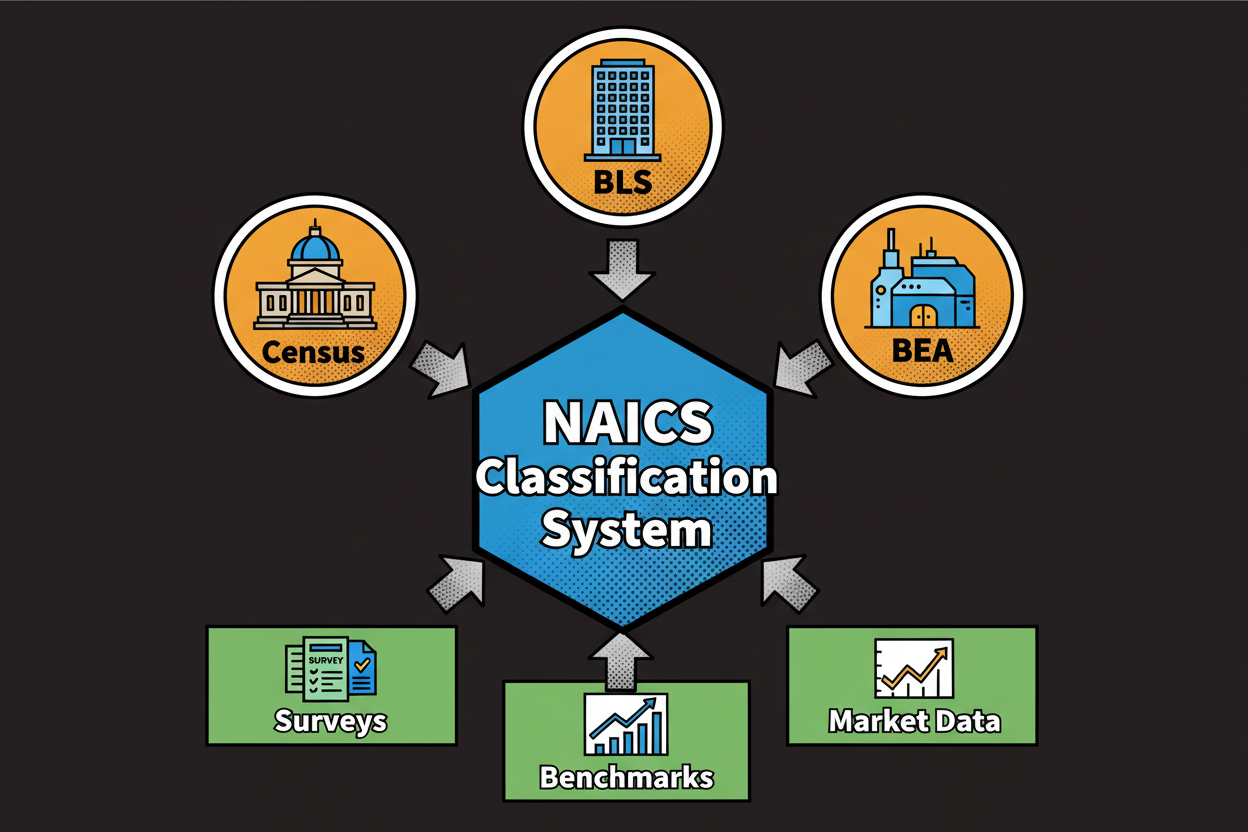
    NAICS ecosystem diagram showing data flow between agencies and businesses

    Understanding the Structure and Purpose of NAICS

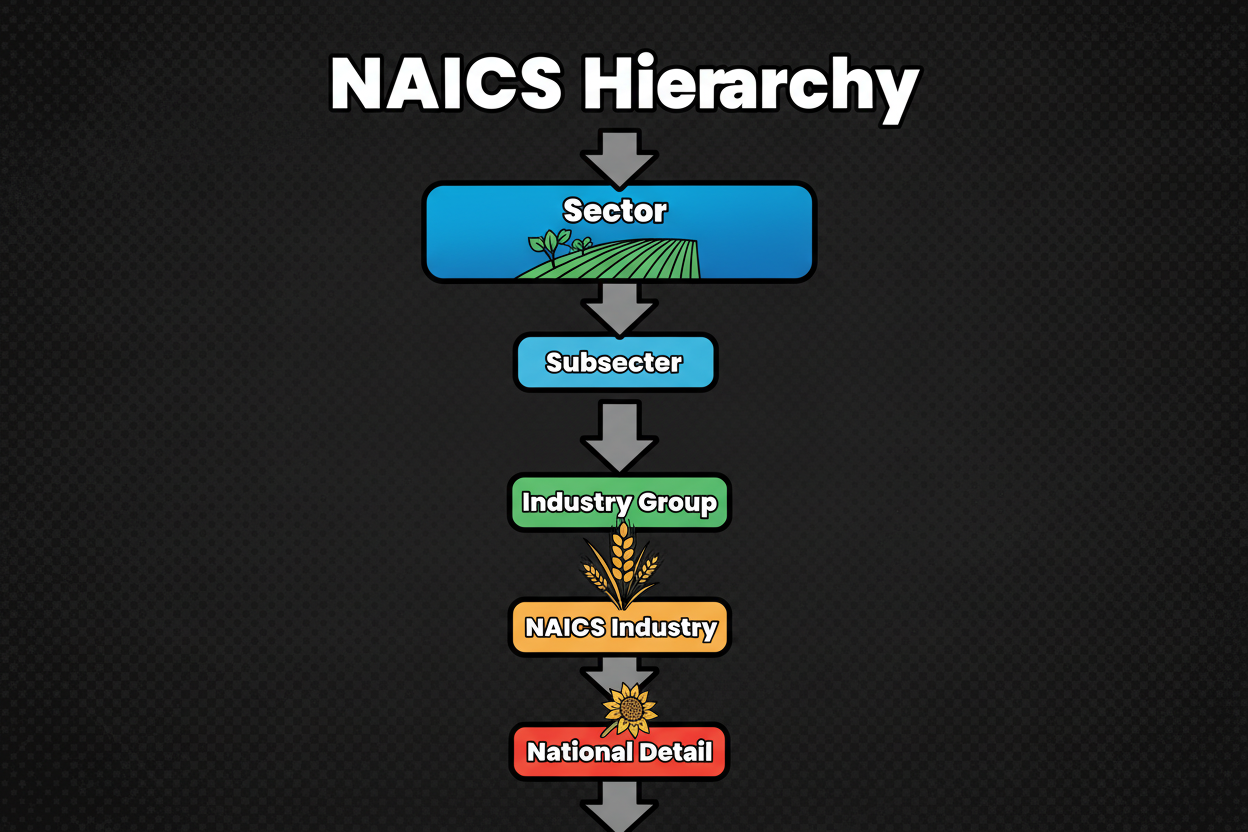
    NAICS uses a 2- through 6-digit hierarchical system that moves from broad to specific. Each additional digit adds detail, narrowing the type of activity until you reach a specific national industry.

    • Sectors (2-digits): Major slices of the economy (e.g., 31–33 for Manufacturing).
    • Subsectors (3-digits): Specific activity groups within a sector.
    • Industry Groups (4-digits): Tighter clusters of related industries.
    • NAICS Industries (5-digits): The level of tri-national comparability (US, Canada, Mexico).
    • National Industries (6-digits): The country-specific layer for fine-grained detail.

    NAICS is production-oriented, meaning it groups establishments by the similarity of the processes they use to produce goods or services.

    Tree diagram showing the NAICS hierarchy from 2 to 6 digits

    How Businesses and Analysts Use NAICS in Practice

    NAICS shows up anywhere government or statistical work needs consistent industry information. Getting the code right keeps your filings aligned and anchors your data to how agencies view production processes.

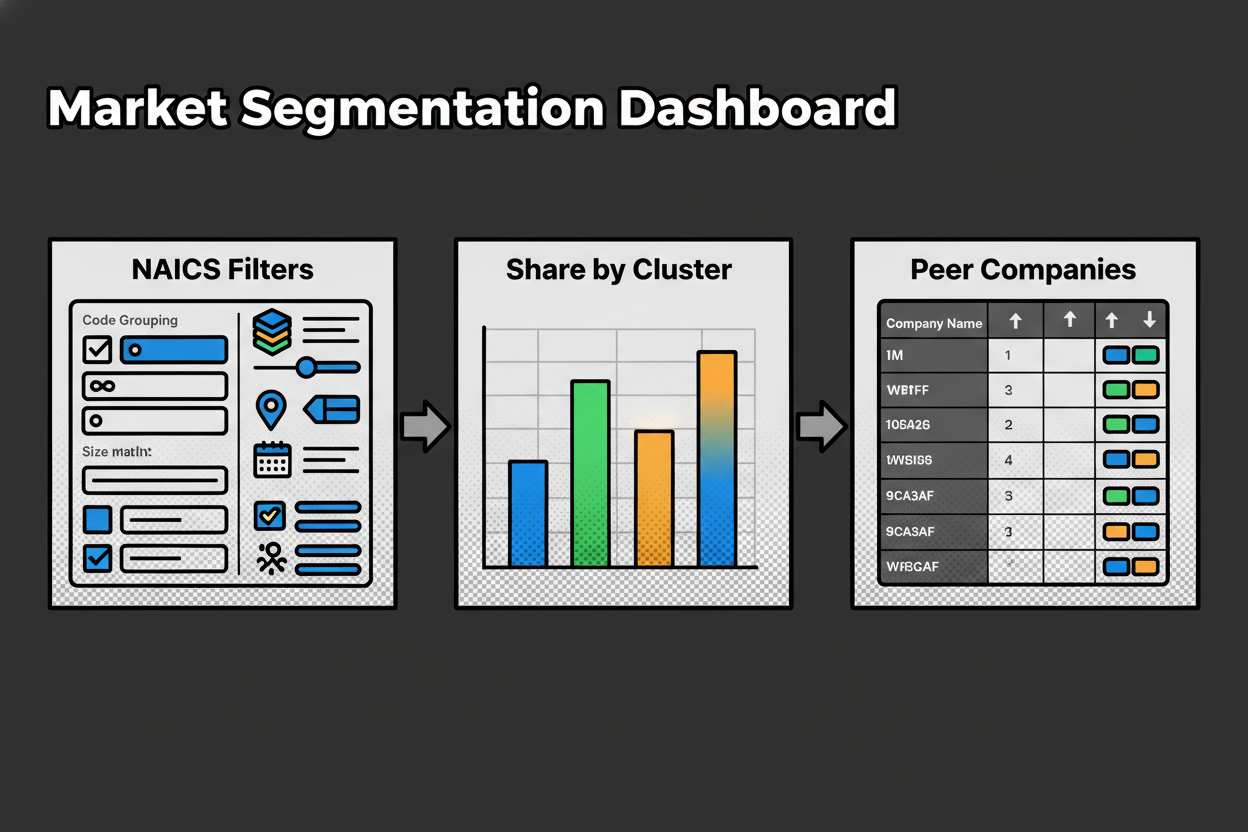
    For analysts, NAICS is a powerful filtering tool. Say you’re sizing a niche segment within business services. Instead of guessing, you can use Classifast.com to instantly map a list of company descriptions to their most likely NAICS codes. By clustering these 5- and 6-digit codes, you can build a clean peer set that aligns with official economic data.

    Analyst dashboard showing market share by NAICS code cluster

    Comparing NAICS to International Classification Systems

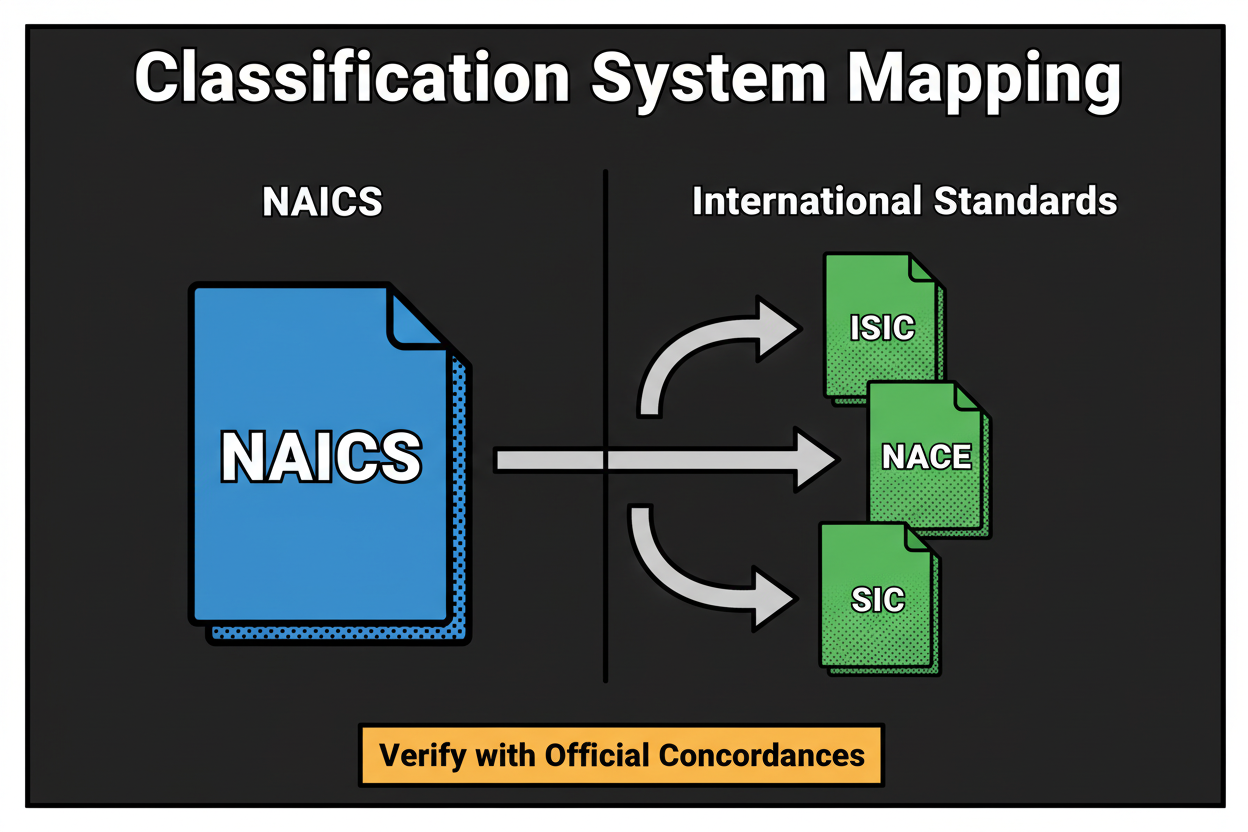
    If you operate across borders, you’ll encounter systems like ISIC (International) and NACE (Europe). While NAICS is the North American frame, mapping between these systems is a common requirement for global companies.

    SystemScopeOrganizing Principle
    NAICSNorth AmericaProduction-oriented
    ISICGlobal (UN)Global statistical standard
    NACEEurope (EU)European statistical standard

    Because these systems have different hierarchies, it is best to use a “semantic bridge.” Classifast supports all of these standards simultaneously, allowing you to input a single description and receive matching codes for NAICS, ISIC, and even NACE-related taxonomies instantly.

    Mapping visual showing NAICS alignment with ISIC and NACE

    Step-by-Step Guide: Leveraging NAICS with Classifast

    The manual way to find a code involves walking the hierarchy level-by-level through massive PDF manuals. The modern way is to use the Classifast Goods and Services Classifier.

    1. Define Primary Activity: Describe what your business does (e.g., “Custom software development for healthcare”).
    2. Instant Search: Paste that description into Classifast.com.
    3. Analyze Results: Classifast uses semantic search to find the 6-digit NAICS code that matches your production process, not just your keywords.
    4. Verify Hierarchy: Review the 2-digit to 5-digit path provided by the tool to ensure the logic holds up.
    5. Record & Maintain: Save the code and the rationale for use in all future government filings.
    Linear flowchart showing the Classifast classification workflow

    Frequently Asked Questions About NAICS

    Q: How often does NAICS change?
    A: NAICS is updated periodically (usually every 5 years). When updates happen, Classifast’s underlying models are updated to ensure you are always using the most current structure.

    Q: What if my business is a hybrid of multiple codes?
    A: Focus on your primary revenue-generating activity. If you build equipment (Manufacturing) but also provide a subscription (Service), Classifast will help you determine which production process is dominant based on your description.

    Q: Is Classifast free to try?
    A: Yes. You can visit Classifast.com right now to classify individual items instantly without even creating an account.

    Conclusion and Key Takeaways

    The North American Industry Classification System provides a shared language for the economy. Whether you are filling out a grant, applying for a government contract, or performing market research, your NAICS code is your identity in the eyes of statistical agencies.

    By using Classifast.com, you can move from hours of manual manual-checking to seconds of automated search. With its Fast API-driven architecture and semantic intelligence, it is the fastest way to ensure your industry data is accurate and compliant.

    Key Takeaways

    • Classify by primary activity, focusing on production rather than marketing.
    • Use Classifast.com for instant, semantic-search-powered results.
    • Walk the hierarchy from 2 digits to 6 digits to ensure logical consistency.
    • Keep it consistent across all registrations, grants, and reports.
  • Ultimate NAICS Code Identification Tool: Instant Business Classification Guide

    Ultimate NAICS Code Identification Tool: Instant Business Classification Guide

    Table of Contents

    Unlock Instant NAICS Code Classification for Any Business

    You need a NAICS code for a form, a grant, or a vendor setup. After ten tabs and conflicting lists, you still aren’t sure which one fits. Classifast turns that guesswork into a 10-second, confidence-ranked answer.

    NAICS is the North American Industry Classification System. It groups businesses by their main economic activity so agencies, banks, and researchers can understand what you do. You’ll see NAICS codes requested on registrations, tax forms, RFPs, grant applications, and market research surveys.

    Here’s the catch. NAICS classification feels simple until it isn’t. Job titles are ambiguous, industries overlap, and many lists you find online are incomplete or outdated. If your business does more than one thing, the choice gets fuzzy fast.

    What usually goes wrong? People search by a brand name or job title, not the actual activity. They scan a wall of codes that all sound close. They pick something that looks familiar and hope for the best. It’s common for businesses to misclassify themselves [to validate]. And that leads to delays, rejections, or bad data in your reports.

    Classifast fixes this by matching the meaning of your description to the right industry activities. You write what you do in your own words. The tool returns a short list of NAICS recommendations, ranked by confidence, with a clear “why this matches” explanation. You also get related industries so you can see close neighbors and validate your final choice.

    Let’s make it concrete with a bakery example. You run a neighborhood bakery. You bake croissants and bread in-house. You sell in-store. You also run an online storefront with delivery on weekends. Are you retail, manufacturing, or e-commerce?

    With manual lookup, you’ll see similar sounding codes for retail bakeries, commercial bakeries, and electronic shopping. Which one wins? The right answer usually depends on your primary revenue driver. If most of your revenue comes from in-store sales, retail bakery is likely your primary. If you wholesale to grocers or produce at scale, a manufacturing code may fit. If most revenue now comes from online orders shipped to consumers, an e-commerce retail code may be more precise.

    Classifast doesn’t guess. It looks for decisive signals in your text: verbs like bake vs. sell, channels like in-store vs. online, and scope hints like wholesale vs. retail. It then ranks the closest NAICS matches, shows confidence scores, and surfaces related industries so you can compare options side by side.
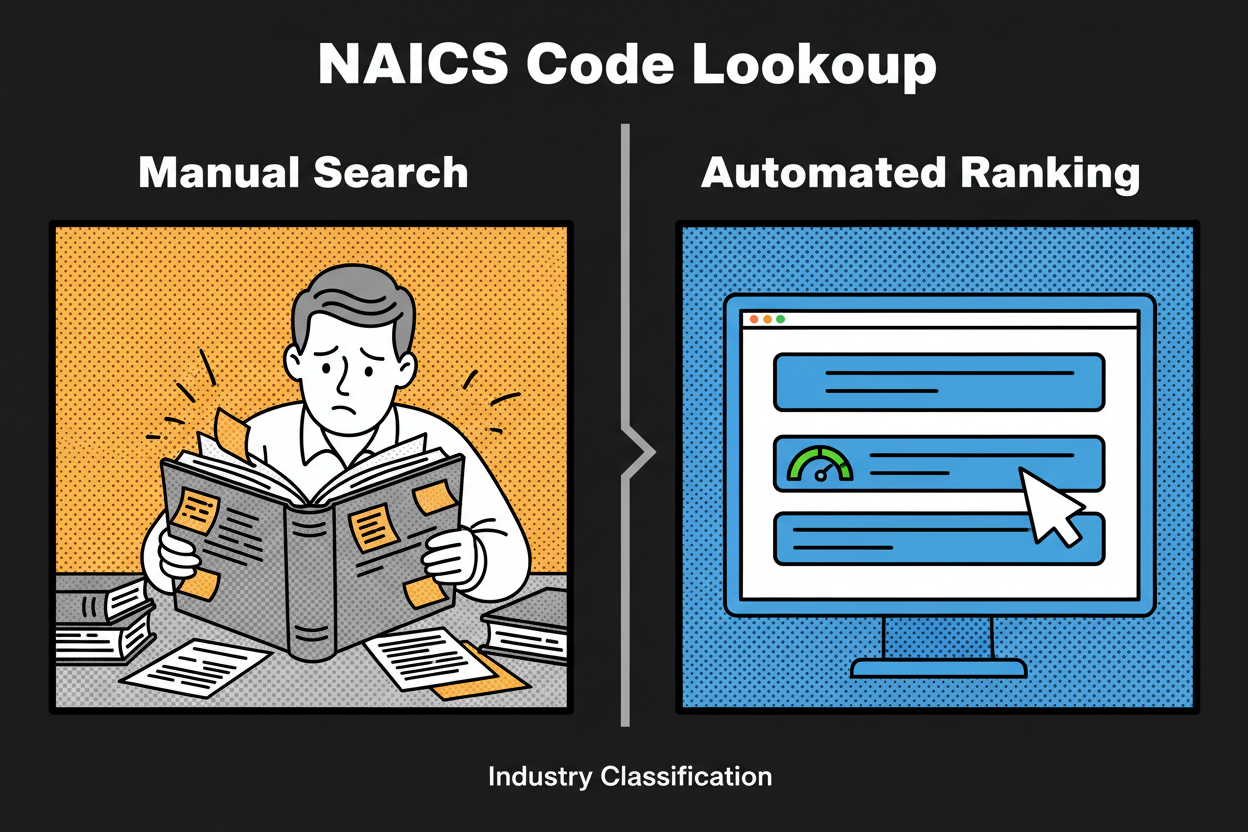
    Split-screen illustration showing on the left a person scrolling through a thick industry code book with sticky notes, and on the right a clean web interface returning a ranked NAICS result instantly with a visible confidence score gauge

    Traditional NAICS searches are keyword-only. They trip over synonyms like online storefront vs. e-commerce, install vs. manufacture, or fractional CMO vs. marketing consultant. Classifast uses semantic search to understand intent, not just words. So “online storefront” correctly maps to e-commerce retail, even when you never typed e-commerce.

    On this page, you’ll do three things: find your NAICS code, understand why it fits, and learn how to validate it with confidence. You’ll see real examples across retail, services, and manufacturing. You’ll also get best practices for multi-activity businesses, where a primary code plus a few related industries is the smartest way to classify.

    If your situation is complex, that’s fine. The tool is built for nuance. It shows how your words influence the match, explains close alternatives, and guides you to choose the code that reflects your main economic activity. You don’t need to memorize the taxonomy. You just need to describe what you do.

    By the end of this guide, you’ll know how to write a crisp business description, how to read confidence rankings, and how to sanity-check your final pick against official descriptions and your revenue mix. And if your business evolves, you can re-run your description anytime to stay aligned with the work you actually do.

    How the NAICS Code Identification Tool Works: Advanced Semantic Search Explained

    Most NAICS tools rely on keywords. That’s why they miss the mark when you say “we install solar panels” but the system fixates on “solar panels” and suggests manufacturing. Semantic search changes the game. It reads your description for meaning and intent, then finds the NAICS activities that best match that meaning, even if your wording is different.

    Classifast covers the full NAICS taxonomy, including titles and descriptions. Every category is encoded so the tool can compare your words to the official language of each industry. You don’t need to know the exact code number or phrase. The tool meets you where you are and translates your description into the right industry classification.

    Here’s how confidence ranking works in plain language. First, the tool calculates similarity between your description and each NAICS category using meaning-based scoring. Then it adjusts the order using tie-break signals that matter in real classification:

    • Activity verbs: manufacture, assemble, install, repair, wholesale, retail, consult, manage.
    • Revenue hints: “most revenue from X” weighs that activity more heavily.
    • Customer type: B2B vs. B2C can tilt you toward wholesale vs. retail or consulting vs. consumer services.
    • Channel: online vs. storefront vs. on-site helps separate e-commerce retail from brick-and-mortar retail or field services.

    If you write “We install residential solar panels and handle permitting. We don’t manufacture panels,” the tool looks past the word solar. The verbs install and handle permitting point to trade contractors. The explicit “don’t manufacture” acts as a negative signal. The result is a high-confidence recommendation in specialized construction, with related industries like electrical contractors as neighbors.

    Related industries are not throwaway suggestions. They’re your built-in validation set. If your top result is Retail Bakeries, Classifast also shows Commercial Bakeries and Electronic Shopping as close options. Each related industry comes with a short rationale like similar activity, different channel or produces in-house at scale. This helps you compare real-world differences without leaving the page.

    A quick before-and-after illustrates the advantage of semantic intent over keywords:

    • Before (manual keyword match): You type online storefront and see a list of retail store codes that refer to physical storefronts. You pick one and hope it’s close enough.
    • After (semantic intent match): You write “We sell directly to consumers through our online store” and the tool maps that meaning to electronic shopping, ranking it above brick-and-mortar retail because of the channel signal.

    Under the hood, the process follows a clear pipeline that’s designed for accuracy and transparency:

    • Input capture: you enter 1 to 3 sentences describing what you primarily do.
    • Text normalization: the tool expands common abbreviations and cleans formatting so signals aren’t lost.
    • Semantic encoding: your text and all NAICS descriptions are represented in a shared meaning space.
    • Candidate retrieval: the system pulls the closest NAICS categories based on semantic similarity.
    • Confidence ranking: it reorders candidates using decisive verbs, revenue hints, customer type, and channel.
    • Related industries: it surfaces adjacent categories to help you compare edge cases.
    • Validation prompts: it nudges you to confirm the final pick against your main revenue activity.
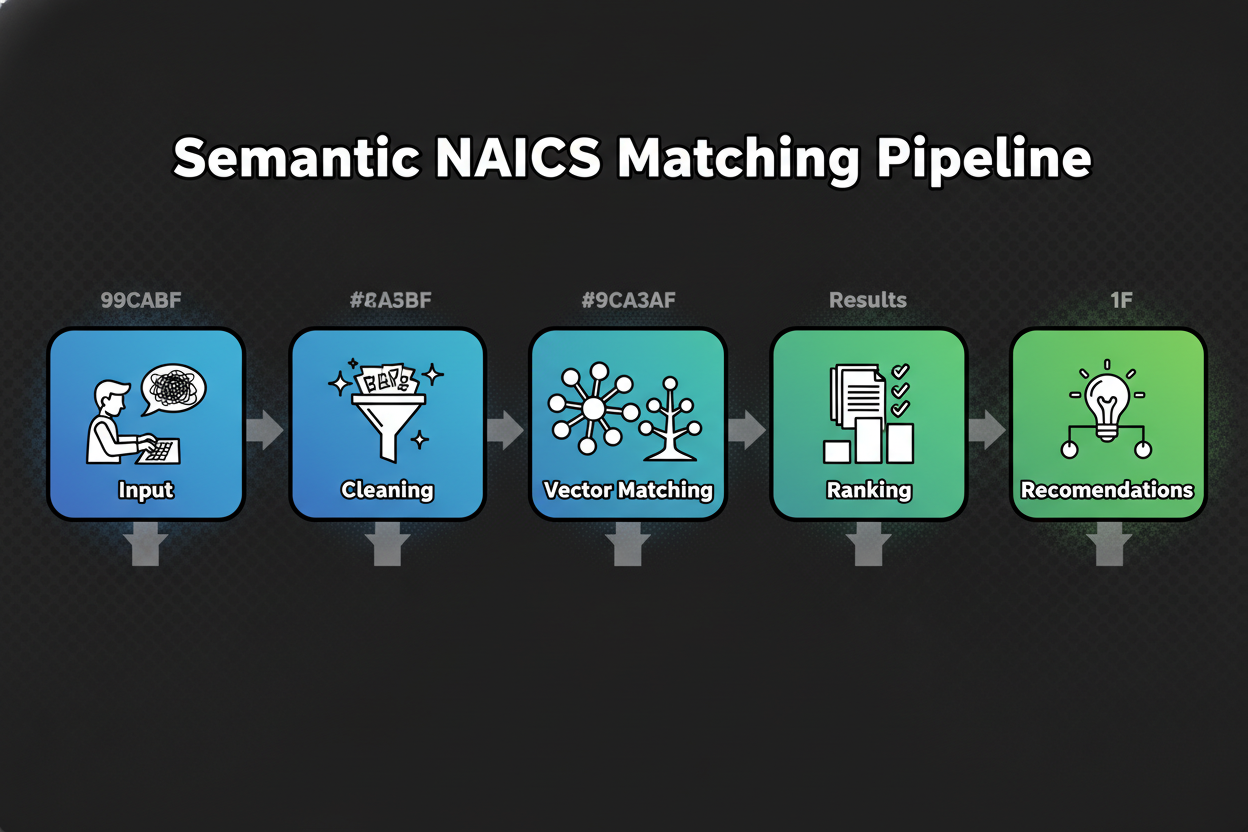
    Left-to-right flowchart: user text input -> text cleaning -> meaning-based vector matching across the NAICS taxonomy -> top matches -> confidence ranking -> final recommendations with related industries

    Privacy-by-design sits at the core of the experience. Your description is processed to return suggestions. The tool does not sell your text. Aggregated, anonymized usage data may be used to improve matching quality. You can revisit or revise your input at any time. For retention details and deletion options, see the privacy page noted in the product interface.

    Let’s walk through a brief example so you can see the logic in action. Suppose you write: “We design, assemble, and sell custom gaming PCs on our website. Most revenue comes from building systems.” The verbs design and assemble, plus the phrase most revenue comes from building, push the result toward computer manufacturing. The channel on our website is noted, so electronic shopping appears as a related industry. If you change the description to “We resell branded PCs and accessories through our online store,” the verb resell and the phrase online store shift the top match to e-commerce retail, with manufacturing downgraded.

    One more quick case. You enter: “Fractional CMO offering positioning, go-to-market plans, and campaign oversight for B2B startups.” The tool reads consulting and strategy verbs and the customer type B2B. It ranks marketing consulting services first, and shows management consulting as a close neighbor. If you instead mention ad buying and media placement, advertising-related categories move up.

    You’ll see each recommendation with a confidence score and a short explanation of why it matches. That explanation points to the words that mattered, like install, wholesale, or subscription, along with channel and customer clues. It’s transparent and repeatable, which makes audits and internal approvals easier.

    Ready to try it? In the next section, you’ll get a simple formula to describe your business, plus a step-by-step playbook to interpret results, resolve close calls, and validate your final NAICS classification with confidence.

    Step-by-Step Guide: Using the Tool for Accurate Business Classification

    Quick answer: How do I find the correct NAICS code for my business?

    • Describe your main business activity in 1-3 sentences.
    • Enter it into the tool.
    • Review the top result and confidence score.
    • Compare related industries if needed.
    • Validate with your primary revenue activity and official descriptions.

    Great. Now let’s go a level deeper so you can squeeze maximum accuracy from every search. This takes minutes, and the payoff is a rock-solid naics classification you can trust.

    Write a crisp input that speaks the tool’s language

    Start with what you actually do, not your title or brand. Use clear verbs and mention the output, your customers, and how you deliver the work. If you can add your main revenue driver, even better.

    Use this simple formula: “We [do activity] for [customer] by [method/channel], primarily earning revenue from [driver].”

    Here are a few one-liners that work well:

    • “We roast coffee beans for independent cafes and sell wholesale by recurring deliveries, primarily earning revenue from bulk orders.”
    • “We install residential solar panels for homeowners with on-site crews, primarily earning revenue from installation projects.”
    • “We provide marketing strategy consulting to B2B startups via retainers, primarily earning revenue from advisory work.”

    Avoid vague inputs like “coffee business” or “we do solar.” If your first try is very short, the tool will still return candidates, but the confidence ranking will improve a lot when you add activity verbs, customers, channels, and your primary revenue source.

    How to read your results like a pro

    Your output has four parts that matter:

    • Primary recommendation: the top NAICS title and code aligned to your description.
    • Confidence score: a visible indicator of match strength based on meaning, not just keywords.
    • Why this matches: a short explanation calling out the words that drove the match, like install, wholesale, subscription, or e-commerce.
    • Related industries: close neighbors that help you compare edge cases without leaving the page.

    If the top result’s confidence is high and the explanation lines up with your activity and revenue, you’re likely done. If two top results are close, read the “Why this matches” snippets and ask which one fits your primary revenue activity today.

    Mock tool interface showing the entered business description at the top, a primary NAICS recommendation with a prominent confidence score, a short explanation of why it matches, and a sidebar listing two related industries

    Example 1: Coffee roaster vs. wholesaler nuance

    Input: “We roast coffee beans in-house and sell wholesale to local cafes. Limited direct-to-consumer sales online.”

    The tool zeroes in on verbs like roast and sell wholesale. It will typically rank a manufacturing category above wholesale, because roast signals production, and your revenue hint centers on wholesale of your own product. The related industries sidebar often shows coffee wholesaling as a close neighbor if your wholesale volume dominates.

    What if the match feels close but not perfect? Refine to: “Most revenue comes from roasting and packaging our own beans; we wholesale to cafes via weekly deliveries.” That revenue sentence helps the confidence score tilt toward manufacturing. If you instead write: “We buy beans from importers and resell to cafes,” the verb buy plus resell will push the recommendation toward wholesale, and manufacturing will drop or move to related industries.

    Two tiny changes, big impact:

    • Mention if you produce in-house vs. resell. That’s a decisive signal.
    • Call out which activity makes most of your revenue. That breaks ties fast.

    Example 2: Solar installation with the right trade classification

    Input: “We install residential solar panels, provide site assessments, and handle permitting. We don’t manufacture panels.”

    The tool picks up install and permitting, which strongly indicate specialized trade contractors. You’ll usually see an electrical or solar-focused trade contractor code on top, with electrical contractors listed as related industries. The phrase don’t manufacture acts as a negative signal that de-emphasizes manufacturing categories.

    If you also sell panels as equipment, clarify primary revenue: “Most of our revenue comes from installation services; we also resell panels as part of the project.” The tool will still prioritize installation as primary and keep equipment wholesaling or retail in related industries where they belong for documentation.

    Example 3: Consultant using the tool across many clients

    If you’re a consultant, you can standardize classification quickly by applying the same input structure across clients. For each client, gather a one-sentence core activity and a short revenue note. Enter both. Save the top recommendation, the confidence score, and the “Why this matches” text in your working file.

    You’ll move faster and keep auditable notes. When two clients look similar but serve different customers, that detail will be reflected in the explanation. For instance, “advisory retainers for B2B startups” will tilt toward marketing consulting, while “ad buying and media placement for local retailers” can tilt toward advertising services. That clarity saves back-and-forth with finance or compliance teams.

    When to refine your input

    If the confidence score is moderate and the top two recommendations tell different stories, it’s time to refine. Add two kinds of detail:

    • Your primary revenue driver. Spell it out with “most revenue comes from…”
    • Channel and customer. Say online store, storefront, on-site, subscription, B2B, or consumer.

    Keep it simple. One added sentence often lifts confidence and clarifies the winner. If your business model is evolving, write the description that reflects the current state, not what you used to do.

    Handling complex or multi-activity businesses

    Many operations do more than one thing. That’s normal. The rule of thumb is to choose the NAICS code that matches your primary revenue activity, then document secondary or related codes for internal use or for forms that ask for them.

    A bakery that manufactures wholesale and also runs a retail counter should decide based on where most revenue comes from. If wholesale production is the main engine, a manufacturing category is likely primary. Keep retail bakery and electronic shopping as secondary references. If seasons change the split, pick the code that best represents your typical or target mix and re-run your description whenever the balance shifts.

    The tool helps by showing related industries that mirror your edge cases. Use those to sanity-check what’s just outside your primary scope.

    Make your input stronger with the formula

    Here’s that practical sentence again. Use it verbatim and fill in the blanks: “We [do activity] for [customer] by [method/channel], primarily earning revenue from [driver].”

    A few quick fills:

    • “We design and install residential irrigation systems for homeowners with on-site crews, primarily earning revenue from installation projects.”
    • “We provide fractional CFO services to funded startups via monthly retainers, primarily earning revenue from advisory engagements.”
    • “We pick, pack, and ship third-party products for online sellers via our warehouse, primarily earning revenue from fulfillment fees.”

    Each one gives the tool decisive verbs, outputs, customers, and channel. That’s the good stuff for accurate industry classification.

    What the confidence score is telling you

    Confidence blends meaning-based similarity with real-world signals like decisive verbs, revenue hints, customer type, and delivery channel. High confidence means your words clearly map to one category. Medium confidence usually means two categories look similar and you need a revenue or channel clue to tip the scale. Low confidence often means the input is short or generic.

    If you see low confidence:

    • Add a verb that reflects the core activity: manufacture, install, wholesale, retail, consult, manage, repair.
    • Name the output: coffee beans, software, apparel, solar panels, training.
    • Call out the channel: e-commerce, storefront, on-site, subscription.
    • State your main revenue driver.

    Two to three extra details usually lift the score and sharpen the recommendation.

    Interpreting the “Why this matches” explanation

    That short line under the result is more than a nice-to-have. It’s your audit trail. It highlights the words that the tool treated as decisive. If you see it emphasize install and permitting, you know it classified you as a contractor for the right reason. If it emphasizes online store and direct-to-consumer, it’s likely recognizing e-commerce retail.

    When the explanation and your reality diverge, rewrite your input to reflect what you actually do. If you no longer manufacture, say “we do not manufacture.” If you sell only via wholesale, say “we sell only wholesale.”

    Validation checklist

    Use this quick checklist before you finalize your naics classification:

    • Match the description to your primary revenue stream.
    • Compare the “Why this matches” text with your invoices and services.
    • Read the official NAICS title and description for the top result.
    • Review related industries to ensure none fits better.
    • Check a comparable business you know to confirm the direction.

    Bringing it all together

    By now, you know how to write an input that the tool understands, how to interpret the confidence ranking, and how to use related industries to cover edge cases. You also have a simple way to validate the final pick so it holds up in forms, proposals, and research.

    Next up, we’ll put this into action with real-world examples across retail, services, and manufacturing, along with a side-by-side comparison table that shows how inputs translate into accurate NAICS codes and confidence scores.

    Real-World Examples: NAICS Classification in Action

    You’ve seen how the tool thinks. Now see it work in the wild. These examples show how small wording changes can shift your naics classification, and how the confidence ranking and related industries help you land the right code without guesswork.

    Retail: Online boutique selling handmade jewelry

    Input a user might enter:
    “We sell handmade jewelry directly to consumers through our online store. We design pieces but outsource the metal casting. Most revenue comes from online sales.”

    What a manual keyword-only search might suggest and why that can be wrong:
    A keyword search fixates on jewelry and handmade. You’ll likely see Jewelry Stores or Jewelry Manufacturing first. It ignores your channel (online) and the fact that production is outsourced, not your primary activity.

    Tool’s primary recommendation:
    Electronic Shopping (code shown in tool).

    Why this matches:
    Decisive signals are sell directly, online store, and most revenue comes from online sales. Those point to direct-to-consumer e-commerce. Design is present but casting is outsourced, so manufacturing is not the primary revenue driver.

    Related industries and why they appear:

    • Jewelry Stores (code shown in tool) because if you operated a physical storefront, this would be the neighbor.
    • Jewelry Manufacturing (code shown in tool) because some boutiques fabricate in-house. It appears to help you validate edge cases where production becomes primary.

    Services: Fractional CMO and marketing strategy consulting

    Input a user might enter:
    “I provide marketing strategy and fractional CMO services to B2B SaaS startups, including positioning, go-to-market plans, and ongoing advisory retainers.”

    What a manual keyword-only search might suggest and why that can be wrong:
    Keywords like marketing and campaigns can push you toward Advertising Agencies. But there’s no ad buying or media placement here. Another common miss is Management Consulting as a catch-all, which is close but broader than your stated focus.

    Tool’s primary recommendation:
    Marketing Consulting Services (code shown in tool).

    Why this matches:
    The verbs provide, strategy, and advisory retainers, plus the customer type B2B, signal consulting rather than advertising execution. Go-to-market plans and positioning further support a strategy-first consulting scope.

    Related industries and why they appear:

    • Management Consulting Services (code shown in tool) because many fractional executives span general management issues. It shows as a neighbor for easy comparison.
    • Advertising Agencies (code shown in tool) appears if you mention media buying, which would tilt the match in that direction.

    Manufacturing/Hybrid: Custom gaming PCs designed, assembled, and sold DTC

    Input a user might enter:
    “We design, assemble, and sell custom gaming PCs directly to consumers via our website. Most revenue comes from building systems; accessories are a small share.”

    What a manual keyword-only search might suggest and why that can be wrong:
    Keywords sell and website trigger Electronic Shopping or Computer and Software Stores. That misses the decisive verbs design and assemble, and it ignores the statement that most revenue comes from building systems.

    Tool’s primary recommendation:
    Electronic Computer Manufacturing (code shown in tool).

    Why this matches:
    Design and assemble are strong production verbs. The revenue note most revenue comes from building systems is the tie-breaker that elevates manufacturing above retail. The channel is online, but the primary activity is production, not resale.

    Related industries and why they appear:

    • Electronic Shopping (code shown in tool) shows up because you sell via your website. It’s useful for validation if your revenue mix shifts toward resale.
    • Computer and Software Stores (code shown in tool) appears when customers can buy in-person or when retail dominates.

    Contrast: Pure reseller case
    Input:
    “We resell branded PCs and accessories through our online store, no assembly or custom builds.”

    Primary recommendation in this case:
    Electronic Shopping (code shown in tool).

    Why this matches:
    Resell and online store signal retail without production. No assembly is an explicit exclusion cue that pushes manufacturing down.

    Construction trade contractor: Residential solar installation

    Input a user might enter:
    “We install residential solar panels, perform site assessments, and handle permitting. We don’t manufacture panels; most revenue is from installation projects.”

    What a manual keyword-only search might suggest and why that can be wrong:
    Solar panels can trigger manufacturing results or even power generation categories. None of that reflects your on-site installation work with homeowners.

    Tool’s primary recommendation:
    Electrical Contractors and Other Wiring Installation Contractors (code shown in tool).

    Why this matches:
    Install, site assessments, and permitting are contractor verbs. The negative cue we don’t manufacture downgrades production categories. Residential points to household customers, which fits the trade contractor scope.

    Related industries and why they appear:

    • Other Building Equipment Contractors (code shown in tool) can appear for systems installation adjacent to electrical work.
    • Electrical Equipment Wholesalers (code shown in tool) may appear if your input mentions selling components, useful for edge cases where equipment resale grows.

    Professional services/IT: ERP implementation, migration, and training

    Input a user might enter:
    “We help companies implement ERP software, including configuration, data migration, and user training. Most revenue comes from implementation projects; we don’t develop proprietary software.”

    What a manual keyword-only search might suggest and why that can be wrong:
    The word software can push a keyword search toward Custom Computer Programming or Software Publishers. Training may pull you into Computer Training as primary. Both miss that implementation services and systems integration are your core revenue.

    Tool’s primary recommendation:
    Computer Systems Design Services (code shown in tool).

    Why this matches:
    Implement, configuration, and data migration are systems integration verbs. The revenue note puts implementation projects at the center. The phrase we don’t develop proprietary software acts as an exclusion cue against software publishing or heavy programming.

    Related industries and why they appear:

    • Custom Computer Programming Services (code shown in tool) appears if you write custom modules. It’s a close neighbor for projects with significant coding.
    • Computer Training (code shown in tool) shows up due to user training, which is often a secondary service in ERP rollouts.

    Side-by-side view: How inputs become confident recommendations
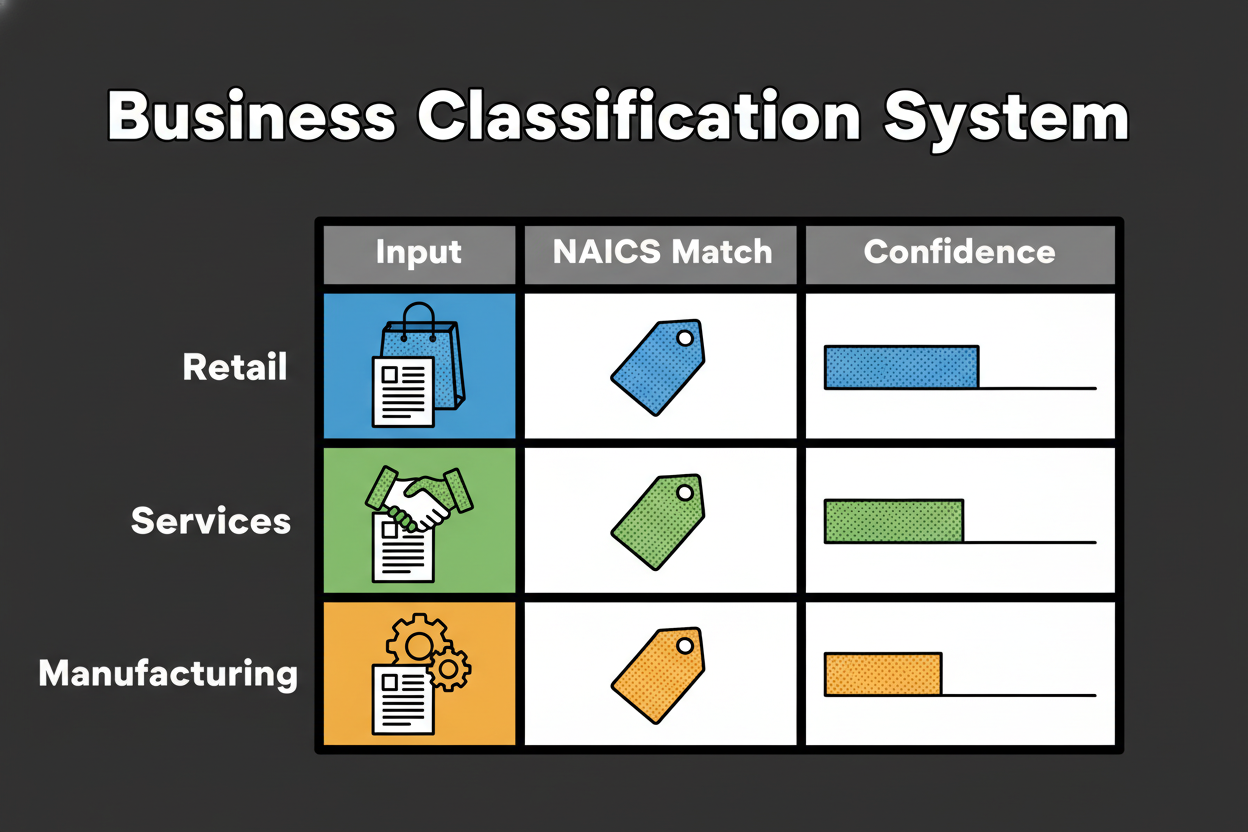
    Table-style graphic with three rows: retail, services, manufacturing. Each row shows the input description, the recommended NAICS title and code, and a confidence score represented by a bar

    Here’s a quick comparison table to make the signals obvious.

    Input description Primary recommendation (title; code shown in tool) Confidence Key signals/Why this matches
    “We sell handmade jewelry via our online store; we design but outsource casting. Most revenue is online DTC.” Electronic Shopping (code shown in tool) High Sell directly, online store, DTC channel; outsourced production lowers manufacturing
    “Fractional CMO providing marketing strategy and advisory retainers for B2B startups.” Marketing Consulting Services (code shown in tool) High Consulting verbs, strategy scope, B2B customers; no ad buying mentioned
    “We design, assemble, and sell custom gaming PCs on our website; most revenue from building systems.” Electronic Computer Manufacturing (code shown in tool) Medium-High Design, assemble, primary revenue from production; online channel noted but not primary activity
    “We install residential solar panels and handle permitting; we don’t manufacture.” Electrical Contractors and Other Wiring Installation Contractors (code shown in tool) High Install plus permitting, residential customers; explicit exclusion of manufacturing
    “We implement ERP software with configuration, migration, and user training; no proprietary development.” Computer Systems Design Services (code shown in tool) Medium-High Implement, configuration, migration; exclusion of software publishing; training as secondary

    What this shows about intent over keywords

    Each case turns on a small set of decisive clues: the activity verb, the revenue driver, the channel, and the customer. A keyword-only search pulls you toward the most obvious noun. The tool reads the whole sentence and ranks by meaning. That’s why online store doesn’t automatically mean retail when you also say design and assemble with production revenue. And it’s why solar panels doesn’t equal manufacturing when you clearly install.

    Benchmark note vs manual classification

    Internal testing will compare the tool’s top-1 and top-3 recommendations against expert-curated codes across a stratified sample of industries [to validate]. The study will also document how often a short refinement like adding most revenue comes from X moves the correct code into the top slot with higher confidence [to validate]. We’ll use these results to continue tuning decisive signals and thresholds.

    Lessons learned

    • Use decisive activity verbs: manufacture, assemble, install, consult, wholesale, retail. They anchor your naics classification.
    • Let your primary revenue driver break ties. If production earns most revenue, manufacturing outranks retail even with an online channel.
    • Channel and customer type matter. Online vs storefront, B2B vs consumer help separate close neighbors fast.
    • Exclusion cues clarify scope. Say “we don’t manufacture” or “resale only” to push incorrect categories down the list.
    • Related industries are your built-in cross-check. Use them to validate edge cases and document secondary activities.
    • Multi-activity businesses should choose by the main revenue activity and keep secondary codes for internal records or specific forms.

    Putting this together, the fastest path to an accurate result is simple: write what you do, who you do it for, how you deliver it, and what pays the bills. The tool will show a clear primary code, a confidence score you can trust, and related industries that make your decision auditable.

    In the next section, we’ll answer the questions users ask most about NAICS codes and the identification tool, including multi-activity scenarios, updates, international use, and how your data is handled.

    Frequently Asked Questions: NAICS Classification and the Identification Tool

    You’ve seen how inputs turn into confident results. Now let’s clear up the questions that come up most when teams finalize a naics classification.
    FAQ accordion styling mock with collapsible questions and short answers, styled in a clean UI panel

    Q: What if my business doesn’t fit a single NAICS code?
    Most businesses do more than one thing. Pick the code that matches your primary revenue activity, then note secondary or related industries for internal use or for forms that specifically ask for them. The tool shows related industries so you can document those edge activities without confusing your primary classification.

    Q: My business has two activities that are equal. How should I choose?
    When the split is truly 50-50, consider your primary growth strategy and typical project mix, then choose the code that best represents how the market sees you. If seasonality flips the mix, select the category that reflects the most common or target state. Keep the second activity as a documented related industry for reference.

    Q: How often are NAICS codes updated, and does the tool stay current?
    The NAICS taxonomy is periodically updated. You don’t need to track changes yourself. The tool maintains the current set of titles and descriptions and refreshes its index so your results reflect the latest language without any extra work on your part.

    Q: Is this tool suitable for international businesses?
    NAICS is a North American industry classification. If you operate outside this region, you can still use the tool to find the closest equivalent activity, then compare that outcome to your local classification system. The meaning-based explanation and related industries help you map across systems with clarity.

    Q: How is my data handled, and is it secure?
    Your description is processed to deliver recommendations and confidence-ranked results. We follow a privacy-by-design approach, do not sell your submitted text, and may use aggregated, anonymized usage data to improve matching quality. For retention and deletion options, review the privacy details provided in the product interface.

    Q: Can I select more than one NAICS code?
    Most organizations choose one primary code. Some forms request multiple codes or additional detail, which is where your secondary and related industries come in. Use the primary for your main identification and keep a short list of secondaries for documentation and specific requests.

    Q: How do I validate my result before using it on forms?
    Compare the top recommendation’s description to your primary revenue activity, then read the “Why this matches” explanation and verify it against your invoices or service lines. Check the related industries to see if any better reflect what actually pays the bills. If your model has changed, rewrite your input to match the current state and re-run it.

    Q: When should I get professional help?
    If your operations are highly regulated, if mergers created a complex multi-entity structure, or if stakeholders cannot align on the primary activity, it can be smart to consult an advisor. Bring your tool results, confidence scores, and explanations to that conversation to make the review faster and more precise.

    Why Accurate NAICS Classification Matters: Compliance, Funding, and Strategic Insights

    NAICS shows up in more places than most teams realize. You’ll see it on registration and reporting forms, vendor onboarding questionnaires, and procurement portals. Researchers and analysts also use naics classification to segment markets, estimate demand, and benchmark competitors.

    Accuracy matters because small differences in language can change how others interpret your business. A production-heavy shop classified as retail might get routed to the wrong vendor category. A contractor classified as manufacturing might miss opportunities that filter for trade services.

    Funding and grants often use NAICS as an eligibility filter. If your code doesn’t match the program’s target segment, your application can be screened out before anyone reads it [to validate]. Insurance and risk pricing can also be influenced by how your activities are labeled. If you pick a category with a different risk profile, you could face mispriced premiums or extra review.

    Strategy benefits too. Clean industry classification feeds better market sizing, competitor sets, and benchmarking studies. If your code is off, it can skew comparisons and lead to the wrong conclusions about share, growth rates, or pricing.

    Here’s a short, realistic story. A small firm that implements ERP systems classified itself under custom programming because it occasionally built connectors. A grant for digital transformation services filtered for systems design and integration, not programming. The application never made it to the next round. After reviewing the actual revenue mix and reclassifying to a systems design category, the firm aligned with future opportunities and moved through vendor onboarding faster. No promises, just a clear path unlocked by accurate labeling.

    So how does the tool reduce risk? It focuses on meaning, not just keywords, and ranks results by decisive signals like activity verbs, revenue drivers, channels, and customer types. It also shows related industries, which act like a built-in second opinion. And it nudges you to validate by comparing the recommendation to your primary revenue stream and official descriptions. Those checks help you avoid common pitfalls where similar-sounding categories describe very different economic activities.

    If you want a quick mental model, think of NAICS as the label others use to route you correctly. Getting the label right saves back-and-forth, avoids misfits in databases, and increases your odds of landing on the right lists for grants, RFPs, or vendor approvals.
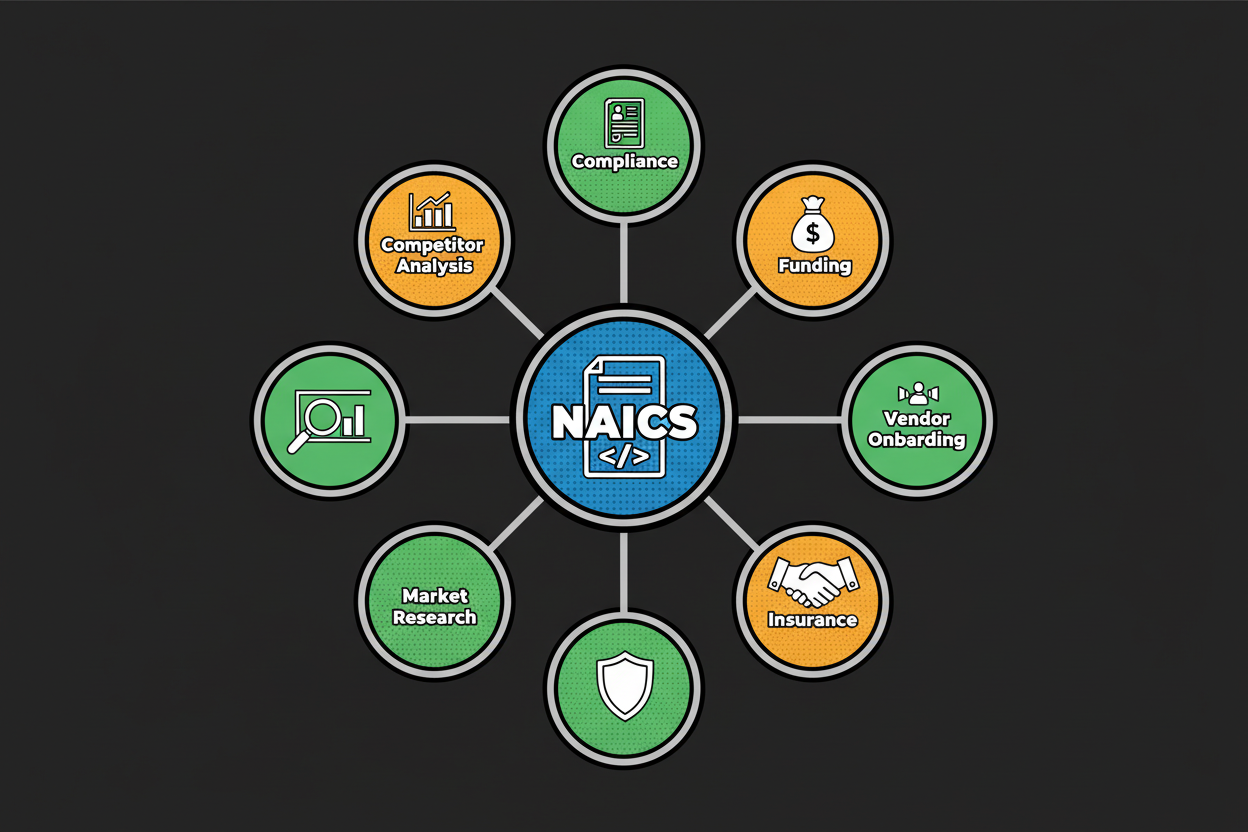
    Circular infographic centered on 'NAICS code' with radiating spokes labeled 'Compliance forms', 'Funding and grants', 'Vendor onboarding', 'Insurance and risk', 'Market research', 'Competitor benchmarking'

    To make this practical, keep these points in mind:

    • Classify by what primarily generates revenue, not by what sounds most prestigious.
    • Use channel and customer signals to separate close neighbors.
    • Add explicit exclusion language if you do not perform a common related activity.
    • Re-run your description when your business model evolves.
    • Document secondary codes for forms that request more detail.

    A final note on metrics: several organizations publish statistics about how often NAICS is requested on applications and how many businesses misclassify themselves. We will include vetted figures once sourced [to validate]. The core guidance here remains evergreen, with or without specific percentages.

    Get Started: Instantly Identify Your NAICS Code with Confidence

    You’re one step away from clarity. Classifast turns your plain-language description into a confident, audit-ready naics classification in seconds. You get a ranked primary recommendation, a clear “Why this matches” explanation, and related industries to double-check edge cases.

    Here’s the simple plan. Write one to three sentences using the formula on this page, paste it into the tool, and review the top match and confidence score. If two results are close, use your primary revenue activity as the tie-breaker and scan the related industries for sanity-checking. Save the output for your records so you can reuse it on forms, vendor portals, and grant applications.

    If you help multiple clients, run each description through the tool, and keep the confidence score with a short note about decisive signals. That creates a repeatable process your finance or compliance team can trust.

    “Classifast gave us a precise code and the reasoning behind it. We finished vendor onboarding in one pass and saved hours of guesswork” [to validate].
    Prominent call-to-action section with a large input box, a 'Find My NAICS Code' button, and trust badges below indicating privacy, reliability, and support

    Try it now. Enter your description, get your code, and move on with confidence. Bookmark this page so you can re-run your input as your business evolves, and share it with colleagues who need a faster, clearer way to classify their work.

    Key Takeaways

    • Write a strong input using clear verbs, outputs, customers, and channel.
    • Choose your primary code by the main revenue activity, not by title.
    • Use related industries to validate edge cases and document secondaries.
    • Read the “Why this matches” explanation to confirm decisive signals.
    • Add exclusion cues like “not manufacturing” to push wrong categories down.
    • Sanity-check against official descriptions and your invoices before filing.

  • Practical guide to NAICS (and SIC) codes

    Practical guide to NAICS (and SIC) codes

    Table of Contents

    Introduction: The Importance of Accurate Business Classification

    Picture this. You run a growing services firm. You register on SAM.gov, pick a NAICS code that sounds right, and start pursuing federal work. Later, you find out a critical opportunity is off-limits because your code ties to a size standard you can’t meet. You weren’t too big for your industry. You were simply in the wrong industry on paper. The lost time, the rework, the missed bid cycle – it hurts.

    Misclassification rarely causes a fire drill on day one. It shows up at important moments. A banker asks for your industry code during underwriting. A contracting officer assigns a NAICS you don’t expect. An OSHA recordkeeping rule applies (or doesn’t) based on how you’re classified. Or your tax preparer needs your principal business activity code. Each touchpoint depends on accurate NAICS and, in some contexts, SIC. Getting this right ahead of time saves you from delays, ineligibility, and avoidable admin costs [reference:5][reference:6][reference:10][reference:9][reference:12].

    NAICS stands for North American Industry Classification System. It’s how U.S. federal statistical agencies describe industries in a consistent, production-oriented way. NAICS covers 20 broad sectors and over 1,000 industries at the detailed national level. Agencies use it to organize data, and many business processes reference it as well [reference:1][reference:4].

    SIC stands for Standard Industrial Classification. It’s the older system that still appears in specific places like SEC filings and some legacy databases. You won’t use SIC daily if you’re focused on modern compliance, but you’ll still see it enough to matter, especially in financial reporting and historical analysis [reference:7][reference:8].

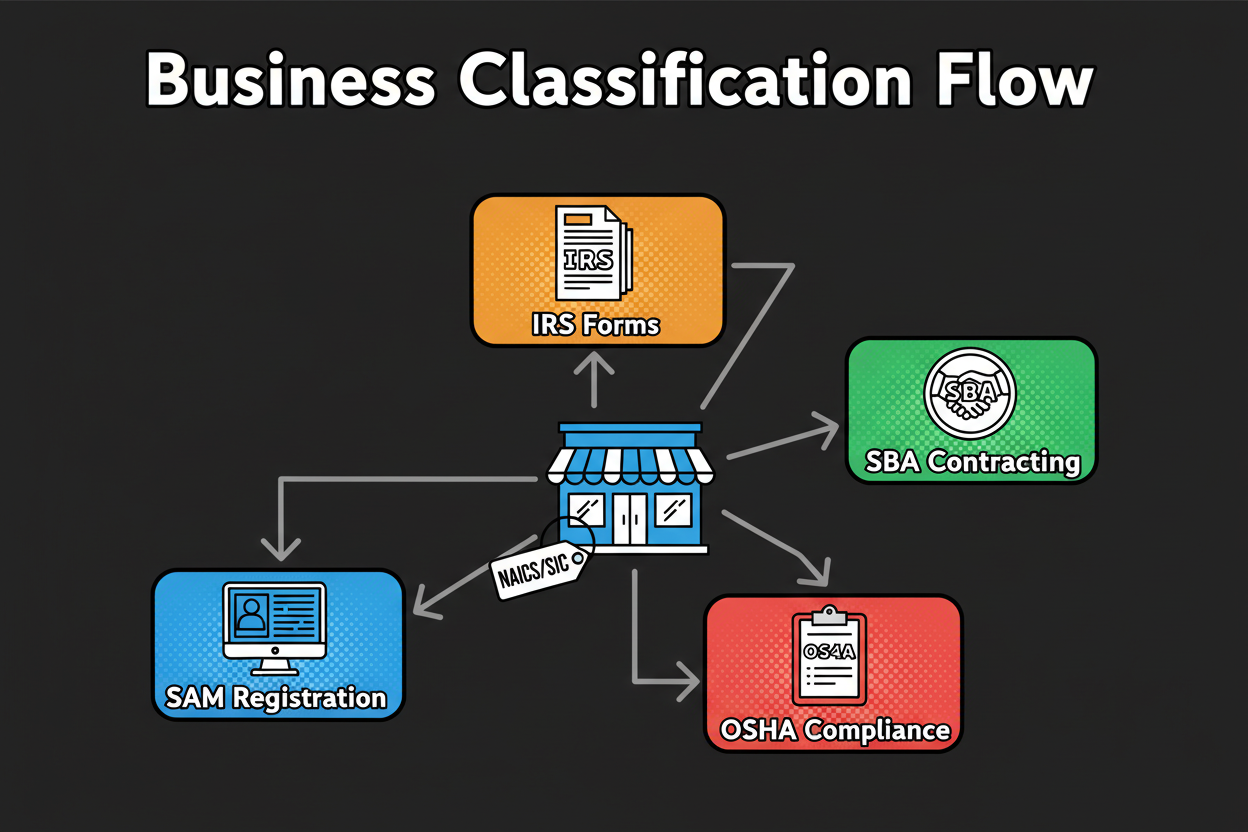
    Here’s why NAICS and SIC Code Identification matters to you. The IRS asks for a principal business or professional activity code that aligns with NAICS when you file returns. The SBA ties small-business eligibility to NAICS-based size standards, which can open or close doors in federal contracting. OSHA bases some recordkeeping exemptions on NAICS categories. And SAM.gov requires NAICS for entities pursuing federal awards [reference:9][reference:5][reference:6][reference:10][reference:12].

    Illustrated flow: a central business icon connected to IRS tax form, SBA contracting badge, OSHA clipboard, SAM.gov registration screen; each node labeled with where NAICS/SIC is used

    • IRS – principal business activity code on tax filings aligns with NAICS [reference:9]
    • SBA – small-business size standards and eligibility linked to NAICS [reference:5][reference:6]
    • OSHA – partial recordkeeping exemptions depend on NAICS classification [reference:10]
    • SAM.gov – federal registration requires NAICS for awards and opportunities [reference:12]

    Let’s make this practical. A consulting firm we worked with selected a code that matched a side service, not their main revenue generator. The result: they showed up as “other than small” for key solicitations because the size standard on that code didn’t fit their true business model. After revisiting their primary activity and checking the SBA size standards tied to the right NAICS, they corrected their profile and regained access to small-business set-asides they were genuinely eligible for [reference:5][reference:6][reference:11].

    In this guide, you’ll learn what NAICS and SIC are, how they differ, and how to identify the correct codes for your business the first time. You’ll get a simple step-by-step process, examples, and best practices you can reuse. We’ll also cover advanced scenarios, like multi-activity companies and evolving business models, so you can manage your codes with confidence.

    Now that you see where classification shows up in your business systems, let’s demystify the codes themselves.

    Understanding NAICS and SIC Codes: Fundamentals and Key Differences

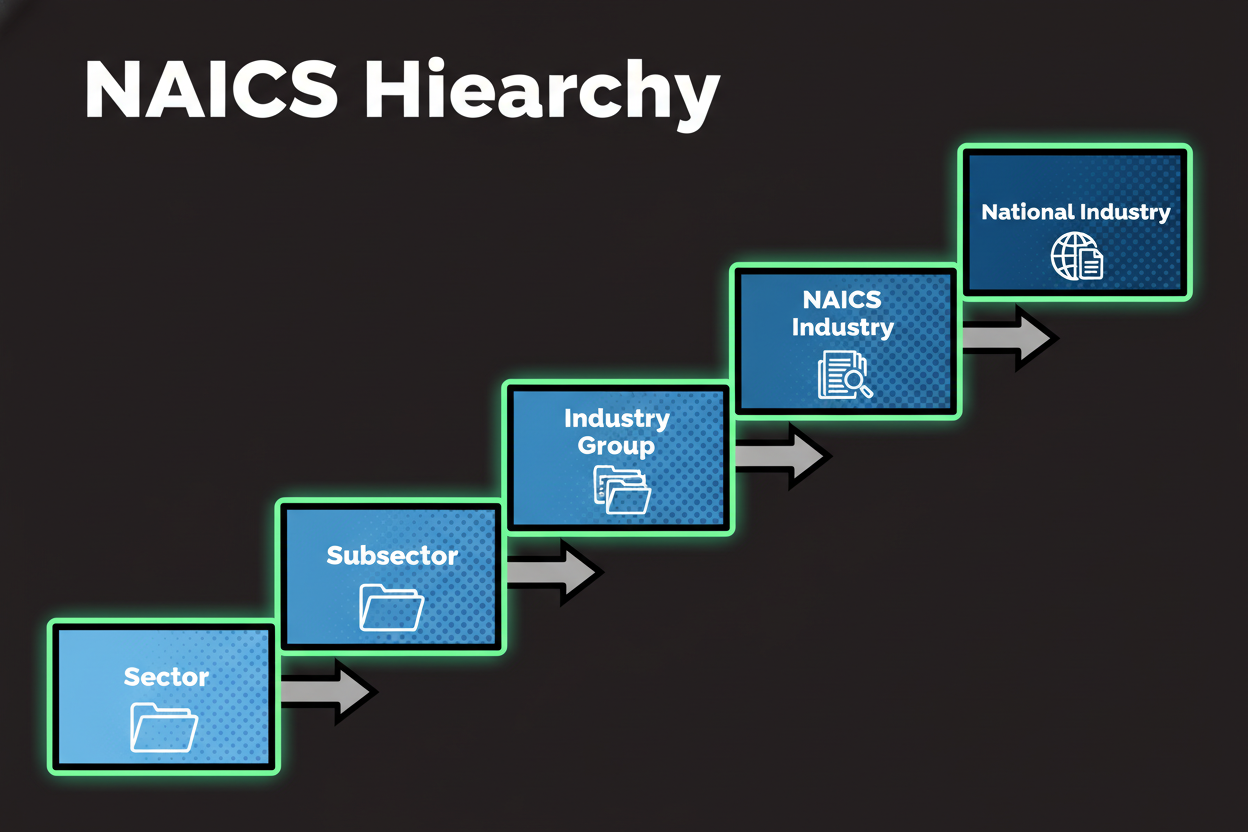
    NAICS is a structured, production-oriented system. It organizes industries from broad sectors down to detailed national industries. The hierarchy runs from 2-digit sectors to 6-digit industries. It’s designed to reflect how goods and services are produced, not just how they’re sold or marketed. That’s why the official definitions include example activities, inclusions, and exclusions. The goal is clarity about what the industry actually does, not just its label [reference:1][reference:2].

    SIC is the predecessor system. It uses 2 to 4 digits and appears in SEC filings and certain legacy datasets. Even though NAICS is the standard for most federal statistical purposes, SIC remains a fixture in capital markets and historical analyses. If you deal with investor relations, public filings, or older data warehouses, you’ll encounter SIC and might need to reconcile it with NAICS [reference:7][reference:8].

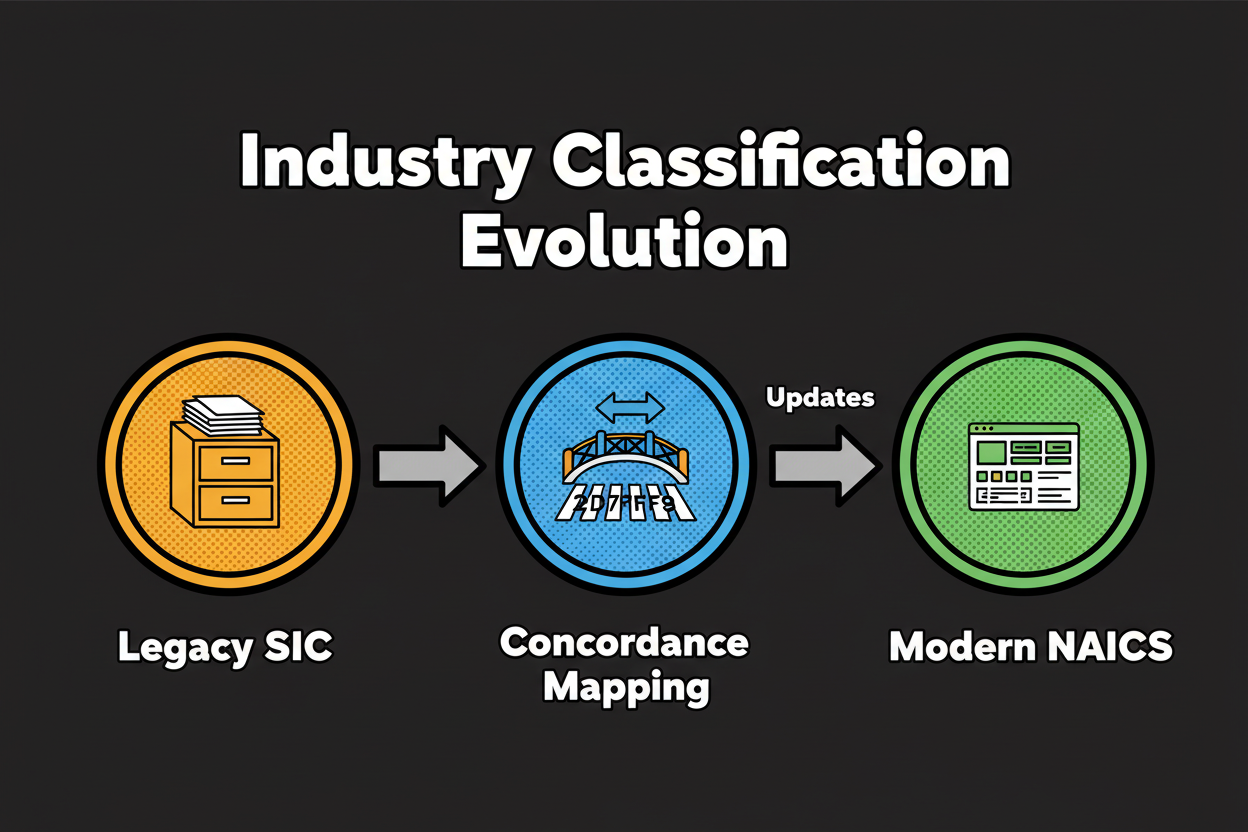
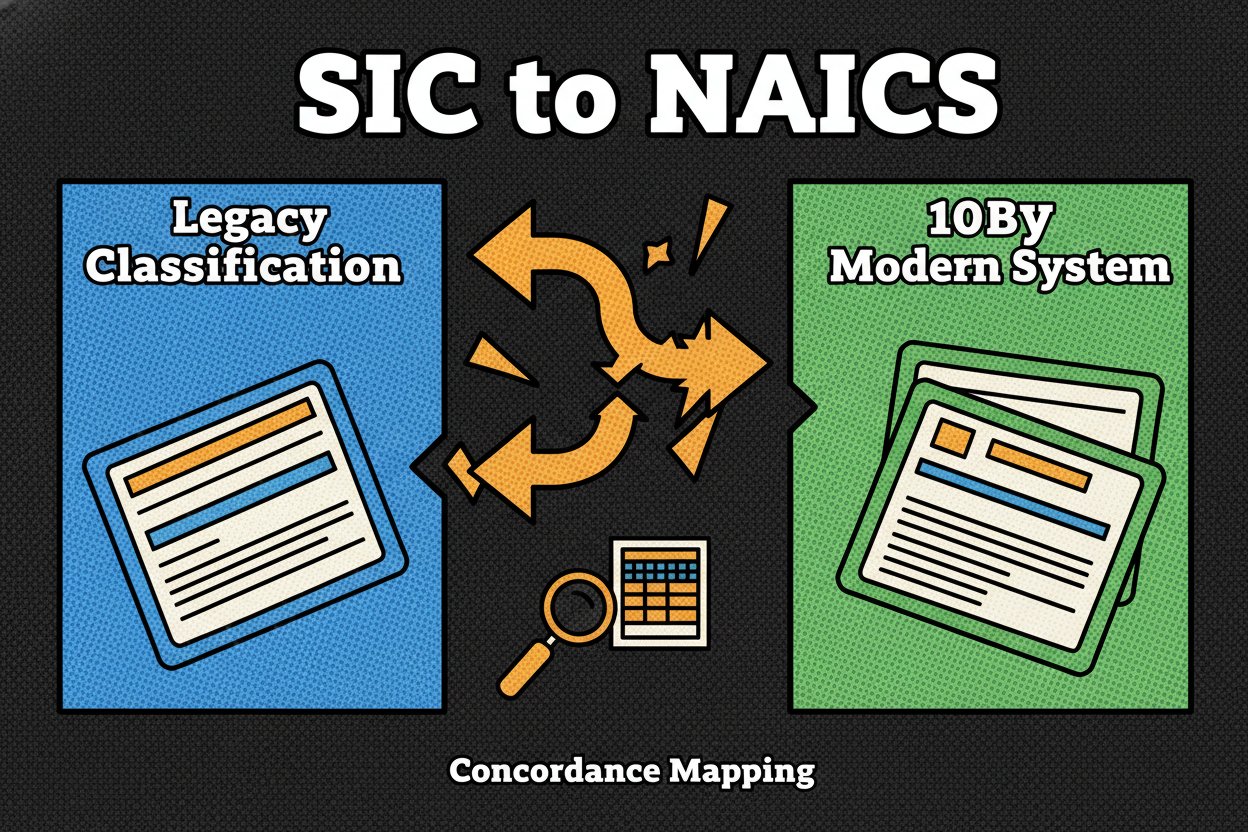
    When you need to bridge systems, concordances are your friend. The Census Bureau publishes official crosswalks that map SIC to NAICS and connect older NAICS versions to newer ones. Concordances let analysts and compliance teams compare apples to apples across data sources and time periods. If your CRM or finance system still stores SIC and your compliance workflows run on NAICS, concordances help you translate without guesswork [reference:3].

    Simple staircase diagram: 2-digit Sector → 3-digit Subsector → 4-digit Industry Group → 5-digit NAICS Industry → 6-digit National Industry, with an example path highlighted

    Horizontal timeline with three labeled points: Legacy SIC → Transition with Concordances → Modern NAICS; arrows indicate mapping and updates

    Feature NAICS SIC
    Digit length 2 to 6 digits 2 to 4 digits
    Orientation Production-based; detailed national industries Older structure; broader groupings
    Primary U.S. use Federal statistics, contracting, SBA size standards SEC filings; some legacy systems
    Official lookup Census NAICS search and definitions SEC SIC list; OSHA SIC manual
    Crosswalks Official concordances available Map to NAICS via concordances

    [reference:1][reference:3][reference:7][reference:8]

    What is the difference between NAICS and SIC codes?
    NAICS is a modern, production-oriented system with 2 to 6 digits used by most U.S. agencies for statistics, contracting, and size standards. SIC is an older 2 to 4 digit system still used in contexts like SEC filings and some legacy databases. Use NAICS for most government reporting and SIC when a specific system requires it. [reference:1][reference:7][reference:8]

    A few specifics make the distinction concrete. NAICS definitions include example activities and exclusions, helping you avoid look-alike industries that sound similar but operate differently. NAICS covers over 1,000 detailed national industries, offering finer granularity for analysis and reporting. By contrast, SIC groups are broader, which is why two companies that look identical in a modern market can fall into the same SIC but different NAICS codes based on how they produce value [reference:1][reference:2][reference:7].

    Mini-example: A craft beverage company makes and sells its own product in a tasting room. Operationally, its primary activity might be beverage manufacturing under NAICS, not retail. But in SEC-style comparisons using SIC, it could be grouped with a broader beverage or consumer category. To reconcile across datasets, the company uses the official concordance to map its SIC reference to the appropriate NAICS for internal reporting [reference:3][reference:7][reference:1].

    • NAICS is production-based, so choose codes by what you primarily produce or deliver, not just where you sell [reference:2]
    • SIC still appears in SEC filings and some compliance tools, so keep a crosswalk handy [reference:7][reference:8][reference:3]
    • NAICS has deeper detail at 6 digits, which supports analytics and size-standard checks [reference:1][reference:6]
    • Official NAICS definitions include examples and exclusions – read them fully before deciding [reference:1]
    • Use concordances to translate SIC to NAICS or align older NAICS versions with your current records [reference:3]

    With the fundamentals in place, here’s a precise method to identify the right code the first time.

    How to Identify the Correct NAICS and SIC Codes for Your Business

    How do I find my NAICS code?
    Use the official Census NAICS search, enter your core products or services, open candidate 6-digit industries, read full definitions and example activities, and select the code that best matches your primary revenue-generating activity. Document your rationale and check SBA size standards [reference:1][reference:2][reference:6].

    Start with how classification works. NAICS is assigned at the establishment level – a single location where business is conducted. Your primary activity is the one that accounts for the largest share of production or revenue. If your company has multiple establishments, each location can have its own primary NAICS based on what it actually does day to day. That’s why it’s common for a diversified enterprise to carry more than one NAICS across its footprint, even though each establishment has one primary code [reference:2].

    The fastest path is through the official Census NAICS website. Use the search tool, try a few different keywords for your main products or services, and open the candidate industries. Don’t stop at the title. Read the full definition. Look at the example activities and any explicit exclusions. Cross-references often point you to a better fit you didn’t think to search for initially [reference:1].

    If federal contracting is in scope for you, pull up the SBA Table of Size Standards for the chosen NAICS. Confirm which metric applies – average annual receipts or number of employees – and note the threshold. This helps you anticipate your small-business status for solicitations that carry that NAICS and size standard. Remember, contracting officers assign one NAICS per solicitation, and SBA eligibility hinges on that assignment and the corresponding threshold [reference:6][reference:5][reference:11].

    Some systems still ask for SIC. When that happens, use the SEC’s official SIC list or OSHA’s SIC manual. If you only know your NAICS, use the Census concordance to identify the best SIC analog. If you only know your SIC, map to NAICS using the same crosswalks, then validate by reading the target NAICS definitions and examples [reference:7][reference:8][reference:3].

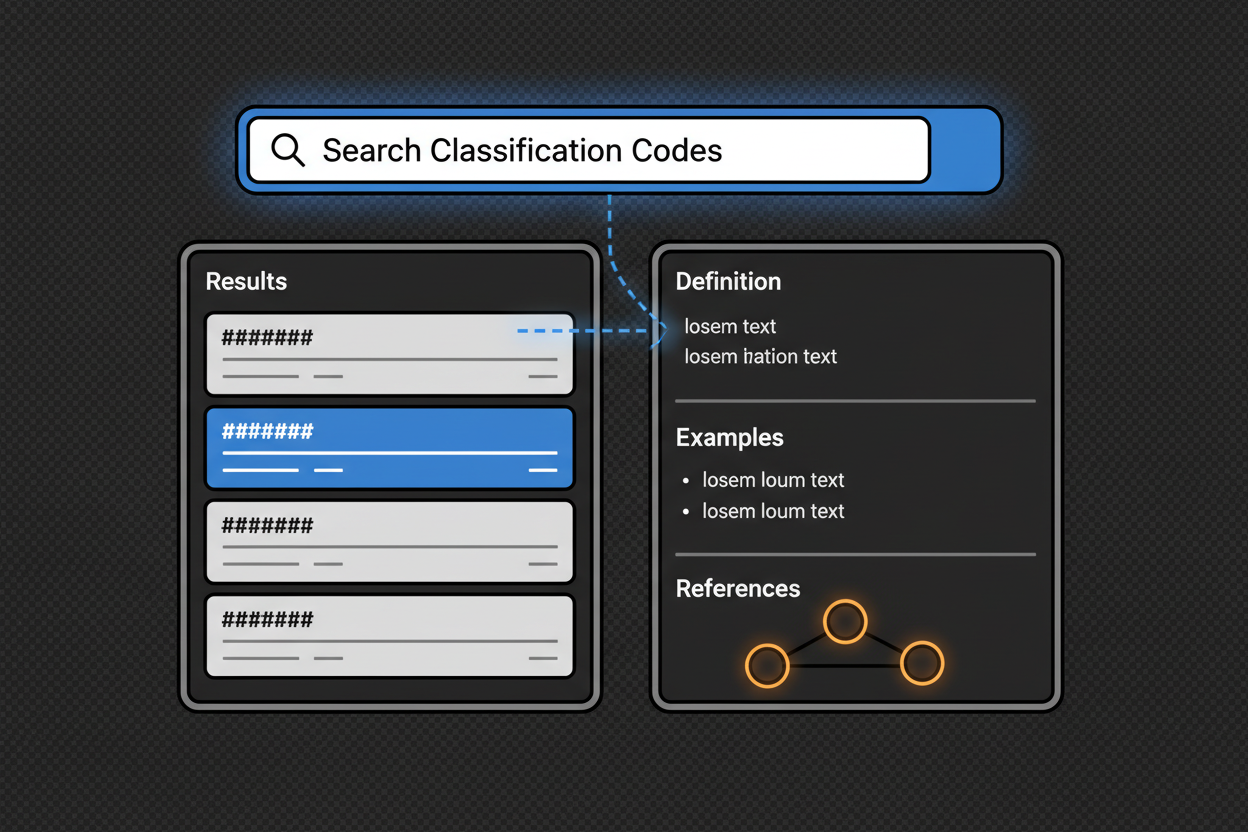
    Mock search interface: search bar with keyword entry, results list with 6-digit codes, side panel showing full definition, example activities, and cross-references highlighted

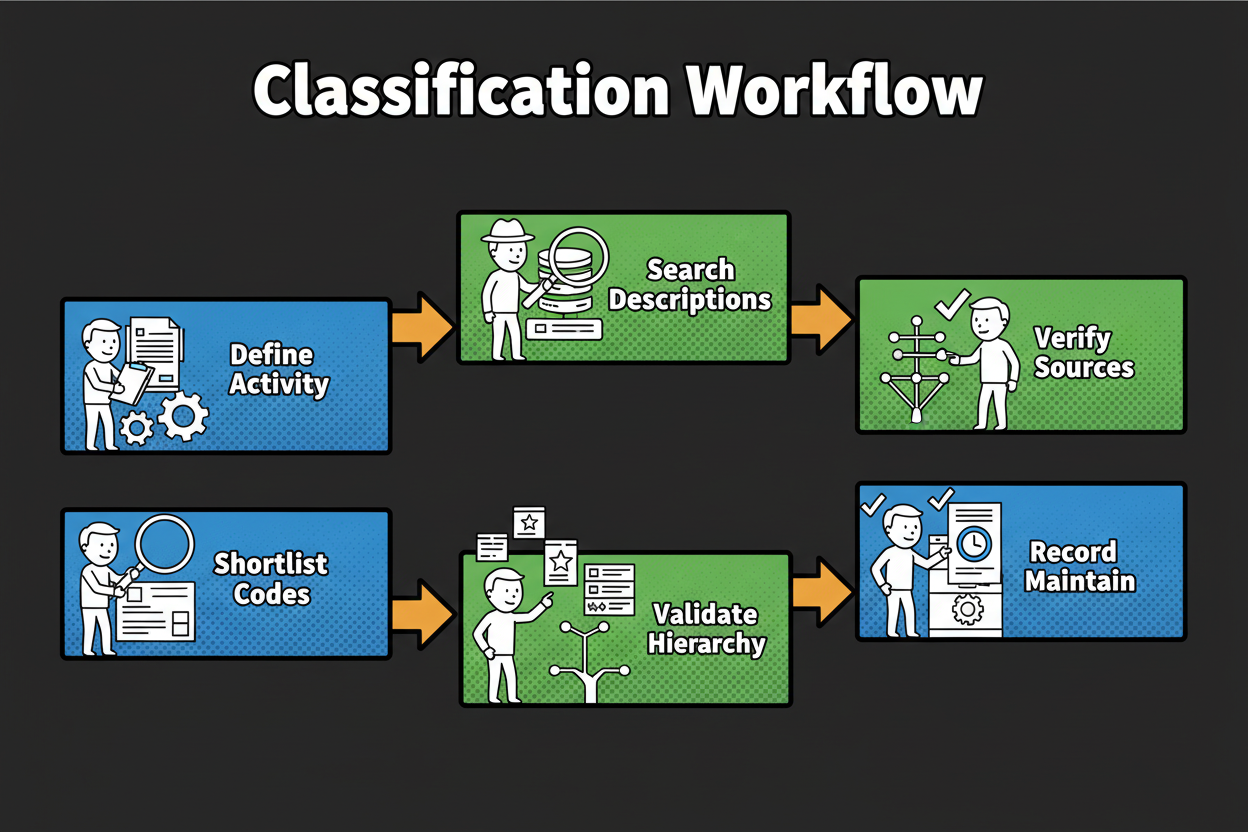
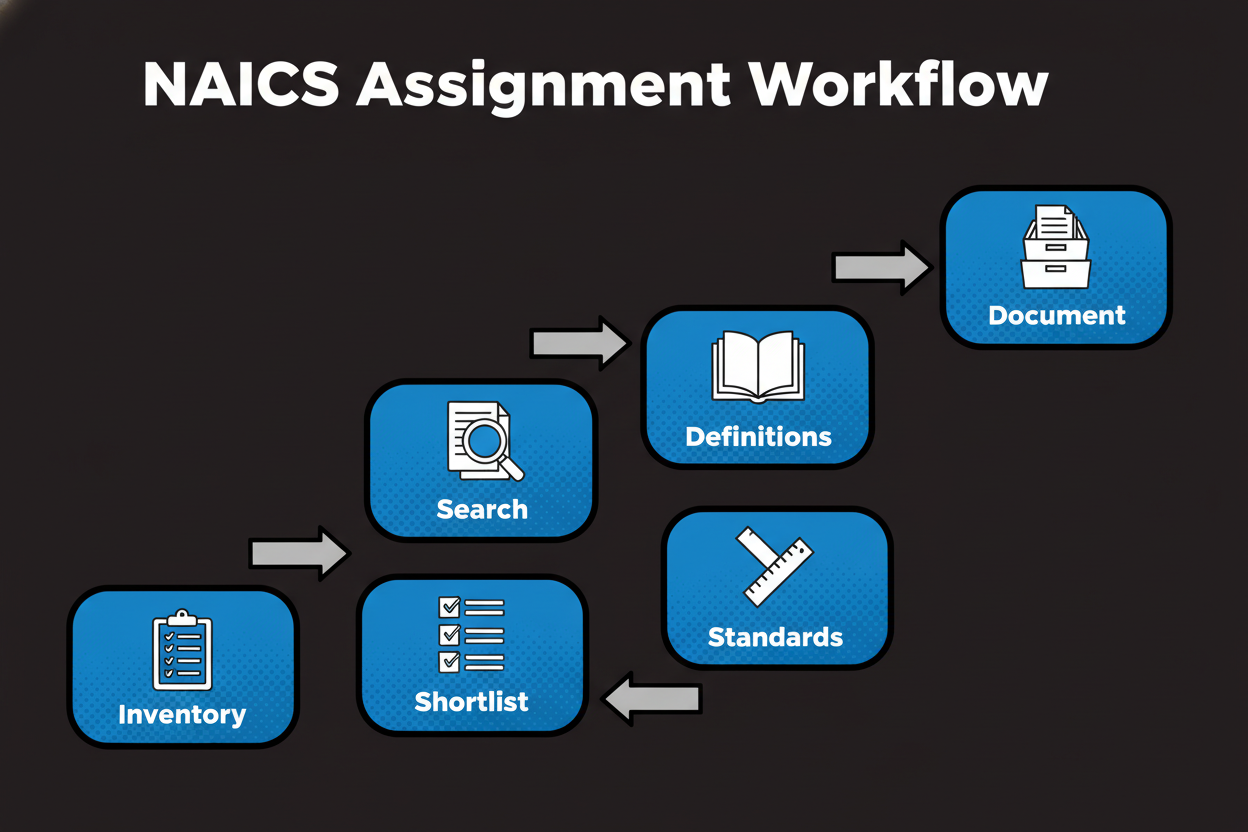
    Numbered flowchart with six nodes: Inventory Activities → Keyword Search → Read Definitions → Shortlist Codes → Check SBA Size Standards → Document and Update Records

    • Inventory your activities and revenue mix per establishment – identify the primary revenue-generating activity [reference:2]
    • Use the official Census NAICS search – test multiple keywords and synonyms for your core offerings [reference:1]
    • Open full 6-digit definitions – read examples, inclusions, and exclusions; follow cross-references to better fits [reference:1]
    • Shortlist 2-3 candidates and document why you accept one and reject others; keep links or screenshots for your file [reference:1][reference:2]
    • Check SBA size standards for your chosen NAICS if you plan to bid, partner, or certify as small; note the metric and threshold [reference:6][reference:5]
    • If a partner or form requires SIC, look it up via SEC or OSHA and crosswalk it to NAICS using official concordances [reference:7][reference:8][reference:3]
    • Update your records consistently – IRS principal activity code, SAM.gov profile, and any state or lender forms should match your chosen NAICS [reference:9][reference:12]

    Mini walkthrough: Say you’re a marketing agency. You list services: campaign strategy, media buying, SEO, creative production. You check revenue – maybe 60 percent comes from campaign management and media buying. In the Census NAICS search, you test “advertising,” “media buying,” and “marketing services.” You open several 6-digit options, then read definitions to see which one covers your primary activity and includes example activities that mirror your work. You note two alternates that sounded right but exclude media buying as a primary service. You choose the best-fit NAICS, then open the SBA size standards table to confirm the receipts or employee threshold you’d face in solicitations carrying that code. You document the rationale and update SAM.gov and your internal records accordingly [reference:1][reference:6][reference:12].

    Two practical guardrails keep you out of trouble. First, don’t pick a code to game SBA size standards. The regulation expects the NAICS to reflect the principal purpose of the work described in a solicitation, and misalignment can create eligibility issues and credibility concerns [reference:6][reference:11]. Second, your NAICS code on tax filings helps the IRS understand your business activity and for statistical purposes, but it does not determine how much tax you owe. Choose it to reflect reality, not to change your tax bill [reference:9].

    Once you’ve selected a code, managing it over time is just as important. If your revenue mix or operations shift, revisit your classification with the same disciplined process and update your systems so everything stays in sync.

    Advanced Strategies: Managing Codes for Multi-Industry and Evolving Businesses

    Once your code is set, the real work starts: keeping it accurate as your business changes. The NAICS rules classify at the establishment level, not only the enterprise. Each location has one primary activity based on the largest share of production or revenue. Secondary activities can be noted internally, but the primary code should follow where most value is created at that site [reference:2].

    Two practical ways to weight activities are revenue share and value added. Revenue share is straightforward: if one activity consistently drives the majority of sales, it likely anchors your primary NAICS. Value added is useful when internal transfers or bundled offerings distort top-line revenue. NAICS guidance supports using the measure that best reflects actual production for the establishment [reference:2].

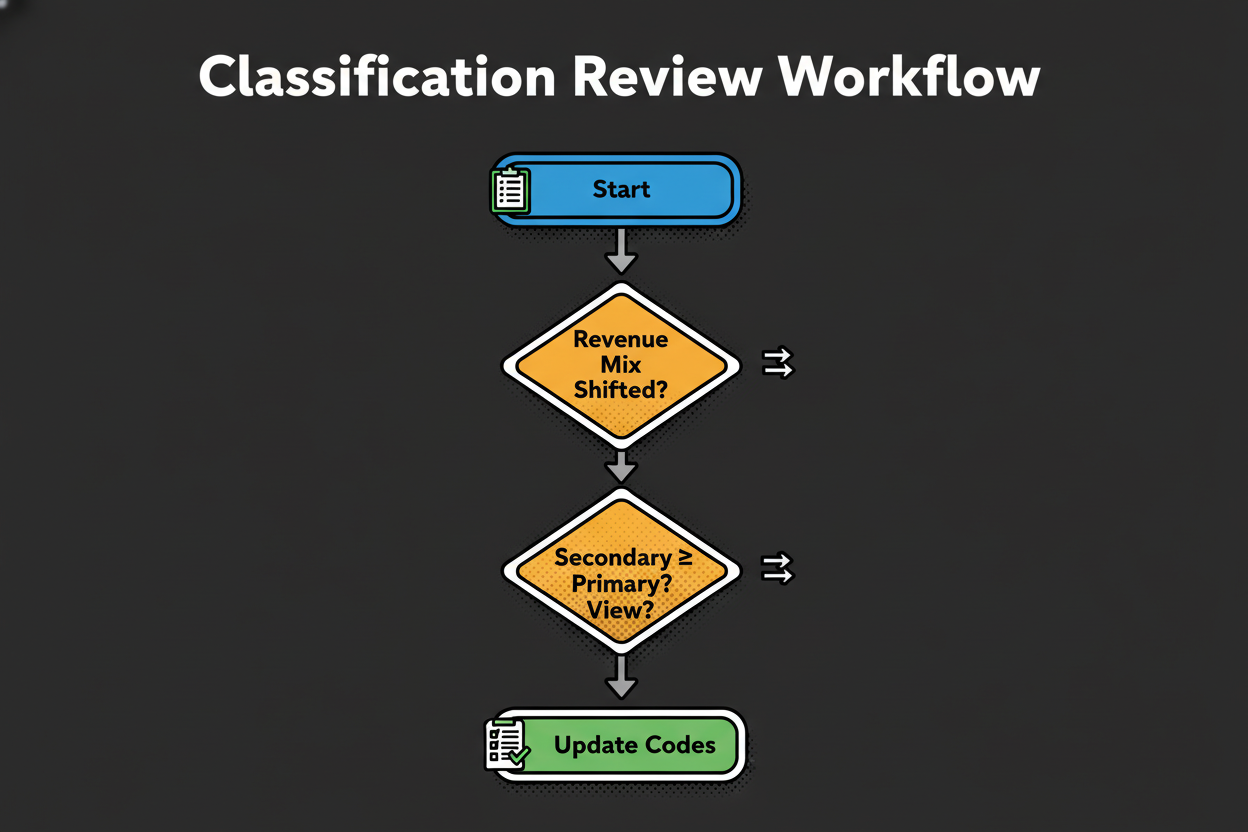
    When should you update your primary NAICS? Look for material shifts. If a new line grows from 30 percent to 55 percent of an establishment’s revenue for sustained periods, it’s a strong signal to reclassify. New product launches, reorganizations that move production between locations, or a spin-up of a new facility are other clear triggers. The test is simple: does the primary activity, by revenue or value added, still match your current code [reference:2]?

    Decision tree: Start → Has revenue mix shifted? → Are secondary activities ≥ primary? → Establishment-level view? → Update primary or add secondary codes → Revise registrations

    Federal contracting adds a layer you can’t ignore. You can list multiple NAICS in your SAM.gov entity registration to reflect your capabilities. But each solicitation carries one assigned NAICS and a single SBA size standard that governs who is “small” for that opportunity. If an assignment seems off, review the statement of work, compare it to NAICS definitions, and submit a timely question to the contracting officer as allowed by the procurement rules. The regulation directs that one NAICS be assigned per solicitation and provides the framework for these determinations [reference:12][reference:11].

    Hybrid and evolving models benefit from careful reading of definitions. SaaS often aligns with software publishing when your primary activity is producing and monetizing a standardized software product. Custom software projects may align with services-oriented development. Hosting and infrastructure can fall elsewhere. The right choice depends on what you primarily produce, not the marketing language on your site. The official NAICS definitions and cross-references will point you to the best fit if you read them fully [reference:1][reference:2].

    E-commerce versus brick-and-mortar retail is another common fork. If your establishment’s core activity is retailing goods online, classification follows retail rules applicable to electronic shopping. A physical store with on-site sales typically sits in the relevant retail trade category. If you’re a marketplace, definitions and cross-references may point to a different area than a first-party retailer. Always match the definition to what the establishment actually does day to day [reference:1][reference:2].

    As your data spans systems, use concordances to maintain continuity. The Census Bureau publishes official crosswalks that map SIC to NAICS and connect older NAICS versions to newer ones. Build a simple internal mapping table that lists your historical codes and their current equivalents, with links to official definitions. It keeps BI dashboards, finance, and compliance speaking the same language over time [reference:3].

    Side-by-side list: Left column a sample SIC code with description; right column one or more NAICS codes with short descriptions; arrows indicating mapping via concordance

    Case study: A services firm opens a product unit and launches a subscription software tool. At the headquarters establishment, services once represented 70 percent of revenue. Within two planning cycles, the software line grows to 58 percent of that location’s revenue and carries the highest value added. The team updates the HQ establishment’s primary NAICS to reflect software production, retains a secondary internal note for professional services, and revisits small-business status using the SBA table tied to the new code. They remain eligible in some sectors but not others, which guides their bid strategy and teaming decisions [reference:2][reference:6].

    The admin side matters too. When you change a primary NAICS, push the update through your core systems: SAM.gov, state registrations, and any lender or grant records. Keep a short memo with your rationale, revenue tables by establishment, links to official NAICS definitions you relied on, and the SBA size standard reference you checked. That file will save you hours later if a partner, auditor, or contracting officer asks for context [reference:12][reference:6][reference:1].

    • Periodic review framework:
    • Review revenue and value-added shares by establishment; flag shifts of 10 percentage points or more
    • Scan official NAICS definitions; use concordances if your historical code’s scope has changed [reference:3]
    • Recheck SBA size standards for your primary codes if contracting is strategic [reference:6]
    • Confirm one NAICS per active solicitation and raise questions early if the assigned code doesn’t match the principal purpose [reference:11]
    • Refresh SAM.gov and align internal and tax-facing records once decisions are final [reference:12][reference:2]

    Complexity invites errors. In the next section, you’ll see the pitfalls the pros avoid and a simple checklist to keep you on track.

    Common Mistakes and How to Avoid Them

    The most common mistake is picking a code because a competitor uses it or it “sounds right.” NAICS selection should follow your primary activity, measured at the establishment level by revenue or value added, not market perception. If your main work is custom services but you choose a publishing code because the label feels modern, you’ll drift away from the official definitions and invite headaches later [reference:2].

    Another pitfall is ignoring the example activities and exclusions inside the definitions. The right title can still be the wrong code if the examples don’t match how you produce value. The official NAICS pages include cross-references that often send you to a better fit in two clicks. Read them. They’re there for a reason [reference:1].

    Some teams are tempted to choose a code to fit a more favorable SBA size standard. That backfires. Contracting officers assign a single NAICS per solicitation, and small-business status is determined against that code’s standard. If you select a code that doesn’t reflect the principal purpose of work or your primary establishment activity, you risk ineligibility or protest exposure. Better approach: align to the true activity and build your pipeline around opportunities where you legitimately qualify as small [reference:11][reference:6].

    Operational consistency matters. OSHA uses NAICS to determine partial recordkeeping exemptions. A misclassification can add reporting burden you don’t need or, worse, cause you to miss required logs. The IRS asks for your principal business or professional activity code on Schedule C and uses it for processing and statistics. Keep your code truthful and consistent across systems. And remember, NAICS doesn’t change how much tax you owe; it classifies your activity, not your liability [reference:10][reference:9].

    Here’s a quick scenario. A firm applied for a small-business set-aside loan program and targeted federal work. They chose a services code with a low receipts threshold and, based on their current revenue, looked “other than small.” After reviewing their actual work, they updated to a more accurate NAICS that better matched their primary activity and fell under an employee-based threshold. That alignment, confirmed against the SBA table, restored eligibility and focused their capture on the right solicitations [reference:5][reference:6].

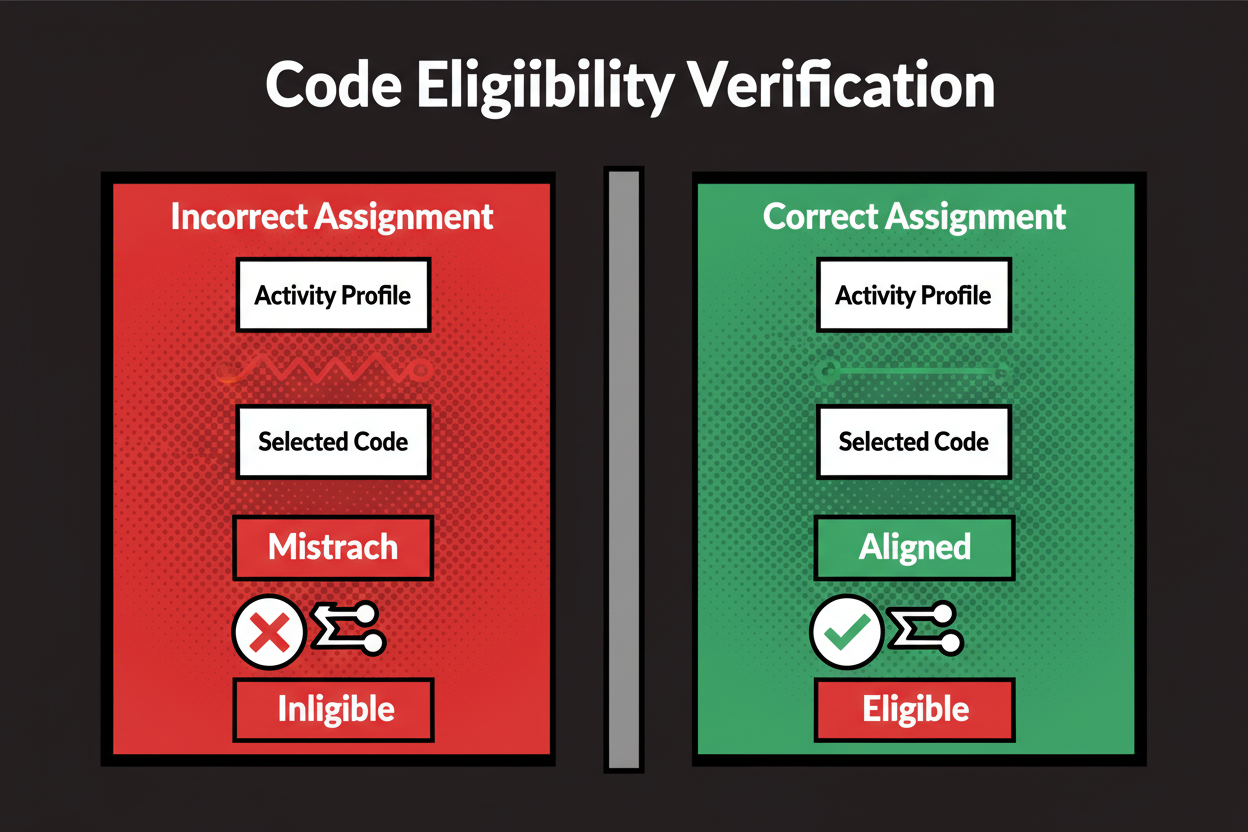
    Split panel: Left 'Incorrect code' shows size standard mismatch and “ineligible”; Right 'Correct code' shows aligned primary activity and “eligible” badge

    Two concrete checks reduce surprises. First, note whether your target size standard is receipts-based or employee-based, because that choice changes your growth runway and reporting prep. Second, bookmark the IRS instructions that ask for the principal business activity code, so your tax team can update it in the next filing cycle without a scramble [reference:6][reference:9].

    • Final validation checklist:
    • Read the full 6-digit NAICS definition, examples, and exclusions before deciding [reference:1]
    • Confirm primary activity at the establishment level by revenue or value added, not brand positioning [reference:2]
    • Verify the SBA size standard for your chosen code and note whether it’s receipts or employees [reference:6]
    • Check OSHA implications, including any partial recordkeeping exemptions tied to your NAICS [reference:10]
    • Align IRS principal activity code, SAM.gov profile, and state records to the same selection [reference:9][reference:12]
    • Write a short internal memo with your rationale, supporting links, and a plan to revisit during annual planning

    Keep this list close. It will save you from last-minute surprises in bids, audits, and filings. Next up, we’ll answer the questions teams ask most so you can keep momentum without second-guessing your choices.

    Frequently Asked Questions About NAICS and SIC Code Identification

    You’ve done the heavy lifting. You understand primary activity, you’ve shortlisted codes, and you’ve sanity-checked size standards. Still, a few practical questions always come up: how to change a code, whether you can have more than one, what to do when an assignment looks off, and how to handle digital models like SaaS or marketplaces.

    Here’s a straight-shot FAQ that mirrors what real teams ask during tax season, SAM.gov updates, and federal bids. Where it helps, we point you to official sources so you can verify in minutes, not hours [reference:1][reference:6][reference:9][reference:11][reference:12].

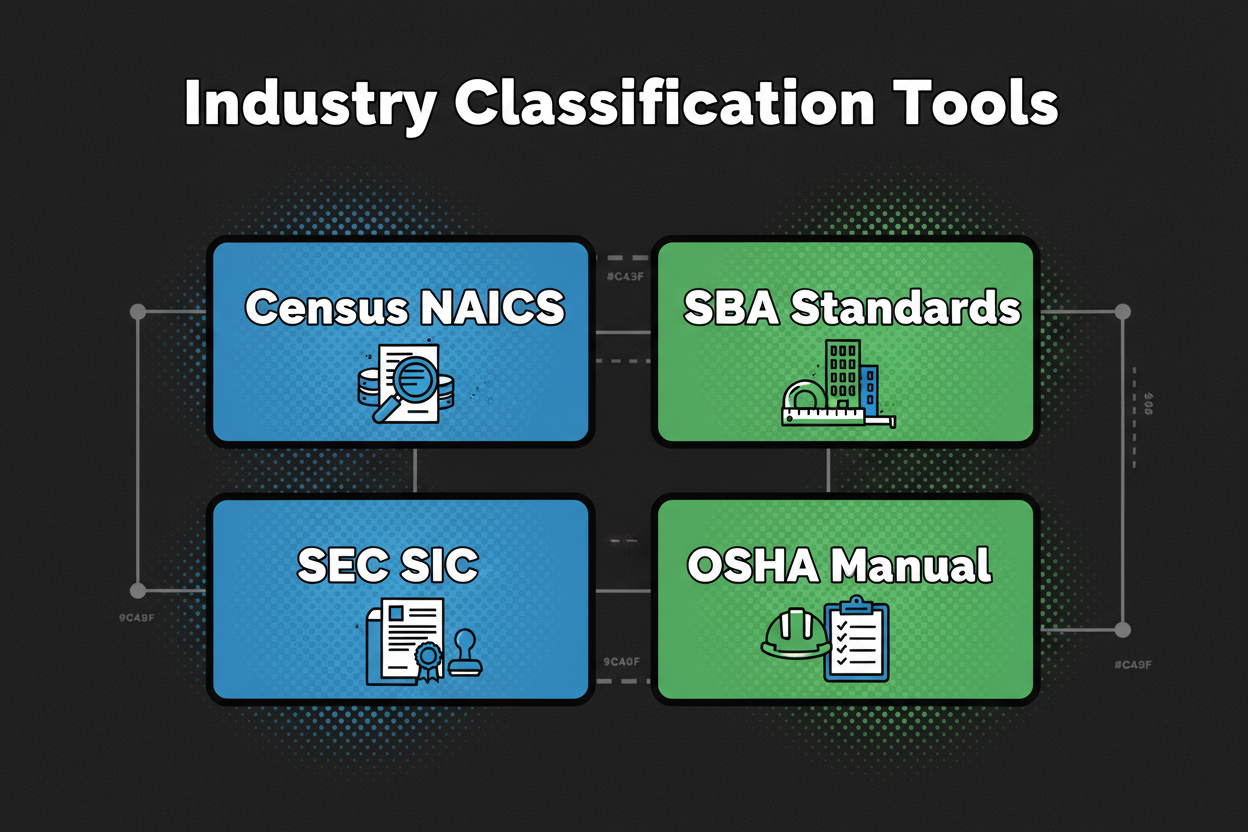
    Grid of four tiles with logos and short labels: Census NAICS Search, SBA Size Standards, SEC SIC List, OSHA SIC Manual

    How do I change my business’s NAICS or SIC code?

    Update your principal business activity code on the next tax filing, adjust your entity profile in government registration portals, and reflect the change in any state or industry systems that store your classification. Keep a short internal memo documenting your rationale and the official definitions you used.

    Changing your code is mostly housekeeping, but do it carefully. Update the IRS principal business activity code in your next filing cycle and match your SAM.gov profile and state records to the same selection for consistency [reference:9][reference:12]. If you operate in multiple states or maintain lender records, mirror the change in those systems too.

    Can a business have more than one code?

    Yes. You can list secondary codes for meaningful lines of activity, but each establishment has one primary code that reflects its main revenue-producing activity. For federal solicitations, a single NAICS is assigned to each opportunity.

    This rule keeps analysis and eligibility simple: one primary per establishment, one NAICS per solicitation. If an RFP’s code doesn’t match the described work, you can ask the contracting officer to review, citing official definitions [reference:2][reference:11].

    What happens if I use the wrong code?

    Misclassification can affect small-business eligibility, safety recordkeeping obligations, and how your data is analyzed. It usually does not change tax owed by itself, but it can cause mismatches and delays. Correct it by selecting the best-fit code based on your primary activity and updating your records.

    Two common symptoms: unexpected OSHA recordkeeping triggers or missed small-business eligibility. Fixing the code and updating your registrations typically resolves both. And again, your NAICS code doesn’t set your tax liability; the IRS uses it for processing and statistics [reference:10][reference:5][reference:9].

    Where can I find official code lookup tools?

    Use the official NAICS search to read full definitions and examples, check small-business size standards by NAICS, consult the SEC SIC list or OSHA SIC manual when a system requires SIC, and use official concordances to map between systems.

    Bookmark these and you’ll save hours in future reviews. The Census NAICS site gives you definitions and examples, the SBA table shows applicable thresholds, and concordances help you translate between systems cleanly [reference:1][reference:6][reference:7][reference:8][reference:3].

    How do I classify SaaS, e-commerce, or marketplaces?

    Choose the code that best reflects your primary activity. Compare definitions for software publishing, custom software services, hosting, retail, or marketplace facilitation. Read example activities and exclusions to confirm the best fit.

    Digital models often span multiple definitions. Read the official NAICS pages in full, paying close attention to inclusions, exclusions, and cross-references. That’s where the right fit reveals itself [reference:1][reference:2].

    Can I challenge a NAICS code in a solicitation?

    Yes. Ask the contracting officer to clarify the assigned NAICS if it does not match the described work. Provide a brief rationale pointing to official industry definitions.

    Time is your friend here. Raise questions during the solicitation window and ground your rationale in official definitions and example activities. Remember, each solicitation carries a single NAICS and the size standard tied to it [reference:11].

    How do I map a SIC code to a NAICS code?

    Use official concordances to identify candidate NAICS codes from a SIC code, then read the NAICS definitions and example activities to pick the best match for your operations.

    This is how you align historical datasets, public filings, and modern operational reporting. Start with the concordance, then validate by reading the NAICS definition end-to-end [reference:3][reference:7][reference:1].

    If you take one thing from this FAQ, let it be this: always read the official definition and examples, then document your reasoning. It protects you when questions arise and keeps your IRS, SAM.gov, OSHA, and contracting workstreams aligned [reference:9][reference:12][reference:10][reference:11].

    Conclusion: Next Steps for Confident Business Classification

    Accurate NAICS and SIC Code Identification isn’t busywork. It shapes your SBA eligibility, your OSHA recordkeeping duties, how the IRS processes your returns, and how contracting officers treat your bids. One thoughtful selection now avoids countless corrections later [reference:5][reference:6][reference:10][reference:9][reference:11].

    Here’s a compact plan you can run this week to lock in a correct, defensible classification.

    • Audit your activities and revenue by establishment; confirm the true primary activity [reference:2]
    • Shortlist candidate NAICS using the official Census search and read full definitions and examples [reference:1]
    • Verify the SBA size standard tied to your chosen NAICS and note receipts vs employees [reference:6]
    • Document your rationale with links to definitions and any concordance mapping you used [reference:3]
    • Update your IRS principal business activity code, SAM.gov profile, and state records [reference:9][reference:12]
    • Schedule a periodic review to catch shifts in revenue mix or new product lines [reference:2]

    Keep your internal memo handy and revisit it as your business evolves. When definitions or data needs shift, use the official concordances to maintain continuity across systems without reinventing your analytics [reference:3]. Do this consistently, and your classification will stop being a hurdle and start working as a lever for growth.