Table of Contents
- Introduction to the ETIM Classification System
- Understanding the ETIM Structure (EC, EF, EV, EU)
- ETIM as an International Standard: Principles and Governance
- Technical Attributes and Data Exchange with ETIM xChange
- Regional Variations and Global Adoption
- Frequently Asked Questions about ETIM
- Conclusion: Streamlining Your Classification Workflow
Introduction to the ETIM Classification System
You’re onboarding thousands of SKUs from dozens of suppliers. Each sends a different spreadsheet. Watts vs. power. Diameter vs. Ø. Mixed languages. Units all over the place. Your PIM groans, your web filters break, and buyers can’t compare products cleanly.
This is the “data mess” that technical industries face daily. The solution is the ETIM Classification System, an international standard for technical products that groups items into product classes and defines their main technical characteristics. It allows organizations to exchange product information efficiently across the value chain, supporting synonyms and multilingual labels to improve findability.
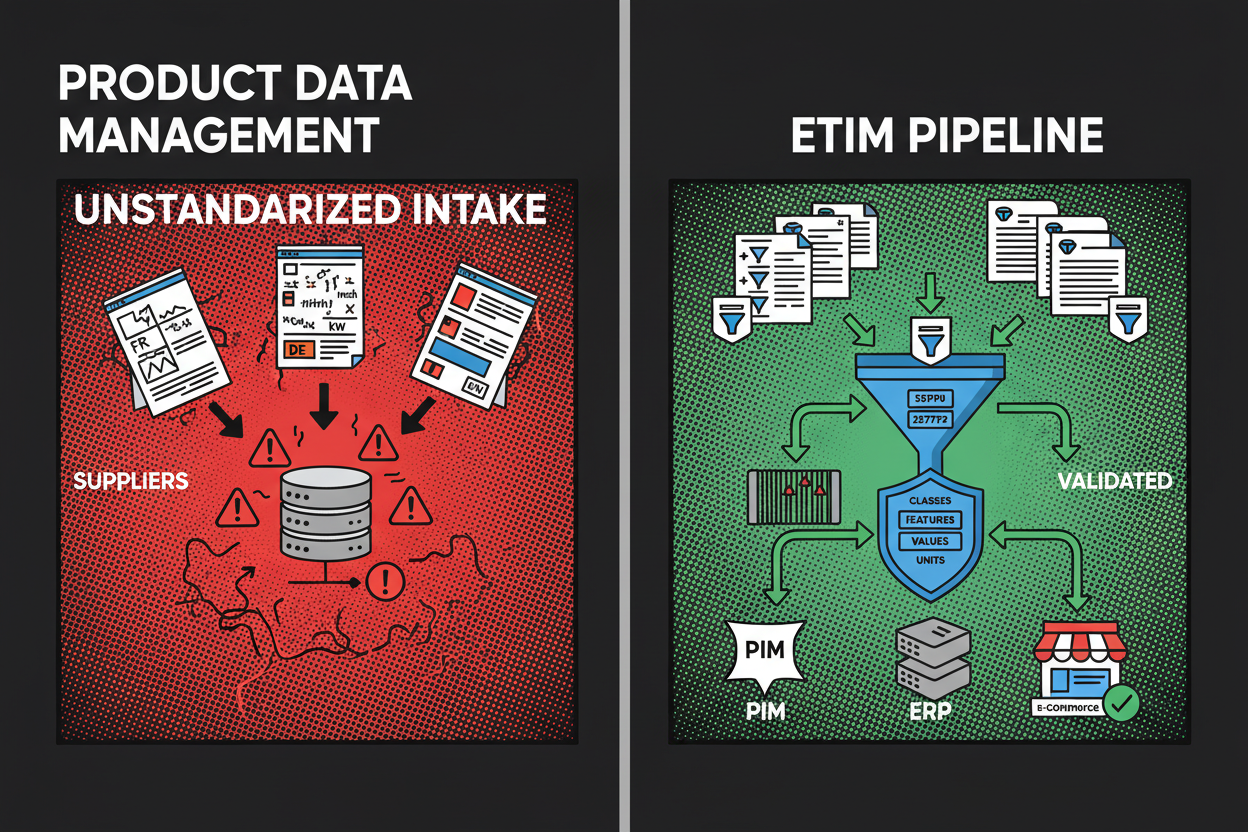
Bad data costs organizations trillions annually in rework and lost sales. In technical supply chains, this manifests as wrong orders and project delays. By mapping each SKU to an ETIM class, you align disparate values into a shared language.
Pro Tip: While ETIM provides the framework, Classifast provides the engine. Built with FastAPI and advanced semantic search, Classifast allows you to instantly map your technical descriptions to ETIM classes and features, providing the audit trail and rationales necessary for high-stakes data management.
Understanding the Structure of the ETIM Classification System
ETIM is built from a repeating set of building blocks. Each element has a stable identifier so systems can reference it precisely without language barriers.
ETIM uses standardized two-letter prefixes followed by six digits:
- EG = Group (e.g., EG000017) – The high-level product group.
- EC = Class (e.g., EC000016) – The specific product type (e.g., LED lamp).
- EF = Feature (e.g., EF000138) – A technical attribute (e.g., power).
- EV = Permitted Value (e.g., EV000147) – A list value (e.g., E27 socket).
- EU = Unit (e.g., EU000015) – A standardized unit (e.g., Watts).
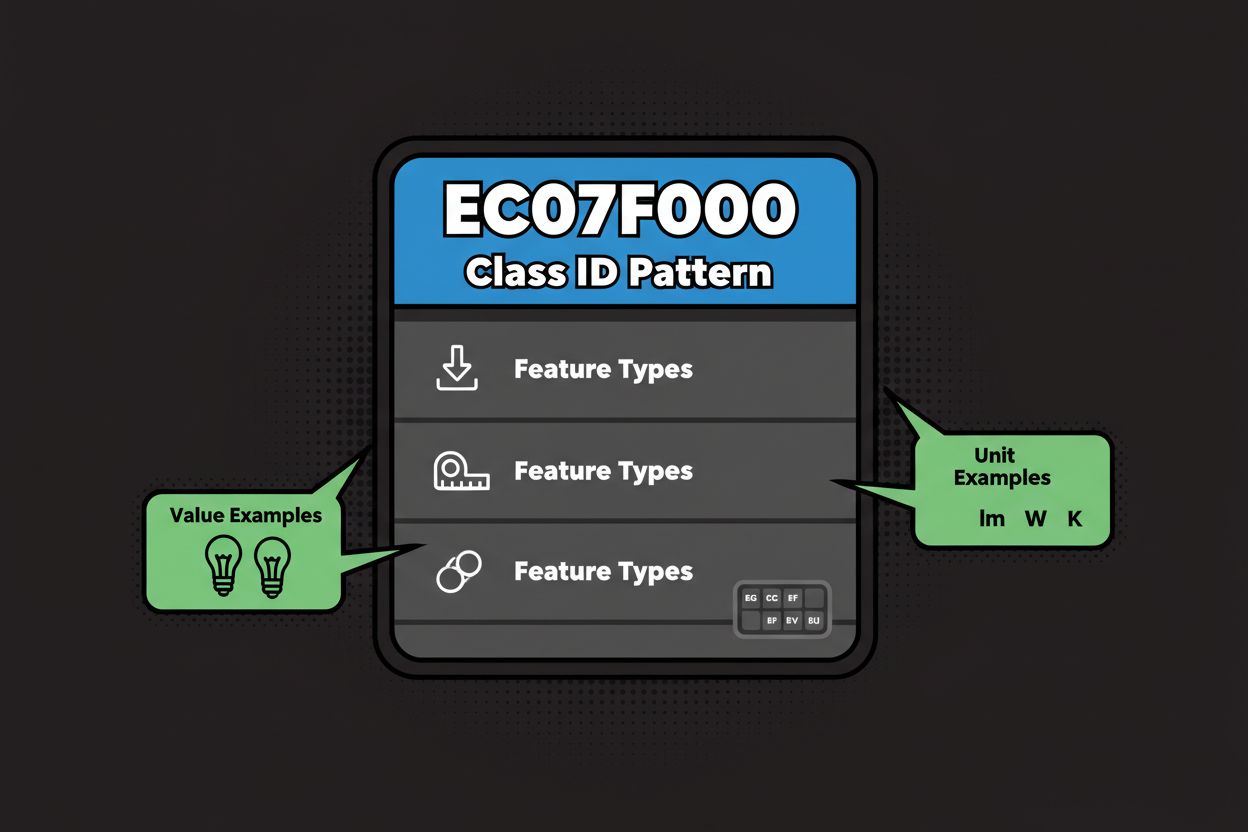
For a miniature circuit breaker, once placed in the correct EC class, you rely on features like rated current (numeric with EU = Ampere) and tripping characteristic (value list with EV values like B, C, or D). This structure is what Classifast navigates instantly, replacing manual lookups with intelligent, semantic categorization.
ETIM as an International Standard: Principles and Governance
ETIM International is a non-profit association. Its governance ensures the standard remains neutral and vendor-independent. At its core is the “one-country-one-vote” rule, preventing any single market or company from dominating the standard’s evolution.
The Technical Committee oversees Requests for Change (RFCs). This community-driven process ensures that when technology evolves—such as new smart-home capabilities—the ETIM model evolves with it. Because Classifast supports these international standards (including UNSPSC, NAICS, and HS/HTS), users can trust that their classifications are always aligned with current global governance.
Technical Attributes and Data Exchange with ETIM xChange
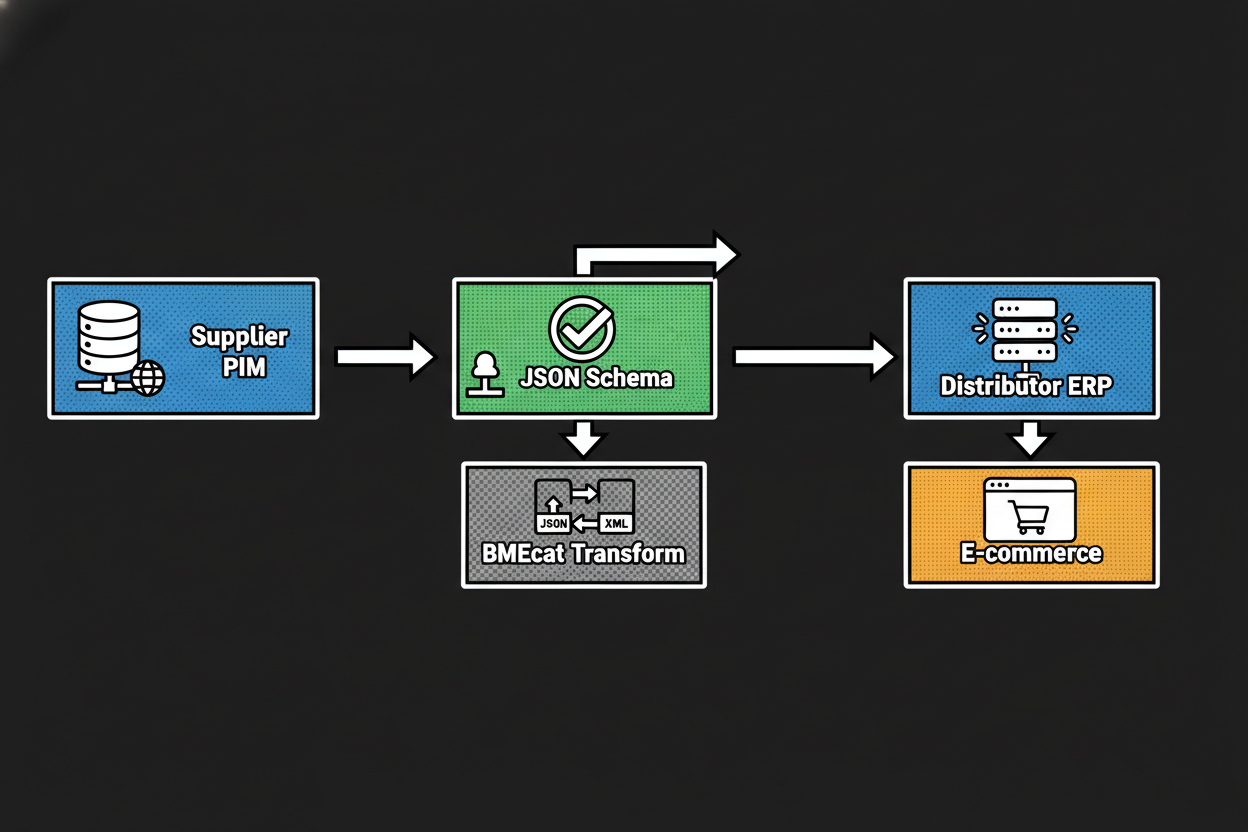
ETIM is a classification model, not just a file. To move this data, you need an exchange format. Today, ETIM xChange (a JSON-based format) is the preferred route for PIM, ERP, and e-commerce integration.
Classifast fits perfectly into this pipeline by helping you generate the initial classification data. With its advanced tech stack, Classifast provides:
- Instant Mapping: Use semantic search to find the right EC codes.
- Audit Trails: Every decision is backed by a rationale, making your ETIM xChange payloads “audit-ready.”
- Multi-Standard Support: Easily switch between ETIM, UNSPSC, or customs-focused HS codes.
The Implementation Checklist:
- Identify the correct EC class for each product family.
- Normalize numeric values to ETIM EU units.
- Map categorical choices to permitted EV codes.
- Use Classifast to validate your choices and provide a rationale for each entry.
Regional Variations and Global Adoption
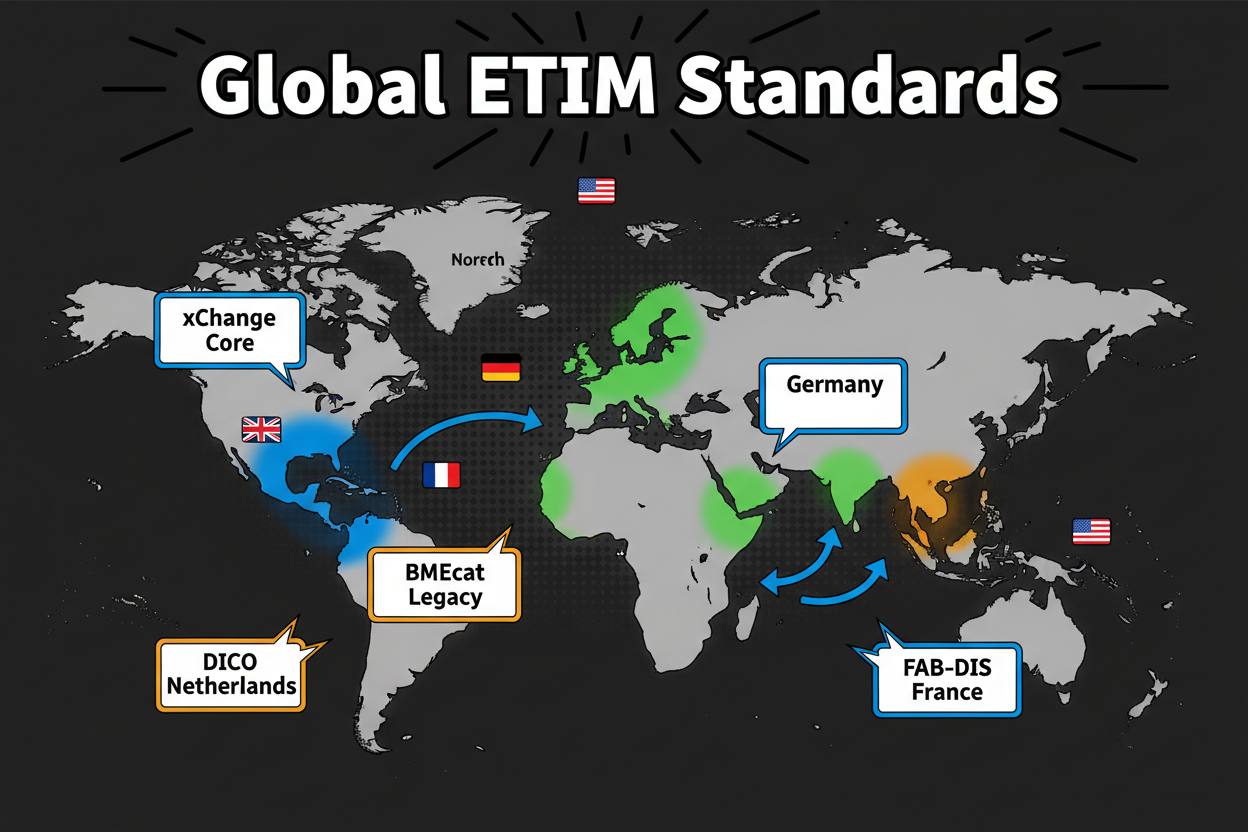
The ETIM model is identical worldwide. What changes are the language labels and national coordination. For example, the Dutch data pool 2BA accepts ETIM xChange natively, showing how a global core can meet local operational needs.
Whether you are in Europe using ETIM or in North America looking at NAICS and UNSPSC, Classifast serves as the universal bridge. It simplifies the transition between different regional standards, ensuring your product data is interoperable regardless of the destination market.
Frequently Asked Questions about ETIM
Q: What industries benefit most from ETIM? A: Technical sectors like electrical, HVAC, plumbing, and industrial supply. They rely on precise attributes to drive engineering decisions.
Q: How does ETIM differ from UNSPSC? A: ETIM is attribute-centric (detailing specific features like voltage), whereas UNSPSC is often used for high-level procurement categorization. Classifast.com supports both, allowing you to classify once and map to multiple standards.
Q: What if my partners still use BMEcat (XML)? A: You can maintain your data backbone in ETIM xChange (JSON) and transform it for partners who require legacy XML.
Q: How do I handle multi-function devices? A: Classify by the primary function. If the “essential character” is ambiguous, use Classifast’s semantic search to compare definitions and select the most defensible code.
Conclusion: Streamlining Your Classification Workflow
ETIM provides the shared language your technical products need to succeed in a global market. By utilizing stable identifiers (EC, EF, EV, EU), you ensure your data is filterable, comparable, and reliable.
However, manual classification is a relic of the past. To achieve true speed and accuracy, you need a high-performance solution. Classifast replaces tedious manual lookups with instant, intelligent categorization.
Ready to transform your technical data? Start Classifying Now at Classifast.com — Fast, accurate, and audit-ready.