Category: UNSPSC

  • Understanding the UNSPSC Hierarchy: A Comprehensive Guide to Classification

    Understanding the UNSPSC Hierarchy: A Comprehensive Guide to Classification

    In today’s global marketplace, categorizing products and services accurately is essential for efficient procurement, supply chain management, and data analysis. One of the most widely used systems for such classification is the UNSPSC hierarchy. This standardized system helps businesses and governments uniformly categorize products, allowing seamless communication and reporting across industries and regions.

    This comprehensive guide will walk you through the intricacies of the UNSPSC hierarchy, explain its importance, structure, and application, and offer resources such as Classifast.com to facilitate your classification needs.

    What is the UNSPSC Hierarchy?

    The United Nations Standard Products and Services Code (UNSPSC) is an open, global classification system for products and services. The UNSPSC hierarchy organizes these items into a structured, consistent taxonomy that helps users identify and classify goods and services quickly and accurately.

    This system is hierarchical and uses a multi-level coding structure that breaks down from broad categories to very specific items. Proper understanding and usage of the UNSPSC hierarchy improve procurement efficiency, simplify reporting, enhance spend analysis, and support compliance with trade regulations.

    Structure of the UNSPSC Hierarchy

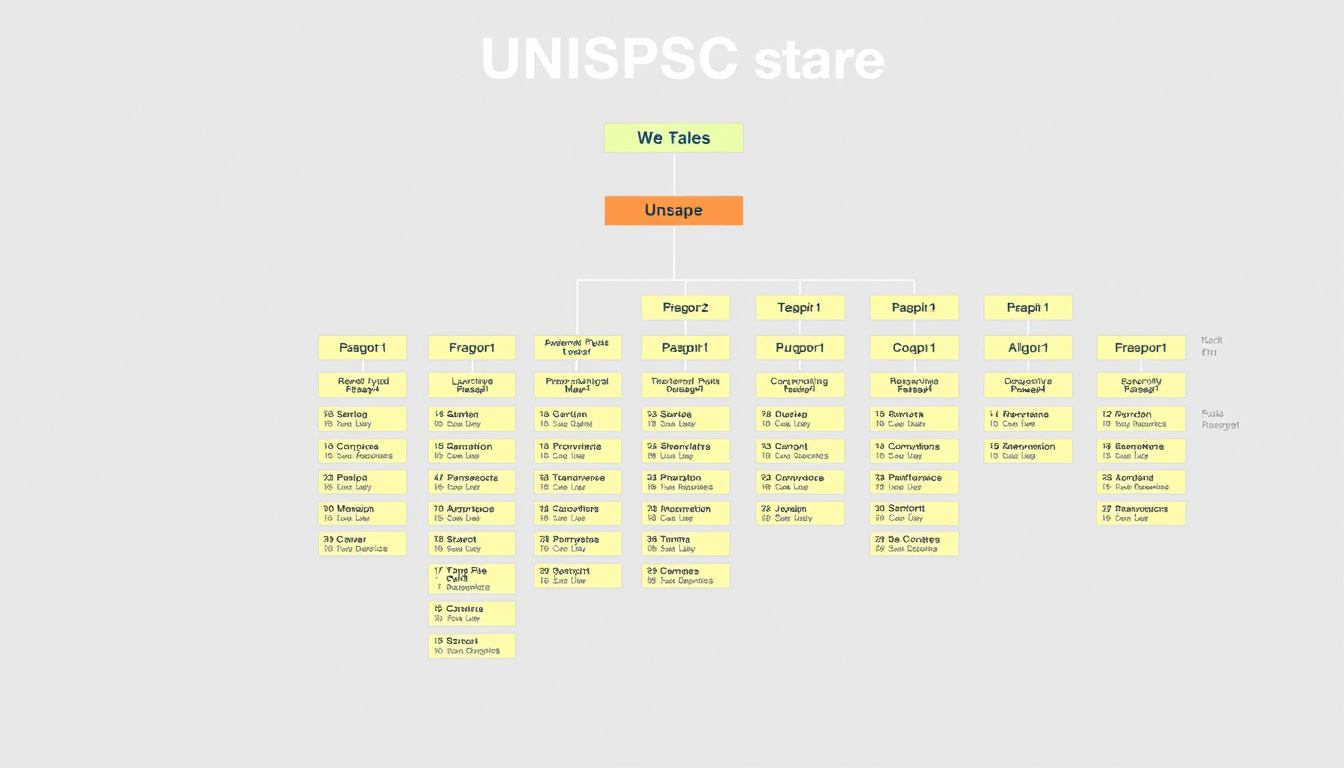
    The UNSPSC hierarchy is organized into four primary levels, each with a unique four-digit code component, combining into an eight-digit UNSPSC code:

    1. Segment (2 digits)
      The broadest classification, representing the general category of products or services. For example, "10" may signify "Live Plant and Animal Material and Accessories and Supplies."

    2. Family (2 digits)
      Subdivides the segment into more specific groups. Within the "10" segment, a family might be "Livestock."

    3. Class (2 digits)
      Further narrows classification into more defined groups, such as "Cattle."

    4. Commodity (2 digits)
      The most specific level, identifying individual products or services like "Dairy cattle."

    The combined eight-digit UNSPSC code might look like this: 10101501.

    This structured hierarchy enables straightforward navigation from broad classifications to specific items, essential for categorization and data standardization.

    Why is the UNSPSC Hierarchy Important?

    The UNSPSC hierarchy’s importance extends across multiple industries and applications:

    • Standardizing Procurement: Businesses and governments use the UNSPSC to streamline procurement processes and improve vendor and product selection.
    • Spend Analysis: Accurate coding enables financial teams to analyze spending patterns and identify savings opportunities.
    • Supply Chain Optimization: It simplifies communication among suppliers, buyers, and logistics providers.
    • Reporting and Compliance: Using recognized classification helps meet regulatory requirements and facilitates global trade.
    • Data Integration: Supports integration of purchasing data with ERP systems and other software.

    Using a standardized system such as the UNSPSC hierarchy reduces errors, increases productivity, and drives better decision-making.

    How to Navigate and Use the UNSPSC Hierarchy

    Understanding how to efficiently navigate the UNSPSC hierarchy is key to harnessing its full potential.

    Step-by-Step Guide:

    1. Identify the Product or Service Description: Begin with a clear text description of what you want to classify.
    2. Consult the Hierarchy Levels: Use the hierarchy segments (Segment, Family, Class, Commodity) to narrow down the classification progressively.
    3. Use Tools for Quick Classification: Utilize resources like Classifast.com, which offer instant classification based on text input, saving valuable time and improving accuracy.
    4. Validate Codes: Ensure the selected UNSPSC codes match the items to avoid discrepancies in reporting.
    5. Regular Updates: Stay informed about UNSPSC updates, as the system periodically evolves to capture new products and services.

    Practical Examples of the UNSPSC Hierarchy

    To illustrate, let’s classify “laptop computers” in the hierarchy:

    • Segment: 43 – Information Technology Broadcasting and Telecommunications
    • Family: 43 – Computer Equipment and Accessories
    • Class: 4321 – Computers
    • Commodity: 43211504 – Laptop computers

    Thus, the UNSPSC code for laptop computers is 43211504.

    This precise classification aids procurement teams in filtering suppliers who meet the exact product criteria or reporting expenditures accurately.

     professional business meeting with diverse team analyzing classification charts on screen

    Leveraging Classifast.com for Efficient UNSPSC Classification

    Classifast.com is a powerful tool designed for anyone needing quick and reliable UNSPSC hierarchy classification. By simply entering a text description of a product or service, Classifast provides instantaneous, accurate classification codes across international standards including UNSPSC, NAICS, ISIC, ETIM, and HS codes.

    Benefits of Using Classifast.com:

    • Time Savings: Eliminate manual sifting through thousands of codes.
    • Accuracy: Reduces errors in code selection through AI-powered matching.
    • Multi-Standard Support: Useful if your operations require different classification standards.
    • User-Friendly Interface: Ideal for procurement officers, data analysts, and compliance professionals.

    Using automated tools like Classifast.com ensures your UNSPSC hierarchy classifications are consistent and aligned with global standards, facilitating smoother operations.

    Advantages of Using the UNSPSC Hierarchy in Business

    Organizations that adopt the UNSPSC hierarchy see numerous benefits, including:

    • Improved procurement efficiency
    • Better supplier and product tracking
    • Clearer spend visibility and analytics
    • Easier compliance with international regulations
    • Enhanced integration with digital platforms

    5 Tips for Effective UNSPSC Hierarchy Management

    1. Train Your Team: Educate procurement and accounting teams on UNSPSC codes and hierarchy.
    2. Use Technology: Employ classification tools such as Classifast.com to boost precision.
    3. Maintain Consistency: Apply the same classification standards throughout your organization.
    4. Review Regularly: Audit classifications periodically to ensure they align with actual purchases.
    5. Stay Updated: Follow UNSPSC releases and guidelines to keep your categories current.

    Frequently Asked Questions about the UNSPSC Hierarchy

    1. What does the UNSPSC hierarchy represent in procurement?

    The UNSPSC hierarchy categorizes products and services into a standardized framework, facilitating consistent procurement, reporting, and spend analysis across organizations.

    2. How can I quickly classify a product using the UNSPSC hierarchy?

    You can manually navigate the four-tier hierarchy, but for faster and more accurate classification, automated tools like Classifast.com are highly recommended.

    3. Are UNSPSC codes updated regularly?

    Yes, the UNSPSC organization frequently updates the codes and hierarchy to reflect new products, services, and market changes, ensuring the system remains relevant.

    Additional Resources

    For more detailed information on international product and services classification standards, visit Classifast.com. This resource will help you access accurate UNSPSC codes and alternate standards such as NAICS and ISIC codes essential for cross-border trade and compliance.

    For authoritative guidance, you may refer to the official UNSPSC website or publications like those from the United Nations Global Marketplace, which provide reliable explanations and updates on the hierarchy and its usage (UN Global Marketplace).

    Conclusion

    Mastering the UNSPSC hierarchy is indispensable for businesses and organizations seeking to optimize procurement, supply chain management, and data analytics. Its structured taxonomy breaks down complex product and service categories into manageable codes, facilitating clearer communication and greater operational efficiency.

    To harness the full potential of the UNSPSC hierarchy, leverage cutting-edge tools like Classifast.com that provide rapid, accurate classification from simple text descriptions. This seamless integration of technology and standardized classification empowers your team to make informed decisions, reduce errors, and stay ahead in a competitive marketplace.

    Start streamlining your classification process today—visit Classifast.com and experience instant UNSPSC hierarchy classification designed for your business needs!

  • Top UNSPSC Categories Transforming Global Procurement Practices Today

    Top UNSPSC Categories Transforming Global Procurement Practices Today

    In today’s dynamic business world, understanding how to leverage standardized classification systems is vital. UNSPSC categories play a crucial role in transforming global procurement practices by enabling organizations to streamline purchasing, improve spend analysis, and foster supplier alignment. These categories, part of the United Nations Standard Products and Services Code (UNSPSC), provide a universal language for identifying and classifying products and services worldwide, enhancing transparency and efficiency in procurement processes.

    This article explores the top UNSPSC categories that are fundamentally reshaping procurement today, demonstrating how businesses across industries benefit from adopting these standards. We’ll also discuss tools like Classifast.com, which makes classification easier, and wrap up with FAQs to address common queries.

    Understanding UNSPSC Categories and Their Impact on Procurement

    UNSPSC categories are a hierarchical coding system used globally to classify goods and services. These codes help procurement professionals categorize spend data accurately, enabling better decision-making and spend management. The UNSPSC standard is continually updated to reflect emerging industries and technologies, ensuring its relevance for modern procurement challenges.

    By organizing thousands of products and services under consistent codes, companies can compare data across departments and regions, optimize supplier contracts, and eliminate duplication or maverick spend. Additionally, governments and multinational corporations depend on UNSPSC categories to ensure compliance and transparency in purchasing.

    Top UNSPSC Categories Shaping Global Procurement

    Several UNSPSC categories have seen increased adoption due to their alignment with evolving business needs and market trends. Below are the most influential categories currently transforming global procurement operations.

    1. IT Hardware and Software (UNSPSC 43)

    The rise in remote work and digital transformation initiatives have driven significant demand in IT-related products and services. The UNSPSC category 43, which covers IT hardware, software, and related services, is pivotal for procurement teams aiming to source technology efficiently while ensuring cost-effectiveness and compliance.

    Items under this category include computers, networking devices, software licenses, and IT consulting services. By using these standardized codes, enterprises can better manage tech spend and evaluate vendor performance objectively.

    2. Industrial Equipment and Supplies (UNSPSC 39)

    Industrial manufacturing and infrastructure development heavily rely on this category encompassing machinery, tools, and maintenance supplies. Procurement departments in construction, energy, and manufacturing sectors use UNSPSC codes within this segment to classify equipment ranging from heavy machinery to safety gear.

    Accurate categorization here helps companies optimize asset management, control lifecycle costs, and schedule timely procurement without disruption.

    3. Medical Equipment and Supplies (UNSPSC 42)

    The healthcare industry faces complex procurement challenges due to varying regulations and critical equipment needs. UNSPSC category 42 covers medical devices, surgical supplies, pharmaceuticals, and health-related services, streamlining supplier identification and spend tracking.

    Hospitals, clinics, and health agencies benefit from consistent coding that reduces errors, prevents overstocking, and improves compliance with healthcare standards.

    4. Environmental and Waste Management Services (UNSPSC 95)

    With sustainability increasingly integral to procurement strategy, environmental services classification is gaining prominence. This category includes waste management, recycling, environmental consulting, and renewable energy services.

    Companies focused on corporate social responsibility (CSR) and regulatory compliance use these UNSPSC codes to monitor and improve their sustainable sourcing practices, promoting green procurement globally.

    5. Professional and Business Services (UNSPSC 80)

    Procurement of consulting, marketing, logistics, and other professional services falls under this broad category. Accurate classification allows businesses to manage external service contracts efficiently while benchmarking service provider performance.

    This category is crucial for controlling operational costs, ensuring contractual compliance, and aligning outsourced services with strategic business goals.

    How to Effectively Use UNSPSC Categories in Procurement

    Implementing UNSPSC categories into procurement workflows requires thoughtful consideration. Here are best practices for leveraging UNSPSC coding effectively:

    1. Integrate UNSPSC Codes into ERP and Procurement Systems
      Embedding UNSPSC codes into purchasing platforms ensures consistent classification and enhances data accuracy across all transactions.

    2. Train Procurement Teams on Coding Standards
      Educate staff on UNSPSC structure and category relevance for better data input, spend analysis, and supplier collaboration.

    3. Regularly Update and Validate Codes
      As products and services evolve, refresh UNSPSC mappings to capture new market offerings and phase out obsolete items.

    4. Use Classification Tools Like Classifast.com
      Manual classification can be tedious and error-prone. Platforms like Classifast.com offer instant text-to-code classification using international standards such as UNSPSC, NAICS, and ISIC. This accelerates your procurement categorization process and improves code accuracy.

    5. Analyze Spend Data with UNSPSC-Based Reports
      Leverage category data for insights on supplier consolidation, cost-saving opportunities, and risk mitigation.

    The Role of Classifast.com in Simplifying UNSPSC Classification

    Accurate UNSPSC category assignment is foundational but can be challenging due to the vast scope of products and services. Classifast.com specializes in rapid and precise classification by analyzing any text input and mapping it to multiple international standards like UNSPSC, NAICS, and HS codes.

    Using Classifast offers numerous benefits:

    • Speed: Instant code retrieval saves hours spent on manual classification.
    • Accuracy: Minimizes human errors for consistent data quality.
    • Flexibility: Supports multiple classification standards, making cross-border procurement compliant.
    • Ease of Use: User-friendly interface that requires no technical expertise.

    For procurement professionals looking to harness the power of UNSPSC categories, Classifast is a practical, efficient tool that ensures classification reliability, supporting better procurement decisions and global trade compliance.

     diverse international business professionals collaborating with advanced procurement tools in a modern office environment

    FAQ: Common Questions About UNSPSC Categories in Procurement

    Q1: What are UNSPSC categories used for in procurement?
    UNSPSC categories classify products and services to streamline spend analysis, supplier management, and purchasing workflows globally. They enable uniform reporting and improve procurement efficiency.

    Q2: How can companies find the right UNSPSC codes for their purchases?
    Companies can use automated tools like Classifast.com to quickly search and assign accurate UNSPSC codes based on product or service descriptions, minimizing errors and saving time.

    Q3: Are UNSPSC categories compatible with other classification standards?
    Yes, UNSPSC can be used alongside standards like NAICS (North American Industry Classification System) or HS codes for customs, facilitating compliance in international trade and diverse procurement activities.

    Conclusion: Embrace UNSPSC Categories to Drive Procurement Excellence

    UNSPSC categories are revolutionizing how organizations approach procurement by providing a standardized framework to classify and analyze purchasing data. Whether dealing with IT hardware, medical supplies, industrial equipment, or environmental services, businesses equipped with these categories gain greater visibility and control over their spending.

    To maximize the benefits of UNSPSC categories, procurement teams must adopt best practices and leverage classification tools such as Classifast.com, which simplifies code assignment and enhances accuracy. As global markets grow more complex, aligning procurement processes with trusted standards empowers companies to reduce costs, increase efficiency, and build resilient supply chains.

    Start transforming your procurement strategy today by integrating UNSPSC categories into your systems and workflows. Visit Classifast.com to experience instant, reliable classification that supports smarter purchasing decisions and drives your business ahead in the competitive global marketplace.


    For more authoritative insights on procurement classification, see the official UNSPSC website at unspsc.org (source).

    Click here to quickly find category codes from UNSPSC or from many other industry standards.

  • Mastering UNSPSC Classification: Streamline Procurement and Inventory Management

    Mastering UNSPSC Classification: Streamline Procurement and Inventory Management

    In today’s fast-paced business environment, efficient procurement and inventory management are crucial for maintaining competitive advantage and operational excellence. One key tool that organizations leverage to achieve this is UNSPSC classification. UNSPSC classification provides a standardized system for categorizing products and services, enabling companies to streamline their procurement processes, improve spend visibility, and enhance inventory tracking accuracy. In this article, we’ll explore the fundamentals of UNSPSC classification and how mastering it can revolutionize your procurement and inventory management systems.

    What Is UNSPSC Classification?

    UNSPSC stands for the United Nations Standard Products and Services Code. It is an open, global classification system that categorizes both products and services into a hierarchical schema structured across four levels: Segment, Family, Class, and Commodity. Each level delves deeper into specific types of items or services.

    By applying UNSPSC classification to purchases and inventory items, companies can achieve a universal language that facilitates better communication between suppliers, buyers, and internal departments. It helps organizations standardize descriptions, making it easier to manage catalogs, automate procurement workflows, and generate more insightful analytics.

    Why UNSPSC Classification Matters in Procurement and Inventory Management

    Implementing UNSPSC classification in your procurement system transforms how you acquire goods and manage your stock. Here are some significant benefits:

    1. Enhanced Spend Analysis

    When all procurement data is classified accurately using UNSPSC codes, businesses can gain a precise view of spending patterns. This visibility enables identifying cost-saving opportunities, supplier consolidation, and leakage prevention.

    2. Improved Supplier Management

    By assigning UNSPSC codes to products and services, procurement teams can segment suppliers by the type of goods provided. This aids in benchmarking supplier performance, negotiating contracts, and ensuring compliance.

    3. Streamlined Inventory Control

    Classifying inventory items with UNSPSC codes facilitates smoother stock tracking and management. Categorization according to global standards makes it easier to optimize stock levels, reduce overstock or stockouts, and expedite inventory audits.

     Corporate team analyzing UNSPSC codes on large screen, efficient supply chain management system in action

    4. Accelerated Purchase Order Processing

    Standardized coding reduces ambiguity in product descriptions, minimizing errors in purchase orders. It also supports e-procurement systems by enabling automated matching of requisitions to supplier catalogs.

    How to Master UNSPSC Classification

    Mastering UNSPSC classification involves more than simply attaching a code to each product or service. It requires a comprehensive strategy and reliable tools to ensure accuracy and consistency. Follow these key steps:

    Step 1: Understand Your Procurement and Inventory Categories

    Begin by auditing your current product and service lists. Group these items logically to correspond with UNSPSC segments and families before drilling down to classes and commodities.

    Step 2: Use Accurate Classification Tools

    Manual classification can be time-consuming and prone to errors. Utilize advanced classification tools like Classifast.com, which offers instant UNSPSC classification by inputting text descriptions. This ensures fast, reliable, and consistent categorization aligned with international standards.

    Step 3: Train Your Procurement and Inventory Teams

    Educate your teams on the importance of UNSPSC classification and how to use tools and resources effectively. Consistency across all departments is vital for maintaining clean data.

    Step 4: Integrate UNSPSC Codes into Your ERP and Procurement Software

    Embed UNSPSC classification into your Enterprise Resource Planning (ERP) and purchasing platforms. This integration enables automated workflows, enhanced reporting, and seamless supplier communications.

    Step 5: Regularly Review and Update Classifications

    Procurement categories and products evolve over time. It’s essential to schedule periodic reviews to update UNSPSC codes, ensuring alignment with the latest standards and business needs.

    Key Features of a Reliable UNSPSC Classification System

    When selecting an approach or software for UNSPSC classification, consider these features:

    • Comprehensive Coverage: Ability to classify a broad spectrum of products and services.
    • International Standard Alignment: Codes up-to-date with global UNSPSC taxonomy.
    • Ease of Use: User-friendly interfaces for rapid classification.
    • Integration Capabilities: Seamless connection with ERP, inventory, and procurement systems.
    • Accuracy and Consistency: High precision in classification to reduce human errors.

    Using a dedicated service like Classifast.com offers access to accurate and up-to-date classification data across multiple international standards, including UNSPSC, NAICS, ISIC, and others. This versatility allows companies to harmonize classifications for global operations quickly.

    Practical Example: Improving Procurement Efficiency with UNSPSC Codes

    A multinational manufacturing company faced challenges in procurement due to inconsistent product descriptions and siloed supplier information. By implementing UNSPSC classification throughout its procurement and inventory systems—with the help of automated classification through Classifast—they achieved:

    • A 30% reduction in procurement cycle times.
    • Enhanced supplier segmentation for better negotiations.
    • Improved accuracy in inventory replenishment, reducing stockouts by 20%.

    This example underlines how mastering UNSPSC classification empowers businesses to optimize operational workflows and control costs effectively.

    FAQ: Understanding UNSPSC Classification

    Q1: What is the difference between UNSPSC classification and other product codes?
    A1: UNSPSC classification is an open, hierarchical product and service categorization system focused on standardizing procurement descriptions globally. Other systems, like SKU or UPC, are often company-specific or used mainly for sales tracking.

    Q2: How does automated classification with tools like Classifast improve UNSPSC code accuracy?
    A2: Automated tools analyze text descriptions to assign the most appropriate UNSPSC codes, reducing manual errors, speeding up the process, and ensuring consistency across large data sets.

    Q3: Can UNSPSC classification be used across different industries?
    A3: Yes, UNSPSC codes cover a wide range of industries, making it suitable for organizations in manufacturing, services, government procurement, healthcare, and more.

    Authoritative Insight on the Importance of Standard Classifications

    According to the procurement experts at the Chartered Institute of Procurement & Supply (CIPS), utilizing standardized classification systems like UNSPSC is vital for enabling strategic sourcing initiatives, improving supplier relationship management, and driving cost efficiencies in purchasing activities (source: CIPS).

    Conclusion: Take Control with UNSPSC Classification

    Mastering UNSPSC classification is a strategic move that enables your business to streamline procurement workflows, sharpen inventory controls, and unlock deeper spending insights. With standardized and accurate classifications, you reduce operational complexity and build a foundation for smarter sourcing decisions and improved supplier collaboration.

    To simplify this journey, leverage powerful classification tools such as Classifast.com, which provide instant and reliable UNSPSC codes from any product or service description. Don’t let inconsistent data hold back your procurement potential—embrace UNSPSC classification and transform how your organization manages purchasing and inventory today!

    Click here to quickly find category codes from UNSPSC or from many other industry standards.

  • UNSPSC Lookup: How to Simplify Procurement and Spend Management

    UNSPSC Lookup: How to Simplify Procurement and Spend Management

    In today’s fast-paced business environment, efficient procurement and spend management are essential for organizations aiming to optimize costs and improve supplier relationships. One powerful tool to achieve this is the UNSPSC lookup system. By harnessing the United Nations Standard Products and Services Code (UNSPSC), companies can categorize products and services consistently, enabling streamlined procurement processes and clearer spend analysis. This article explores how the UNSPSC lookup can simplify procurement and contribute to smarter spend management.

    What is UNSPSC Lookup?

    The UNSPSC is a globally recognized classification system for products and services. It provides a standardized coding framework that allows businesses to identify and group items systematically. A UNSPSC lookup involves searching or coding products and services in this standardized format to ensure uniform cataloguing. By utilizing this framework, organizations can promote clarity and transparency in purchasing and financial reporting.

    How UNSPSC Lookup Enhances Procurement Efficiency

    Procurement teams face numerous challenges, such as managing diverse supplier catalogs, avoiding purchasing mistakes, and maintaining compliance. Performing a UNSPSC lookup on products or services allows procurement professionals to:

    • Standardize descriptions: Avoid confusion with ambiguous item names by using UNSPSC codes.
    • Simplify supplier comparisons: Group products by standardized codes for easier price and quality analysis.
    • Improve contract management: Segment spend by category for targeted negotiations.
    • Enable automation: Easily integrate procurement software with spending data for automated workflows.

    By embedding the UNSPSC lookup into the procurement lifecycle, businesses reduce manual work and improve data accuracy.

    Using UNSPSC Lookup for Spend Management

    Spend management involves understanding and controlling company expenditures. Leveraging UNSPSC lookup can boost spend visibility and analysis through:

    • Consistent classification: Align spending across departments by using common codes.
    • Spend transparency: Identify high-value categories and suppliers.
    • Fraud prevention: Detect unusual or unauthorized purchases by analyzing spending patterns.
    • Budget control: Monitor category-specific budgets efficiently.

    Moreover, financial teams can generate more reliable reports for stakeholders, enhancing decision-making.

    Step-by-Step Guide to Performing an UNSPSC Lookup

    1. Identify the product or service: Obtain a detailed description or SKU from your procurement data.
    2. Access a UNSPSC lookup tool: Use official or third-party platforms that facilitate searching by description or code.
    3. Search for the correct code: Enter relevant keywords or browse the hierarchy to find the most accurate UNSPSC code.
    4. Verify code accuracy: Cross-check with product specifications and supplier information.
    5. Integrate code into procurement systems: Use the code in purchase orders, invoices, and contracts.
    6. Analyze and report spend: Utilize categorized data for business intelligence insights.

    Using these steps ensures accuracy and maximizes the benefits of the UNSPSC lookup process.

     business professionals collaborating over modern interface showing spend analysis and category data

    Benefits of UNSPSC Lookup for Different Industries

    The UNSPSC system is versatile and applies across varied sectors:

    • Manufacturing: Streamlines sourcing of raw materials and equipment.
    • Healthcare: Enables precise classification of medical supplies and services.
    • Retail: Facilitates inventory categorization and supplier negotiations.
    • Government: Supports compliance and audit trails in public procurement.

    The broad applicability of UNSPSC lookup makes it a valuable asset for any organization aiming to maintain robust and transparent procurement operations.

    Common Challenges and How to Overcome Them

    While UNSPSC lookup offers many advantages, implementation is not without challenges:

    • Code complexity: With thousands of codes, selecting the right one can be daunting.
    • Data integration: Aligning UNSPSC codes with existing systems requires technical planning.
    • User training: Staff need education to effectively use and interpret UNSPSC categories.

    To mitigate these issues, companies should invest in comprehensive training, choose user-friendly lookup platforms, and ensure IT support for smooth integration.

    Authoritative Insight on UNSPSC Usage

    According to the United Nations Development Programme (UNDP), the UNSPSC coding system is essential for harmonizing procurement data globally and improving economic transparency (source). This endorsement underscores the value of adopting a standardized lookup approach for procurement and spend management optimization.

    FAQs About UNSPSC Lookup

    Q1: What exactly does UNSPSC stand for?
    A1: UNSPSC stands for United Nations Standard Products and Services Code, a global classification system for products and services to standardize procurement processes.

    Q2: How do I perform a UNSPSC lookup for my company’s purchases?
    A2: You can perform a UNSPSC lookup by using online tools or software integrated with your procurement system to match items with the correct UNSPSC codes based on descriptions or categories.

    Q3: Can UNSPSC lookup help reduce procurement costs?
    A3: Yes, by providing transparency and standardization, UNSPSC lookup enables better spend analysis and supplier negotiations, which can lead to cost savings.

    Conclusion: Take Control of Procurement with UNSPSC Lookup

    Integrating UNSPSC lookup into your procurement and spend management routines offers a smart, scalable solution to challenges such as inconsistent product categorization and unclear spending visibility. By adopting this standardized system, your organization can simplify purchasing processes, enhance data-driven decision-making, and unlock new efficiencies.

    Don’t let procurement complexity hold your business back. Begin exploring UNSPSC lookup tools today and transform your spend management strategy, paving the way for smarter growth and stronger financial health.

    Click here to quickly find category codes from UNSPSC and from many other industry standards.