Category: ETIM

  • Mastering the ETIM Classification System: The Ultimate Guide to Technical Data Standards and Global Interoperability

    Mastering the ETIM Classification System: The Ultimate Guide to Technical Data Standards and Global Interoperability

    Table of Contents

    Introduction to the ETIM Classification System

    You’re onboarding thousands of SKUs from dozens of suppliers. Each sends a different spreadsheet. Watts vs. power. Diameter vs. Ø. Mixed languages. Units all over the place. Your PIM groans, your web filters break, and buyers can’t compare products cleanly.

    This is the “data mess” that technical industries face daily. The solution is the ETIM Classification System, an international standard for technical products that groups items into product classes and defines their main technical characteristics. It allows organizations to exchange product information efficiently across the value chain, supporting synonyms and multilingual labels to improve findability.
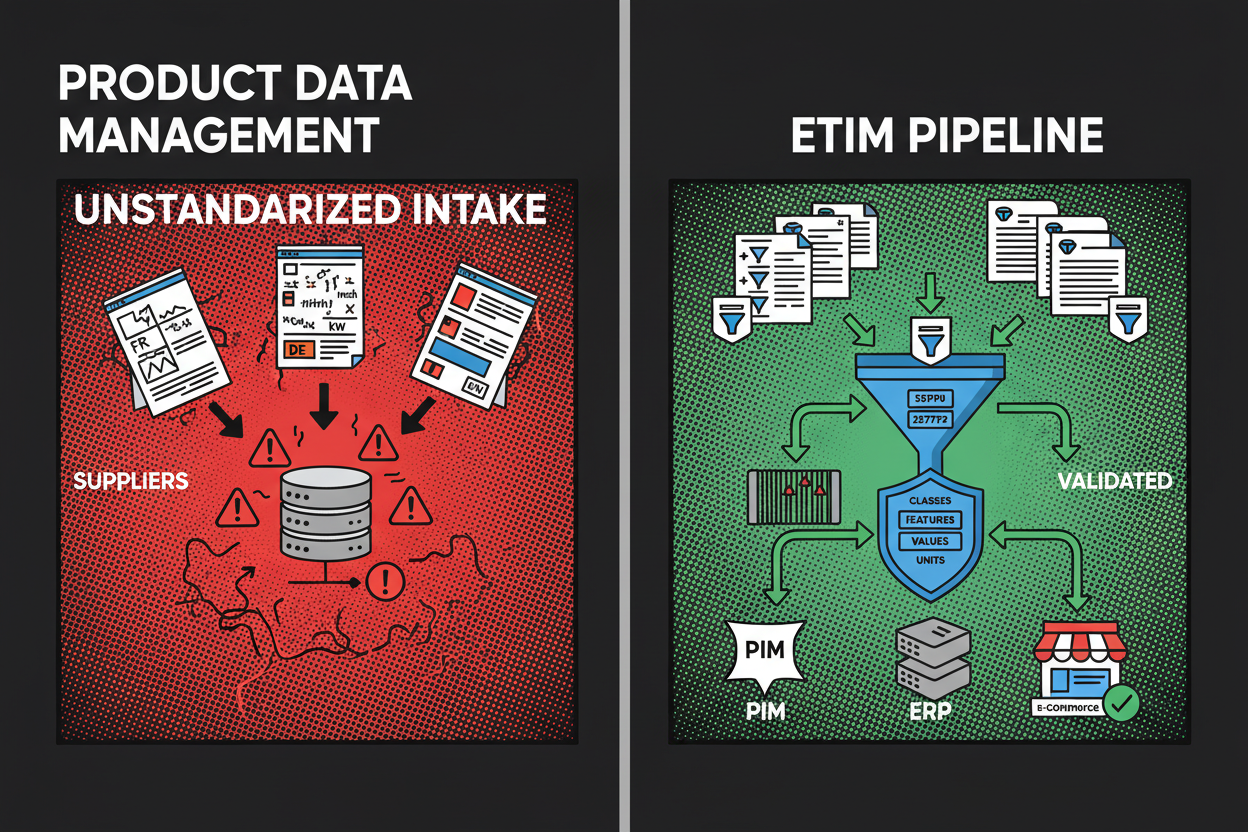
    Split-screen scene: left shows messy spreadsheets from different suppliers; right shows a clean pipeline where supplier feeds are classified by ETIM flowing into PIM/ERP

    Bad data costs organizations trillions annually in rework and lost sales. In technical supply chains, this manifests as wrong orders and project delays. By mapping each SKU to an ETIM class, you align disparate values into a shared language.

    Pro Tip: While ETIM provides the framework, Classifast provides the engine. Built with FastAPI and advanced semantic search, Classifast allows you to instantly map your technical descriptions to ETIM classes and features, providing the audit trail and rationales necessary for high-stakes data management.

    Understanding the Structure of the ETIM Classification System

    ETIM is built from a repeating set of building blocks. Each element has a stable identifier so systems can reference it precisely without language barriers.

    ETIM uses standardized two-letter prefixes followed by six digits:

    • EG = Group (e.g., EG000017) – The high-level product group.
    • EC = Class (e.g., EC000016) – The specific product type (e.g., LED lamp).
    • EF = Feature (e.g., EF000138) – A technical attribute (e.g., power).
    • EV = Permitted Value (e.g., EV000147) – A list value (e.g., E27 socket).
    • EU = Unit (e.g., EU000015) – A standardized unit (e.g., Watts).
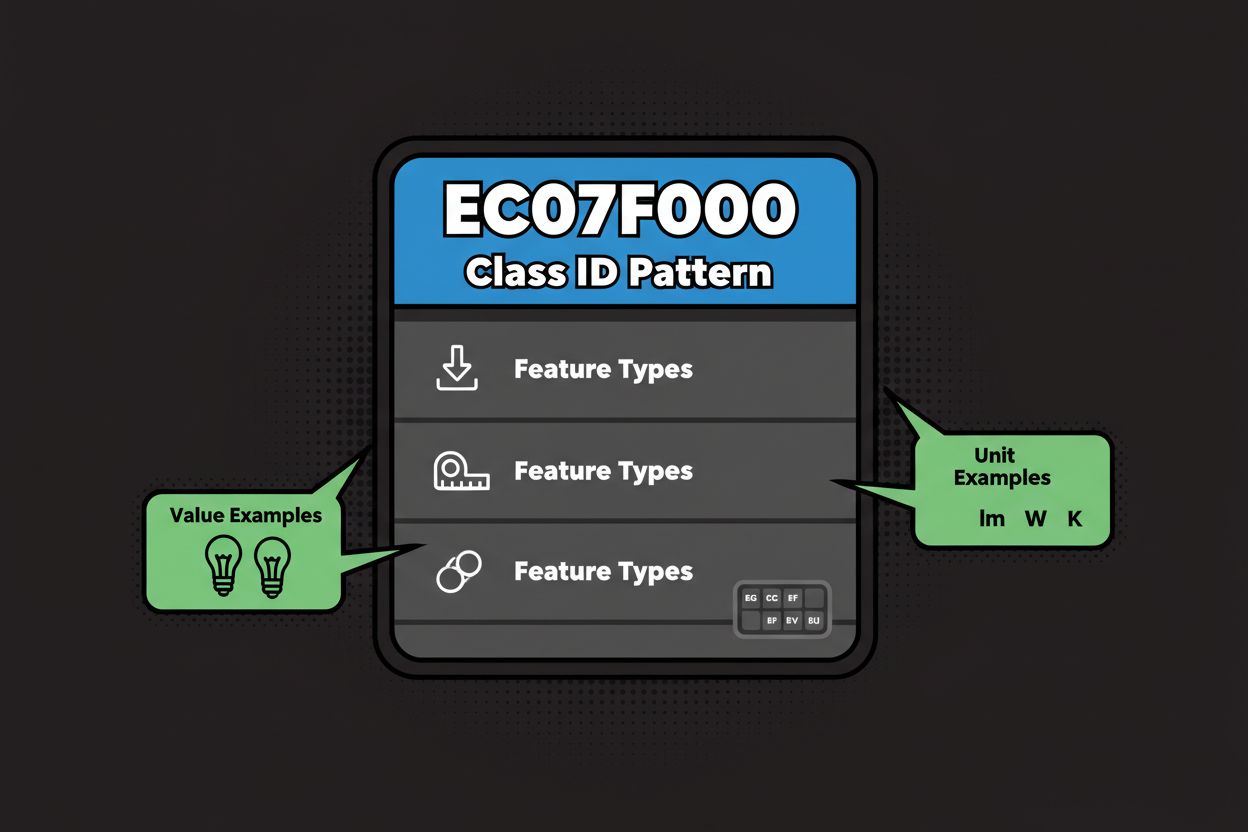
    Zoomed card of a single ETIM class showing Class ID, Features, and Units

    For a miniature circuit breaker, once placed in the correct EC class, you rely on features like rated current (numeric with EU = Ampere) and tripping characteristic (value list with EV values like B, C, or D). This structure is what Classifast navigates instantly, replacing manual lookups with intelligent, semantic categorization.

    ETIM as an International Standard: Principles and Governance

    ETIM International is a non-profit association. Its governance ensures the standard remains neutral and vendor-independent. At its core is the “one-country-one-vote” rule, preventing any single market or company from dominating the standard’s evolution.

    The Technical Committee oversees Requests for Change (RFCs). This community-driven process ensures that when technology evolves—such as new smart-home capabilities—the ETIM model evolves with it. Because Classifast supports these international standards (including UNSPSC, NAICS, and HS/HTS), users can trust that their classifications are always aligned with current global governance.

    Technical Attributes and Data Exchange with ETIM xChange

    ETIM is a classification model, not just a file. To move this data, you need an exchange format. Today, ETIM xChange (a JSON-based format) is the preferred route for PIM, ERP, and e-commerce integration.

    Classifast fits perfectly into this pipeline by helping you generate the initial classification data. With its advanced tech stack, Classifast provides:

    1. Instant Mapping: Use semantic search to find the right EC codes.
    2. Audit Trails: Every decision is backed by a rationale, making your ETIM xChange payloads “audit-ready.”
    3. Multi-Standard Support: Easily switch between ETIM, UNSPSC, or customs-focused HS codes.
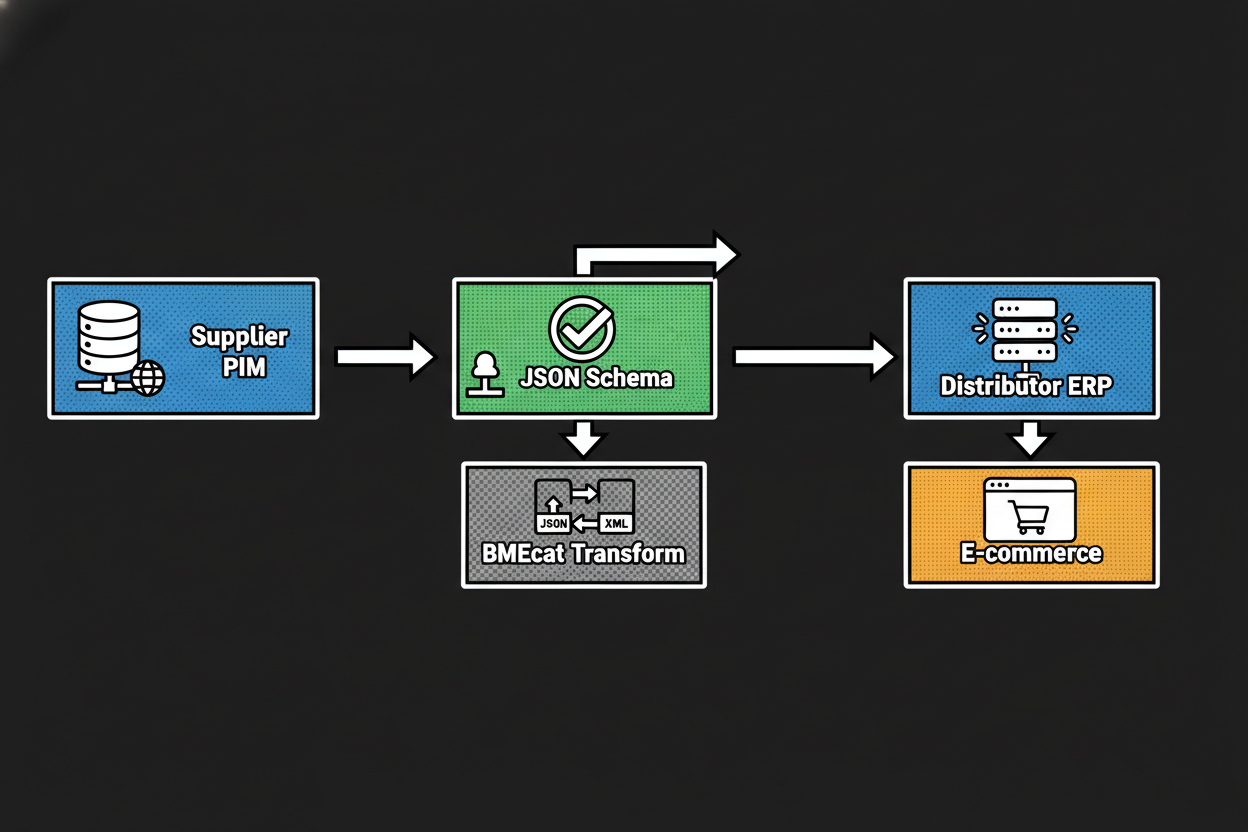
    Pipeline diagram: Supplier PIM exporting ETIM xChange JSON through a validation gate

    The Implementation Checklist:

    • Identify the correct EC class for each product family.
    • Normalize numeric values to ETIM EU units.
    • Map categorical choices to permitted EV codes.
    • Use Classifast to validate your choices and provide a rationale for each entry.

    Regional Variations and Global Adoption

    The ETIM model is identical worldwide. What changes are the language labels and national coordination. For example, the Dutch data pool 2BA accepts ETIM xChange natively, showing how a global core can meet local operational needs.

    Whether you are in Europe using ETIM or in North America looking at NAICS and UNSPSC, Classifast serves as the universal bridge. It simplifies the transition between different regional standards, ensuring your product data is interoperable regardless of the destination market.
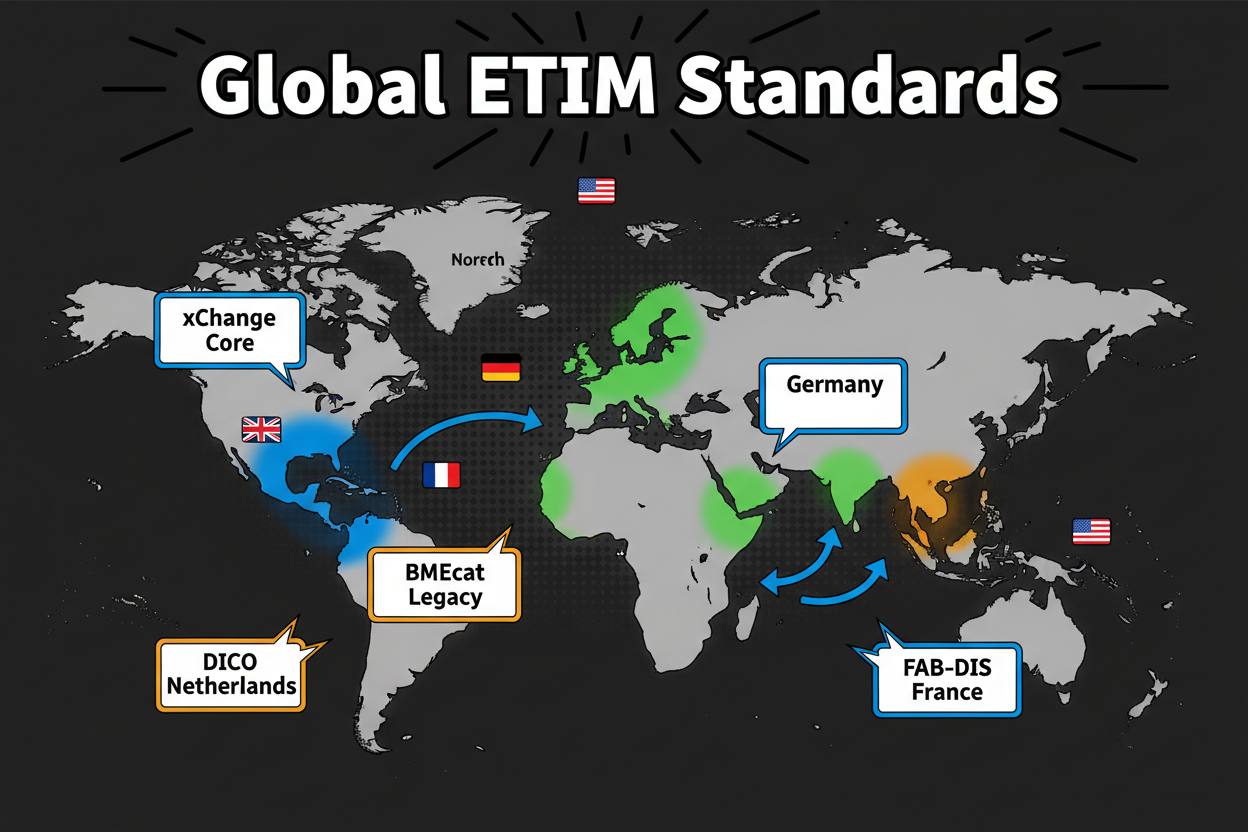
    World map with highlighted regions indicating ETIM adoption

    Frequently Asked Questions about ETIM

    Q: What industries benefit most from ETIM? A: Technical sectors like electrical, HVAC, plumbing, and industrial supply. They rely on precise attributes to drive engineering decisions.

    Q: How does ETIM differ from UNSPSC? A: ETIM is attribute-centric (detailing specific features like voltage), whereas UNSPSC is often used for high-level procurement categorization. Classifast.com supports both, allowing you to classify once and map to multiple standards.

    Q: What if my partners still use BMEcat (XML)? A: You can maintain your data backbone in ETIM xChange (JSON) and transform it for partners who require legacy XML.

    Q: How do I handle multi-function devices? A: Classify by the primary function. If the “essential character” is ambiguous, use Classifast’s semantic search to compare definitions and select the most defensible code.

    Conclusion: Streamlining Your Classification Workflow

    ETIM provides the shared language your technical products need to succeed in a global market. By utilizing stable identifiers (EC, EF, EV, EU), you ensure your data is filterable, comparable, and reliable.

    However, manual classification is a relic of the past. To achieve true speed and accuracy, you need a high-performance solution. Classifast replaces tedious manual lookups with instant, intelligent categorization.

    Ready to transform your technical data? Start Classifying Now at Classifast.com — Fast, accurate, and audit-ready.

    Clean banner with a prominent 'Start Classifying Now' button
  • The Ultimate Guide to ETIM Classification for Electrical and HVAC Catalogs: Standardization and Automation

    The Ultimate Guide to ETIM Classification for Electrical and HVAC Catalogs: Standardization and Automation

    Table of Contents

    Why ETIM Classification Matters for Electrical and HVAC Catalogs

    Picture this. You’re a catalog manager staring at twelve tabs of spreadsheets, PDFs, and supplier portals. One vendor lists voltage as 230 V, another as 0.23 kV, a third says “230VAC” in the title and nowhere else. Half your new SKUs include specs in German and Italian. You’re trying to map everything to ETIM, one feature at a time, across thousands of products while distributors ping you about missing attributes and rejected imports. ETIM classification is required.

    You translate, guess, normalize, and rework. Then you do it again for the next distributor with slightly different expectations. That’s the grind of manual ETIM mapping in electrical and HVAC catalogs.

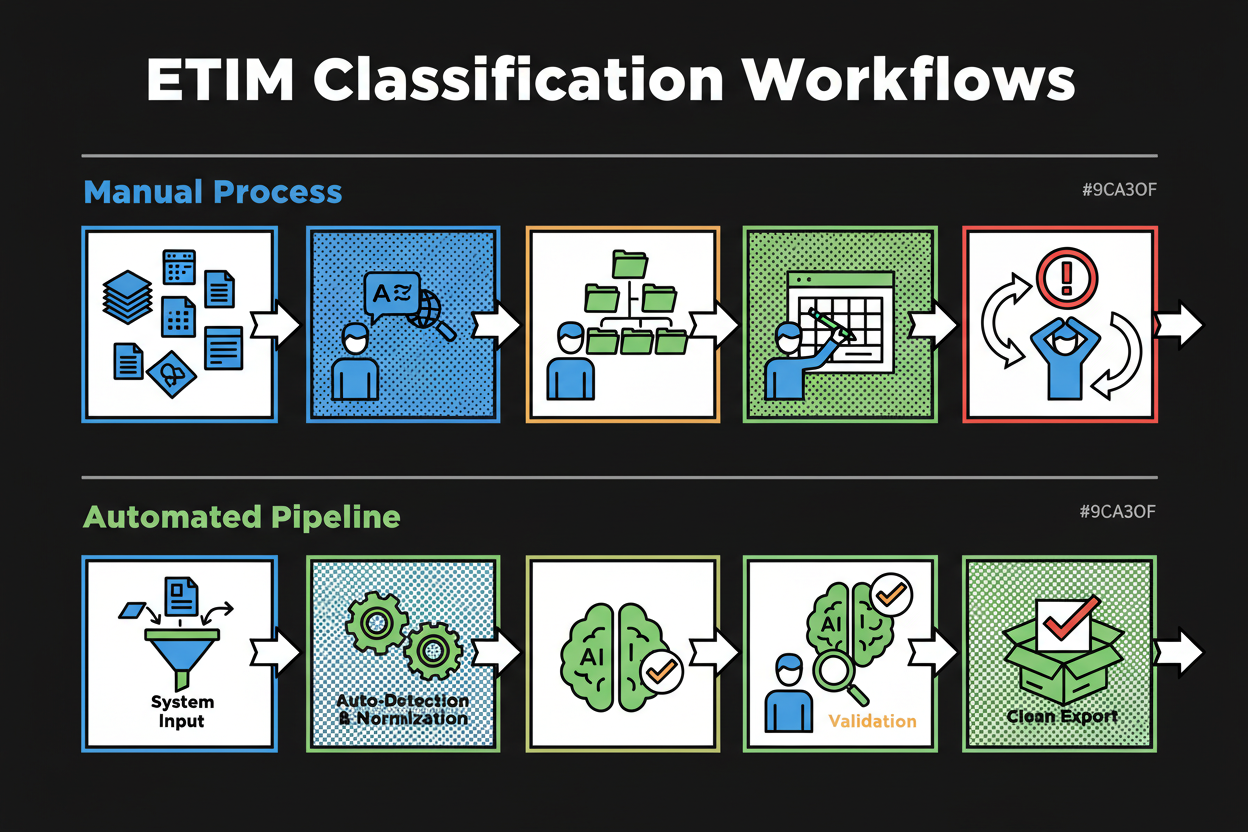
    Now imagine a different flow. You drop your data and documents into a system like Classifast.com. It detects languages, normalizes units, and suggests the right ETIM class with the features most likely to apply. It flags anything uncertain so you only review edge cases. Then it validates against the ETIM model and exports clean, structured data to your PIM or ERP.

    That is the promise of automation: higher accuracy, real scale, and a lot less labor.

    Across ETIM use cases, teams have reported major wins when they standardize product data. One manufacturer scenario reported up to a 70% reduction in time to onboard new products to distributor systems, and technical attribute errors that “virtually disappear” once standardized fields are in place. Another real-world case described task turnaround times shifting from hours to minutes after aligning product data for ETIM-focused distribution workflows. Consistent structure reduces chaos, and automation reduces grind.

    Comparison of manual vs automated ETIM classification

    A day in the life: manual mapping pain you might recognize

    You gather datasheets from five suppliers. One calls the product a “socket outlet with switch”, one says “Schuko Steckdose mit Schalter”, one just says “SO-SW”. You spend ten minutes per SKU searching for the right ETIM class in the viewer, only to find the set of features is close but not perfect. Then the units don’t match—millimeters vs inches, Celsius vs Fahrenheit.

    Multiply that by a launch of 1,200 SKUs. That’s weeks of repetitive work and a long tail of rework as partners reject inconsistent fields.

    The business case for standardization

    ETIM classification gives everyone a shared language for technical data. Manufacturers can supply one structured spec set. Distributors can import without retyping. And your e-commerce team can build precise filters that actually help customers find the right part instead of scrolling for an hour.

    Understanding ETIM: The Foundation of Product Data Standardization

    What is ETIM classification?

    ETIM classification is a standardized, multilingual way to describe technical products using predefined product classes with a fixed set of features, allowed values, and measurement units. It enables manufacturers and distributors to exchange consistent product data across systems and markets.

    Inside the ETIM model: entities, identifiers, and multilingual design

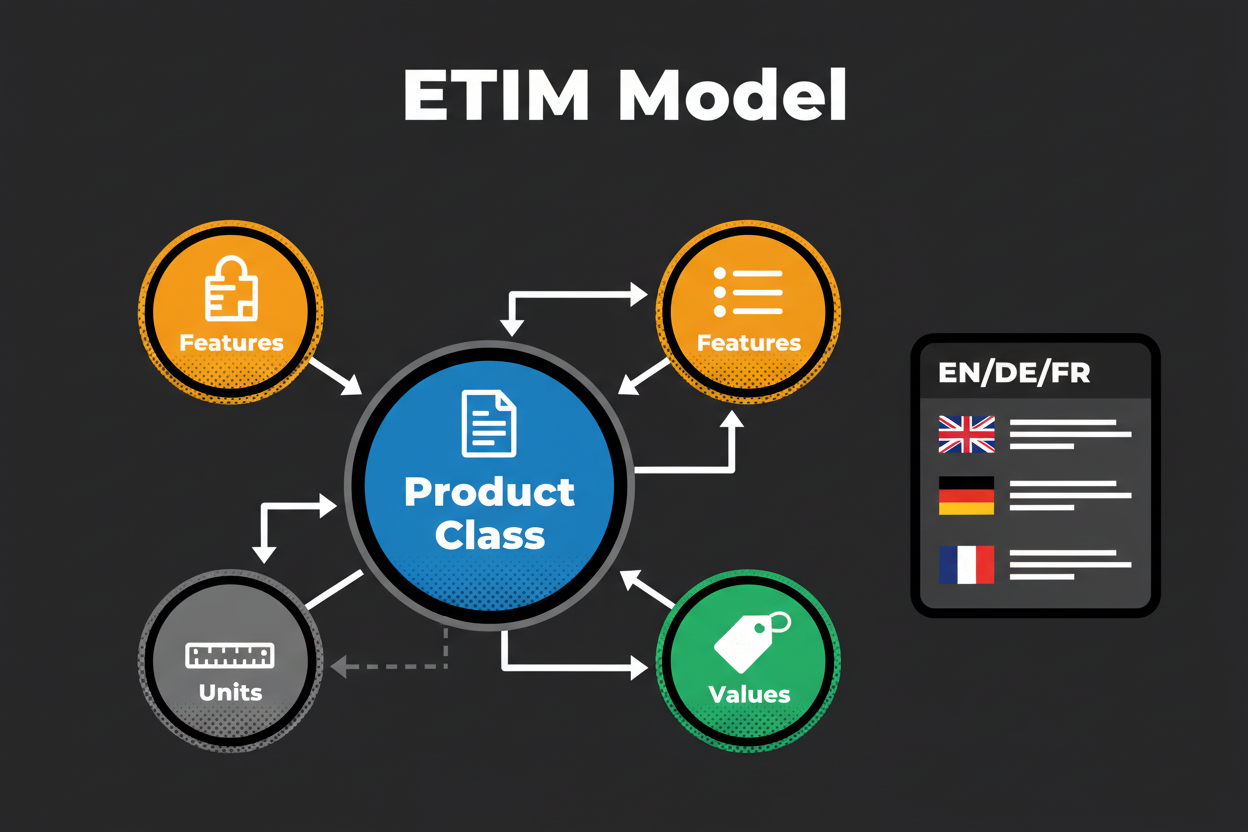
    ETIM is a product data model with clear building blocks:

    • Product Groups: High-level buckets for managing related classes.
    • Product Classes (EC): The heart of ETIM. Each class represents a specific product type and comes with a defined list of features.
    • Features (EF): Technical characteristics that describe products in the class (alphanumeric, numeric, range, or logic).
    • Values (EV): Predefined choices used with alphanumeric features.
    • Units (EU): Standardized measurement units used with numeric and range features.
    • Synonyms: Extra search terms per language linked to a class.

    All these objects use language-independent identifiers. The codes like EC, EF, EV, and EU do not change by language. Labels and synonyms, on the other hand, are language-dependent, so the same class can be displayed with local naming without breaking system-to-system exchange.

    ETIM data model diagram

    ETIM vs UNSPSC vs eCl@ss vs GS1

    StandardPrimary FocusBest Use Cases
    ETIMTechnical attributes for electro-technical and HVACTechnical catalogs, e-commerce filters
    UNSPSCSpend categorization and procurementProcurement analytics, high-level categorization
    eCl@ssCross-industry classification with propertiesIndustrial MDM, engineering catalogs
    GS1 GPCRetail product classificationRetail supply chain, barcoding ecosystems

    The Complete ETIM Classification Process

    1. Prepare: Consolidate product sources (ERP, supplier feeds, PDFs). Detect language for titles and documents, resolve duplicates, and normalize basic units.
    2. Map: Assign each SKU to the correct ETIM product class. Extract attributes from descriptions and align them to the class’s features (EC, EF, EV, EU).
    3. Validate: Check each record against ETIM constraints. Are required features populated? Are you using official EU unit codes?
    4. Export: Produce a structured file (CSV, BMECat, or API payload) for your PIM/ERP.
    5. Publish and syndicate: Push to e-commerce, marketplaces, and distributors.
    6. Review and improve: Track exceptions and rework to tighten your extraction rules.

    Automating ETIM Classification: How Classifast Delivers Accuracy and Efficiency

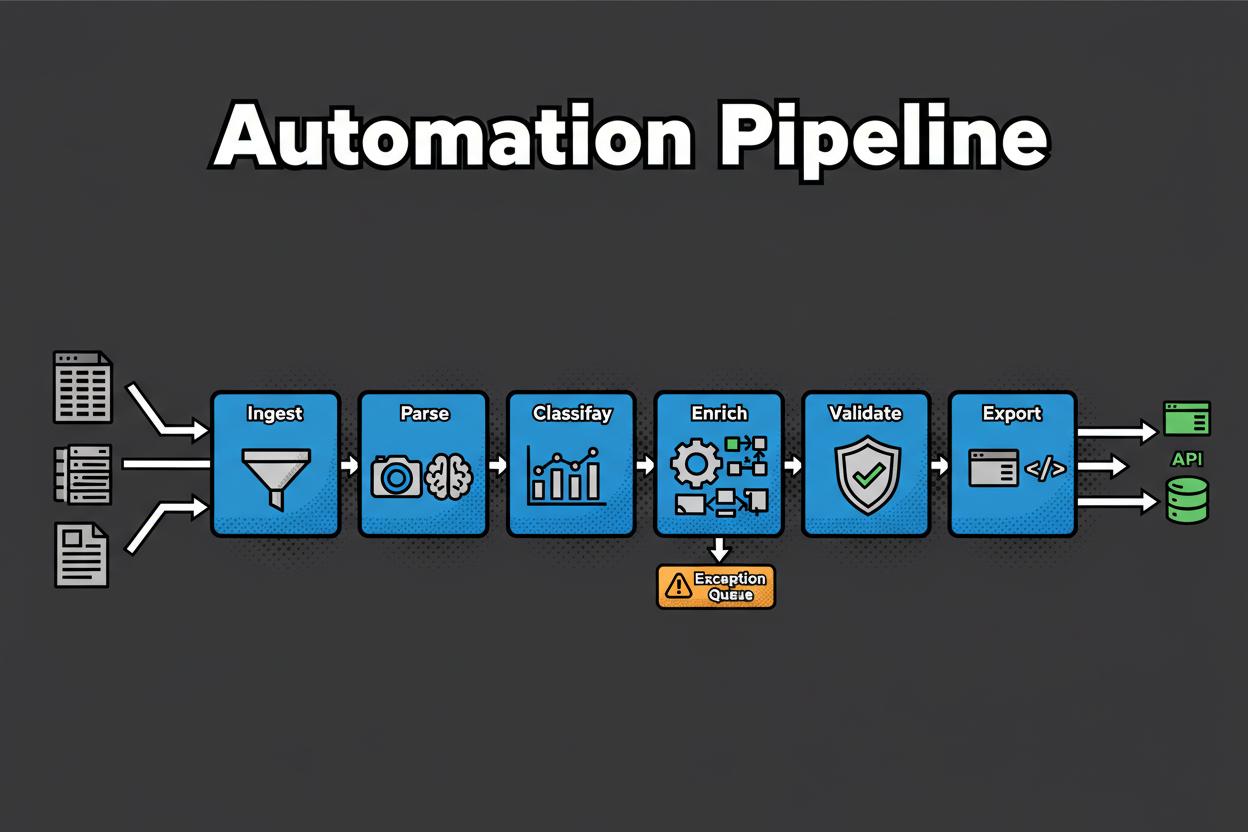
    Whether you build in-house or use a specialized platform, effective automation follows a clear conveyor: ingest, parse, classify, validate, export.

    Classifast is a high-performance web application designed specifically for this task. Built with FastAPI and modern web technologies, it provides instant classification for industry standards like ETIM, UNSPSC, NAICS, ISIC, and HS codes. By using advanced semantic search, Classifast understands the technical context of your product descriptions, moving beyond simple keyword matching to deliver fast, intelligent categorization.

    Classifast Automation Pipeline

    How the Classifast Pipeline works:

    • Ingest & Parse: The system reads your CSVs or PDFs, detects languages, and runs OCR to pull out structured attributes.
    • Extract and Normalize: Attributes are mapped to ETIM features (EF) by meaning. Numeric values are automatically converted to ETIM units (EU).
    • Semantic Classification: The engine proposes the top matching ETIM classes (EC) with confidence scores. High-confidence matches can be auto-assigned, while edge cases are routed to a human reviewer.
    • Validation & Export: Every SKU is checked against ETIM version constraints before being exported as a PIM-ready file.

    Best Practices and Common Pitfalls

    Prepare high-quality data upfront

    • Inventory SKUs: Define canonical IDs before you begin.
    • Unit Dictionary: Map all supplier abbreviations to ETIM EU codes immediately.
    • Clean Titles: Ensure titles include differentiating specs like voltage or range.

    Troubleshooting Common Issues

    • Ambiguous Descriptions: If Classifast gives a low-confidence score, enrich the title with more technical specs.
    • Mixed Units: Enforce normalization to ETIM EU codes at the start of the pipeline to prevent numeric feature rejection.
    • Version Mismatch: Treat ETIM versions like software releases; regression-test affected classes before a bulk update.

    Frequently Asked Questions

    Q: What is ETIM, and why does it matter?
    A: ETIM is a standardized, multilingual way to describe technical products. It ensures that a “socket” in one system is exactly the same “socket” in another, regardless of language.

    Q: How does Classifast help with ETIM?
    A: Classifast uses semantic search to instantly find the correct ETIM codes for your text inputs. It automates the unit normalization and feature extraction that normally takes hours.

    Q: How do I handle multilingual catalogs?
    A: Anchor your records on language-independent codes (EC, EF, EV, EU). You can then display local labels in your PIM while the underlying data remains globally compatible.

    Conclusion: Taking the Next Step Toward Modern Catalog Excellence

    ETIM gives you the structure; automation via Classifast.com gives you the speed. By moving from manual mapping to a semantic search-driven workflow, you can reduce onboarding cycles by up to 70% and virtually eliminate technical attribute errors.

    Start with a pilot of your top 20 classes. Let the model do the heavy lifting of unit normalization and class selection, so your team can focus on the high-value edge cases.

    Key Takeaways

    • Stable Identifiers: Use ETIM’s language-independent codes to prevent system-to-system drift.
    • Automation is Key: Tools like Classifast shift your effort from “minutes per SKU” to “seconds per SKU.”
    • Governance: Monitor exception rates and keep your unit dictionary updated to maintain scale.